
1390 – 1473·Feast December 23
St. John Cantius
Professor, priest, and humble benefactor of students
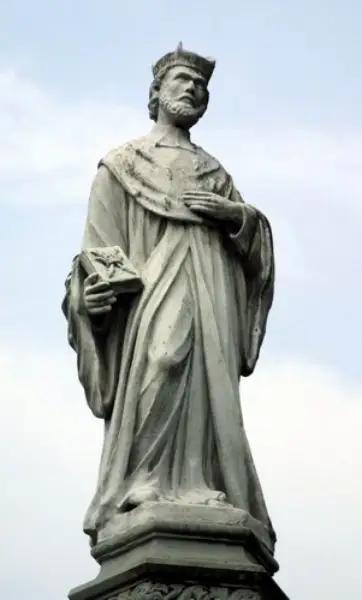
Overview
John Cantius (Jan z Kęt or Jan Kanty) was a priest of Catholic Poland renowned as scholastic philosopher, physicist, and theologian, born on 23 June 1390 in the small town of Kęty near Oświęcim, to Anna and Stanisław Kanty. Educated at the Kraków Academy — the future Jagiellonian University — he progressed through the bachelor's degree and licentiate, took his doctorate in philosophy in 1418, and spent three years teaching philosophy there while preparing for ordination. As a priest he first served as rector of the school maintained by the Canons Regular of the Most Holy Sepulchre at Miechów, then accepted a professorship of Sacred Scripture at his alma mater, where he earned a doctorate in theology and directed the theology department, holding the chair until his death. Kraków knew him above all for his generosity: he kept back only what strictly kept him alive and gave the rest to the poor, particularly struggling students. He undertook one pilgrimage to Jerusalem and four on foot to Rome. His first biographer, the medieval historian Michael Miechowita, recorded his extreme humility and the cautionary motto he adopted against disturbing or defaming others. He died in retirement at the university on Christmas Eve, 24 December 1473, and was buried in Kraków's Collegiate Church of St Anne, where his tomb remains a destination for pilgrims.
The Complete Life
From Kęty to Kraków
The future saint came from modest origins in the small town of Kęty, near Oświęcim in the Polish crown, where he was born on 23 June 1390 to Anna and Stanisław Kanty. His abilities carried him to the Kraków Academy, the institution later renamed the Jagiellonian University, and there he climbed the full ladder of medieval degrees: bachelor and licentiate first, then the doctorate in philosophy, conferred in 1418. Graduation did not end his connection to the classroom. For the three years that followed he conducted philosophy classes at the university while preparing himself for the priesthood, a double life of lecturing by day and formation by night that set the pattern for everything to come — a man who would never really leave the academy, yet who understood the professorship as a step toward the altar rather than an end in itself. The education he received was scholastic in method, but his own interests concentrated above all on biblical studies, the field in which he would eventually hold the most senior chair of his university.
§ Biography
Priest and Professor of Scripture
Ordained a priest, Cantius took his first post away from the university: rector of the school kept by the Canons Regular of the Most Holy Sepulchre at Miechów. The stay was brief but formative, joining pastoral responsibility to his academic habits. It was from Miechów that he was called back to his alma mater with an offer of the professorship of Sacra Scriptura — Holy Scripture — which he accepted. He did not treat the chair as an honor to be held lightly: he pursued a doctorate in theology and in time took over the direction of the theology department, and he continued to occupy the professorship for the rest of his life, down to his death in 1473. A distinctive feature of his scholarship was the copying desk. Cantius spent long hours producing manuscript copies of Scripture, of theological tracts, and of other learned works — an act that was at once scholarship, devotion, and almsgiving, since the copies multiplied texts for readers who could never have obtained them. In an age before print transformed the book trade, the professor who copied Scripture by hand left a legacy measured in pages as much as in students.
§ Biography
Poverty Chosen and Charity Practiced
Contemporaries knew Cantius in the streets of Kraków as much as in its lecture halls. His manner of life was one of strict personal poverty: he took from his means only what was strictly necessary to keep himself alive and distributed the rest as regular alms, with a particular concern for needy students of the university, who saw in the professor both benefactor and advocate. The generosity was matched by mobility of a penitential kind. He made one pilgrimage to Jerusalem — a demanding journey for any medieval European — and no fewer than four pilgrimages to Rome, all of them on foot. His interior disposition his first biographer captured in a pair of cautions the saint adopted as his motto: beware of disturbing others, for it is not sweetly pleasing, and beware of speaking ill, for taking words back is a heavy burden. Michael Miechowita, the medieval Polish historian who wrote the first life of Cantius, dwelt on the extreme humility and charity that the maxim expressed. The motto's two prohibitions — trouble-making and slander — sketch the spirituality of a scholar: holiness pursued in the control of the tongue and the peace of the community.
§ Biography
Christmas Eve in Kraków
Cantius's long service at the university ended as it had begun, within its walls. He lived his final period in retirement at his old university, the Kraków Academy, and it was there that he died on 24 December 1473 — Christmas Eve — at the age of eighty-three. The timing of his death on the threshold of the Nativity has marked his memory ever since: when the calendar reform of 1969 sought a new date for his feast, it chose 23 December — one day before the anniversary of his passing. His remains were laid to rest in Kraków's Collegiate Church of St Anne, and the tomb quickly became — and has remained — a popular site of pilgrimage, the faithful coming to pray at the grave of the professor the city had already begun to venerate. The shrine in the Church of St Anne is today recognized as his major shrine, anchoring a cult that spread from the university city across Poland and, in time, across the ocean to the Polish diaspora. He died as he had lived: a priest of the academy, with no see, no monastery, and no title beyond his chair and his charity.
§ Biography
Beatified, Canonized, Honored in the Liturgy
Recognition came slowly and then decisively. Cantius was beatified by Clement X in Rome on 28 March 1676, nearly two centuries after his death. In 1737 Pope Clement XII named him patron of Poland and of Lithuania, an honor that gave national scope to a devotion already rooted in Kraków. Ninety-one years to the day-count after his beatification, on 16 July 1767, Pope Clement XIII canonized him in Rome, and the bull of canonization survives as a document of that pontificate. The liturgy of the Roman Church has distinguished him in a way no other confessor shares: the Roman Breviary provides three hymns in his honor, and he is the only confessor who was not a bishop to receive this mark of honor in the Catholic liturgy. His feast entered the General Roman Calendar for the first time in 1770, assigned at first to 20 October; the reform of 1969 transferred it to 23 December, beside the anniversary of his death. In 1992 the diocese of Bielsko-Żywiec, which includes his birthplace of Kęty, took him as its patron, and he is honored as patron of students everywhere.
§ Veneration
A Saint of Poland and Its Diaspora
St. John Cantius remains an eminently popular saint in Poland, and his cult traveled with the millions of Poles who emigrated in the nineteenth and twentieth centuries. Across North America, churches and schools raised by Polish diaspora communities bear his name in cities far removed from one another: Cleveland in Ohio, Winnipeg in Manitoba, Detroit in Michigan, Chicago in Illinois, Rolling Prairie in Indiana, Milwaukee in Wisconsin, St. Cloud and Wilno in Minnesota, Philadelphia, Erie, and Windber in Pennsylvania, and New York City and Buffalo in New York State — a geography of remembrance that maps the Polish immigrant world. His name has even entered ordinary use as a first and middle name, borne, for instance, by John Cantius Garand, the American inventor of the rifle that carries his surname. In Kraków his memory is institutional: the Jagiellonian University counts its first great scriptural professor among its patron saints, and the Church of St Anne keeps his tomb as a living shrine. Religious life has also claimed him — the Canons Regular of Saint John Cantius, a community of clerics, take their name from the priest-professor whose copying desk, alms, and pilgrimages defined a spirituality of scholarship in the service of charity.
§ Veneration
Timeline
- 23 Jun 1390
Born at Kęty near Oświęcim to Anna and Stanisław Kanty.
§ Biography
- 1418
Received the degree of Doctor of Philosophy at the Kraków Academy.
§ Biography
- 24 Dec 1473
Died in retirement at his university in Kraków on Christmas Eve, aged 83.
§ Biography
- 28 Mar 1676
Beatified in Rome by Pope Clement X.
§ Veneration
- 1737
Named by Pope Clement XII patron of Poland and of Lithuania.
§ Veneration
- 16 Jul 1767
Canonized by Pope Clement XIII, ninety-one years after his beatification.
§ Veneration
- 1770
His feast entered the General Roman Calendar, assigned at first to 20 October.
§ Feast day
- 1969
The calendar reform moved his observance to 23 December, the eve of his death.
§ Feast day
- 1992
Declared patron of the diocese of Bielsko-Żywiec.
§ Biography
In Their Own Words
Conturbare cave: non est placare suave ... Infamare cave; nam revocare grave ... (Beware disturbing: it's not sweetly pleasing ... Beware speaking ill: for taking back words is burdensome.)
The Record
- Major works
- Copied manuscripts of the Holy Scriptures, theological tracts, and other scholarly works
- Patron of
- Poland·Lithuania·Jagiellonian University·Diocese of Bielsko-Żywiec·Students
- Symbols
- In a professor's gown with his arm around the shoulder of a young student whose gaze is directed towards Heaven·Giving his garments to the poor
- Canonization
- Canonized by Pope Clement XIII on 16 July 1767 in Rome; beatified by Pope Clement X on 28 March 1676
Prayer
Bibliography
Show 4 sources
- Godrycz, J. (1910). "St. John Cantius". The Catholic Encyclopedia. New York: Robert Appleton Company.
- "St. John Kanty", Catholic Faith Community of Saint John Cantius, St. Cloud, Minnesota. Archived from the original on 2016-06-29. Retrieved 2014-02-02.
- Patron Saints Index: "Saint John Cantius". Archived 2008-10-18 at the Wayback Machine
- Calendarium Romanum (Libreria Editrice 1969), p. 111
Profile text adapted from the Wikipedia article, licensed CC BY-SA 4.0.
Pray with this saint every day
Save St. John Cantius to your favorites, read the full profile, and get feast-day reminders in the Saints app.
Get the Saints AppFree on the App Store for iPhone and iPad