
c. 360 – c. 435·Feast July 23 (Roman Catholic); February 29 (Eastern Orthodox, transferred to 28 in non-leap years)
St. John Cassian
Church Father who brought Egyptian monasticism to the West
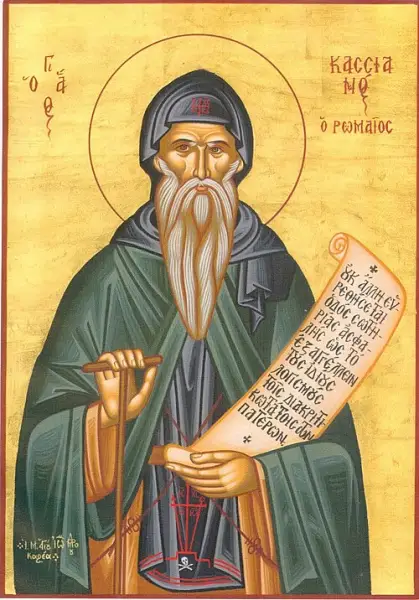
Overview
John Cassian (c. 360 – c. 435), known too as John the Ascetic or as John Cassian the Roman, was a Christian monk and theologian honored by the churches of East and West alike for his mystical writings, and is credited with transferring the ideas and the practices of early Christian monasticism from the Egyptian desert into the medieval West. Born, most likely in Scythia Minor — modern Dobruja — to wealthy parents who gave him a good education, he grew up bilingual in Latin and Greek, his prose showing the imprint of Cicero and Persius. As a young man he traveled to Palestine with his older friend Germanus; the two spent about three years in a hermitage near Bethlehem and then some fifteen years visiting the monastic settlements of Scete in Egypt. Driven from Egypt by the Anthropomorphic controversy around 399, they reached Constantinople, where Patriarch John Chrysostom made Cassian a deacon. When Chrysostom was exiled in 404, Cassian went to Rome to plead his cause before Pope Innocent I, and from there accepted an invitation to found an Egyptian-style monastery near Marseille. Arriving around 415, he established the Abbey of St Victor, a complex for men and women that became a model for Western monasticism. His Institutes and Conferences shaped Benedict of Nursia, and he died at Marseille in 435.
The Complete Life
A Bilingual Youth from Scythia Minor
Cassian entered the world around the year 360, most probably in Scythia Minor, the province corresponding to modern Dobruja in Romania and Bulgaria, though some scholars have argued for a Gallic origin. His family possessed means, and they invested them in his formation: the education that emerges from his own pages bears the stamp of Cicero and Persius, and he commanded both Latin and Greek from childhood, a fact that would later make him useful as an envoy between the Greek East and the Latin West. Of his family we know almost nothing beyond a single remark: in the Institutes he mentions a sister, with whom he kept up a correspondence throughout his monastic years, and who may have followed him as far as Marseille in his old age. As a young adult he set out for the Holy Land in company with an older friend named Germanus, who would stay at his side through most of the coming quarter-century. The pair joined a hermitage near Bethlehem and stayed about three years — a novitiate of a kind — before the desert of Egypt, the true school of monasticism, drew them onward.
§ Biography
The Deserts of Palestine and Egypt
From Bethlehem, Cassian and Germanus traveled to Scete in the Egyptian desert, then torn by internal Christian struggles, and over roughly fifteen years they made their way through the monastic foundations of the region — the settlement at Nitria, the cells at Kellia, and Scetis itself, the great nurseries of Desert Fathers whose sayings Cassian would one day record. Those years were interrupted by crisis. Around 399 the Anthropomorphic controversy, provoked by a letter of Theophilus, Archbishop of Alexandria, split the monastic world: the majority of monks, Cassian reports, received their patriarch's message with bitterness, and he himself charged Theophilus with heresy for contradicting the plain sense of Scripture. A journey to Alexandria to protest failed, and Cassian and Germanus fled Egypt together with some three hundred Origenist monks. Their road led to Constantinople and to the patriarch John Chrysostom, who took them under his protection, ordained Cassian a deacon, and enrolled him among his clergy while the conflict with the imperial family escalated. From deacon of a hunted patriarch, Cassian's path would next lead west, to the city of the pope.
§ Biography
From Chrysostom's Cause to Gaul
In 404 Chrysostom was driven into exile from Constantinople, and he chose the Latin-speaking Cassian for a delicate embassy: to carry the patriarchal appeal to Pope Innocent I in Rome. Whether the mission succeeded in Rome, its larger consequences were unplanned. While in the city Cassian accepted an invitation to found a monastery on Egyptian lines in southern Gaul, near Marseille, and he may also have served as a priest at Antioch in the years between 404 and 415. By around 415 he had reached Marseille, and there he built the work that gives his life its lasting shape: the Abbey of St Victor, a complex of monasteries for men and women alike, an early instance of the double monastery in the West and a pattern for the monastic development that followed. His achievement, in the judgment of the tradition, was translatio in the deepest sense — not of relics but of a culture. He gathered the principles and practices he had watched in the deserts of Egypt and lodged them permanently in Latin Christendom, so that the Western monk's habit, psalmody, and warfare against the vices all trace back, in good part, to what Cassian saw at Scete.
§ Biography
The Threefold Path and the War of the Vices
Cassian's spirituality transmitted the Egyptian scheme of three ascending stages: purgatio, illuminatio, and unitio, corresponding to the later ways of Catholic mystical theology. In the first, the young monk fights by prayer and ascetic discipline to master gluttony, lust, and the desire for possessions, learning by long experience that whatever power he has comes from the Holy Spirit. In the second he practices the holiness of the Gospel, above all the Sermon on the Mount, receiving visitors and tending the poor; many monks, the tradition notes, died without passing beyond it. The third is the soul's union with the Spirit of God, figured as the marriage of the Song of Songs, sought by old monks in the deep desert. Practical to the last, Cassian held that hospitality should override ascetical routine — even the strictest anchorite must entertain those who come. For unceasing prayer he prescribed the cry of Psalm 70, in which the soul begs God to bend down to its aid and to hasten to its help — the versicle Western liturgy now says at the head of every canonical hour. His analysis of the will — to be conquered, even killed, for God — and his eight vices fed both the Rule of Benedict and the Irish Penitentials.
§ Spirituality
Marseille and the Last Works
Cassian came late to authorship, and only under pressure from the great. Around 420 his pen was at last unsheathed at the instance of Bishop Castor of Apt, whose see lay in Gallia Narbonensis; he produced the two treatises on which his fame rests: the De institutis coenobiorum, the Institutes of the Coenobia, written to help Castor establish a monastery on the Egyptian pattern against the chaotic Gallic monasticism of the age of Martin of Tours; and the Conferences, which preserve his conversations with the elders of Scetis on the shaping of the interior man and the perfecting of the heart. His third treatise, On the Incarnation of the Lord, a defense of orthodox teaching against Nestorius, was composed at the prompting of the Archdeacon of Rome, the future Pope Leo I. The books were written in plain, direct Latin, and were translated quickly into Greek — proof that Eastern monks counted him one of their own — and into Georgian by the eleventh century. He died in 435 at Marseille, the city of his foundation, and was buried there; his sarcophagus remains at the Abbey of Saint Victor, with his relics in an underground chapel and his head and right hand in the main church.
§ Writings
A Saint Without a Canonization
Like his near-contemporaries Augustine of Hippo and John Chrysostom, Cassian was never formally canonized: the process came into use only centuries after his death. His sanctity rests on the uninterrupted judgment of the churches. The Eastern Orthodox Churches venerate him with a feast on 29 February — a date that falls only in leap years, so calendars usually transfer it to 28 February. The Oriental Orthodox Churches likewise rank him among the saints, judging his Christology Miaphysite and his works pertinent to the theological debates of the fourth and fifth centuries. The Catholic Church also holds him a saint, keeping his feast on 23 July, the anniversary of his death; Pope Urban V spoke of him as sanctus, and he stands in the Gallican Martyrology and in the Roman Martyrology under the same date, though he is not on the General Roman Calendar — the Archdiocese of Marseille and certain monastic orders keep his memorial. In ninth-century Ireland the Martyrology of Óengus commemorated him on 25 November with the verse 'With John Cassian whose crown is very fair.' In 2022 the Episcopal Church formally added him to its calendar of saints, on 23 July.
§ Veneration
The Teacher of the Rule and the Semipelagian Question
Cassian's influence on Western Europe is difficult to overstate. Benedict of Nursia absorbed many of the Institutes' principles into his own Rule and ordered selections of the Conferences to be read to his monks after the evening meal — a custom from which the very word 'collation', for a light meal, descends. Since Benedictines, Cistercians, and Trappists still live by Benedict's Rule, Cassian's thought continues to shape thousands of religious lives. Pope Gregory the Great's teaching on the seven deadly sins derives from Cassian's eight vices, as does much of his doctrine on compunction and prayer; Philip Neri read Cassian aloud to the laity; John Climacus, John of Damascus, Dominic, de Sales, and Newman himself all felt his hand; his works are excerpted in the Philokalia, the East's great anthology of mystical prayer. The one cloud is theological: because he gave the human will a role in the first steps toward salvation, later theologians labeled him 'Semipelagian', and the Council of Orange condemned that doctrine in 529 — while still recognizing Cassian himself as a saint. Modern scholars such as Lauren Pristas and Augustine Casiday dispute the label, insisting that in Cassian's eyes salvation, from its first stirrings to its end, is wholly the effect of grace. Even Michel Foucault studied his warfare against the flesh, and Pope Leo XIV has drawn on his account of monastic humility.
§ Influence
Timeline
- 360
Born around this date, most likely in Scythia Minor on the lower Danube, to wealthy parents.
§ Biography
- 399
Facing the Anthropomorphic controversy provoked by Archbishop Theophilus of Alexandria, he and Germanus fled Egypt with about 300 Origenist monks.
§ Biography
- 404
Sent to Rome by the exiled Patriarch John Chrysostom to plead his cause before Pope Innocent I.
§ Biography
- 415
Arrived in Marseille and founded the Abbey of St Victor, an Egyptian-style complex of monasteries for men and women.
§ Biography
- 420
Wrote his two great works, the Institutes and the Conferences, at Bishop Castor of Apt's request.
§ Writings
- 435
Died at Marseille.
§ Biography
- 529
The local Council of Orange condemned Semipelagianism, the label later attached to his teaching on grace, though the Church still reckons him a saint.
§ As viewed by the Catholic Church
- 2022
The Episcopal Church entered him on its liturgical calendar, giving him 23 July as feast.
§ Veneration
In Their Own Words
This verse is an unassailable wall, an impenetrable breastplate, and a very strong shield for those who labour under the attack of demons.
The thief on the cross certainly did not receive the Kingdom of Heaven as a reward for his virtues but as a grace and a mercy from God.
The Record
- Major works
- De institutis coenobiorum (The Institutes)·Conlationes patrum in scythica eremo (The Conferences)·On the Incarnation of the Lord (against Nestorius)
- Canonization
- Pre-congregation: never formally canonized, like his contemporaries Augustine and Chrysostom; Pope Urban V called him sanctus and he appears in the Roman Martyrology
Prayer
Bibliography
Show 9 sources
- "John Cassian", Christian Classics Ethereal Library, retrieved 5 April 2016
- "Feb 29 - St John Cassian (360-435)", CatholicIreland.net
- Feiss OSB, Hugh. "Cassian and Monasticism", Monastery of the Ascension, Jerome, Idaho
- Casiday, A. M.C. (2007). Tradition and Theology in St. John Cassian. New York: Oxford University Press. ISBN 978-0-19-929718-4
- Chadwick, Owen (1950). John Cassian: A Study in Primitive Monasticism. Cambridge: University Press
- Stewart, Columba (1998). Cassian the Monk. Oxford University Press. ISBN 978-0-19-511366-2
- Pristas, Lauren (1993). The Theological Anthropology of John Cassian (PhD). Boston College
- McGuckin, John Anthony (2003). The Book of Mystical Chapters. Shambhala. ISBN 978-1-59030-007-7
- Hassett, Maurice M. (1908). "John Cassian". In Herbermann, Charles (ed.). Catholic Encyclopedia. Vol. 3. New York: Robert Appleton Company
Profile text adapted from the Wikipedia article, licensed CC BY-SA 4.0.
Pray with this saint every day
Save St. John Cassian to your favorites, read the full profile, and get feast-day reminders in the Saints app.
Get the Saints AppFree on the App Store for iPhone and iPad