
c. 347 – 407·Feast September 13 (Western); November 13 (Byzantine Rite)
St. John Chrysostom
Golden-mouthed preacher and Archbishop of Constantinople
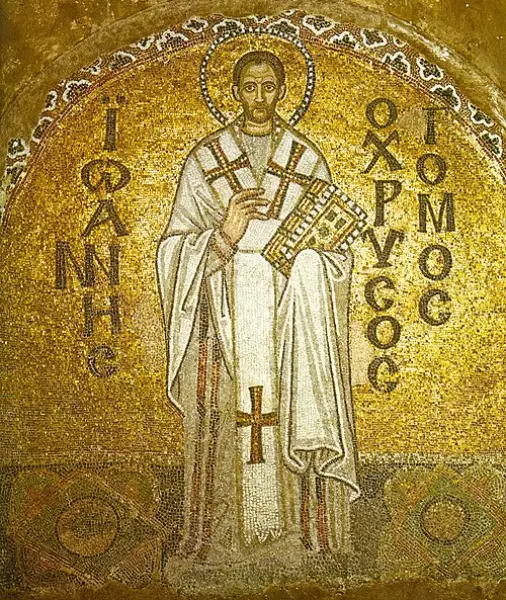
Overview
John Chrysostom (c. 347 – 14 September 407) — Koine Greek for 'John the Golden-mouthed' — was a Church Father who occupied the archbishop's throne of Constantinople and is celebrated above all for his preaching, his expositions of Scripture, his concern for the poor, and his ascetic rigor. Born in Antioch in Roman Syria to a widowed mother, Anthusa, he was trained in rhetoric under the Sophist Libanius and briefly practiced law before turning to theology under Diodorus of Tarsus. After years of extreme asceticism as a hermit near Antioch that permanently damaged his health, he was ordained a deacon in 381 and, after the death of Paulinus II, a priest in 388, and for twelve years he preached at the Golden Church with an eloquence that converted pagans and once, during the statue riots of 387, helped spare the city. Snatched secretly to Constantinople as archbishop in 397, he refused lavish entertainments, reformed his clergy, and founded hospitals, earning the hostility of the court. Condemned at the Synod of the Oak in 403, briefly recalled, then banished again after denouncing the empress Eudoxia, he died in exile at Comana Pontica on 14 September 407, reportedly saying, 'Glory be to God for all things.' His relics returned to Constantinople in 438.
The Complete Life
Antioch: The Rhetorician's Pupil
John was born at Antioch in Roman Syria in 347 — though scholars debate dates between 344 and 349 — to a high-ranking military officer who died soon afterward and to his mother Anthusa, whom Christian tradition paints as a devout believer even if some scholars have described her as pagan. Through her influential connections in the city the boy entered the Sophist school of the rhetorician Libanius, from whom he absorbed the technical skills of a rhetorical career together with a lifelong devotion to Greek language and letters. He qualified and practiced as a lawyer. But Christian commitment deepened as he matured, and he moved to theology under Diodorus of Tarsus, restorer of the School of Antioch. Sozomen preserves the deathbed tribute Libanius supposedly paid his former pupil: John would have been his successor, had the Christians not taken him. Baptized in 368 or 373 and tonsured a reader, he then embraced the ascetic life with an intensity that marked his body permanently — from about 375 he lived as a hermit, standing almost continually and sleeping scarcely at all for two years while committing the Bible to memory, until ruined stomach and kidneys obliged him to come back to the city.
§ Early life
Ordination and Reconciliation
John's climb through the church orders unfolded against the tangled politics of the Meletian schism. Named a reader of Antioch's church by Zeno of Verona on the latter's return from Jerusalem, he was made deacon in 381 by Bishop Meletius, who was then out of communion with Alexandria and Rome. After Meletius died, John kept apart from his followers without attaching himself to the rival claimant Paulinus II; only upon Paulinus's death in 388 did he accept presbyteral ordination from Evagrius of Antioch of the Eustathian faction. The career that followed had a reconciling arc: John was destined to heal the breach, winning communion between Flavian I of Antioch and the sees of Alexandria and Rome for the first time in some seventy years. In the same years his pen served the ascetic movement — his early treatise against the enemies of the monastic life, composed while he was a deacon before 386, answered the pagan and Christian parents worried about sons drawn to the monasteries, and recorded that Antiochenes already customarily had their boys educated by monks. From 386 to 397 he preached at the Golden Church, the cathedral of Antioch, and the city learned what his voice could do.
§ Diaconate and service in Antioch
Preacher of Antioch, Archbishop of Constantinople
The twelve Antiochene years made John's reputation. His expositions of Scripture were plain, practical, and direct — an Antiochene literalism, though he did not scorn allegory entirely — and he drove every sermon toward charity, denouncing the abuse of wealth and demanding alms for the poor. In Lent of 387, after citizens had mutilated the statues of Emperor Theodosius I and the bishop Flavian had gone to intercede for the city, John preached more than twenty homilies calling the people to repentance; pagans were converted by the series, and Antioch was spared the worst. In the autumn of 397 his life changed overnight: the eunuch Eutropius nominated him, unknown to himself, as Archbishop of Constantinople, and he had to be smuggled out of Antioch lest his departure provoke unrest. In the capital he governed as he had preached — refusing the lavish social gatherings his predecessors had hosted, disciplining clergy, sending visiting preaches back to their churches without severance, and founding hospitals. He gained the common people and lost the powerful. Theophilus of Alexandria, coveting sway over Constantinople, and the empress Aelia Eudoxia, stung by his denunciations of extravagance in feminine dress, converged against him.
§ Archbishop of Constantinople
The Poor at the Altar
John's preaching returns ceaselessly to the needy: he has been judged the fiercest of all the eastern Fathers in preaching on social justice. His rhetoric shamed the wealthy out of conspicuous consumption with images deliberately hard to forget — the man made in God's image perishing in the cold while another's excrement is received into a silver chamber-pot — and he taught that almsgiving belongs alongside fasting and prayer, that prayer without almsgiving is unfruitful. The Eucharist itself, he insisted, demanded the feeding of the hungry before the adornment of altars. His asceticism, formed in the desert years, never left him: he preached against the pagan amusements of the capital, the theatre, the horse races, and the holiday revelry, reproaching Christians who could name every charioteer but not a single prophet. In around 405 he even lent moral and financial backing to monks enforcing the emperors' anti-pagan laws in Phoenicia. A darker strand survives too: the eight homilies of 386-387 against Jews and Judaizing Christians, delivered in the conventional invective of the psogos, were nonetheless effective in spreading anti-Jewish sentiment and fed the accusation of collective Jewish guilt for the death of Jesus — a legacy modern scholars continue to weigh against his historical context.
§ Care of the needy
The Synod of the Oak and the Road to Comana
In 403 his enemies gathered. Theophilus of Alexandria, harboring his grievance over the Origenist 'Tall Brothers' whom John had welcomed, joined Eudoxia and others in the Synod of the Oak, which used John's connection to Origen to depose and banish him. The reaction was immediate: the people grew tumultuous, threatened to burn the palace, and an earthquake on the night of his arrest persuaded the frightened empress to beg for his reinstatement. The peace lasted only until a silver statue of Eudoxia was erected beside his cathedral; John branded the dedication rites as pagan and flung at the empress the terrible comparison to Herodias demanding the Baptist's head. Banished again, this time toward the Caucasus in Abkhazia, he provoked riots in which the old cathedral of Constantius burned. From Cucusus, where he was held from 404 to 407, his letters kept their grip on Constantinople, and he appealed to Pope Innocent I and the bishops of Milan and Aquileia — Innocent's protest and his 405 delegation under Gaudentius of Brescia came to nothing. Ordered transferred to remote Pitiunt, John died on the way at Comana Pontica on 14 September 407, in the presbyterium of the church of Saint Basiliscus, his last words giving glory to God for all things.
§ Exile and death
Veneration and the Return of the Relics
John was revered as a saint almost at once. An anonymous partisan — the pseudo-Martyrius — quickly circulated a funeral oration claiming him as a symbol of Christian orthodoxy, though parts of his Constantinopolitan following stayed in schism for decades. The reconciliation was the work of Proclus, archbishop from 434, whose homily in the Hagia Sophia proclaimed that John's life had been filled with sorrow yet his death was glorious, and stirred public opinion until the emperor permitted the return of the relics. On 28 January 438, thirty years after the death, the relics received their shrine in the Church of the Holy Apostles under Theodosius II, son of the empress who had hounded him. The East celebrates him as one of the Three Holy Hierarchs with Basil of Caesarea and with Gregory of Nazianzus, jointly commemorated in the Synaxis of 30 January, and keeps several feasts of his own: the translation of relics on 27 January, his repose on 14 September, and — since the tenth century displaced it for the Exaltation of the Cross — the main celebration on 13 November, the day the news of his death reached the capital. The West keeps him on 13 September and ranks him a Doctor of the Church; in 1908 Pius X declared him patron of preachers.
§ Veneration and canonisation
Golden Mouth, Enduring Voice
No other Greek Father's writings survive in such quantity: some 600 sermons and 246 letters, plus treatises and a commentary on Acts — homilies on Genesis (sixty-seven), on the Psalms (fifty-nine), on Matthew (ninety), on John (eighty-eight), and on Acts (fifty-five). His brief Paschal Homily is still read at the midnight service of Easter in every Orthodox church, and the Divine Liturgy that bears his name remains the normal Eucharistic rite of the Byzantine tradition, even if scholars debate how much of it is truly his. His revision of the liturgy's prayers and rubrics harmonized the church's worship; his On the Priesthood shaped every later theology of the ministry; the Catechism of the Catholic Church draws on his words in eighteen separate sections. The liturgical legacy resounded in music — Rachmaninoff and Tchaikovsky each composed a Liturgy of St. John Chrysostom, as did Grechaninov and Stetsenko, and Arvo Pärt set his twenty-four prayers — while James Joyce gave the nickname 'Chrysostomos' to Buck Mulligan in Ulysses. Richard Salter Storrs ranked him among the most eloquent preachers since the apostles, and Newman called him a bright, cheerful, gentle soul. His bones, scattered by the Fourth Crusade, were partly returned by Pope John Paul II in 2004; his skull rests now at the Cathedral of Christ the Saviour in Moscow — though Athos, Florence, and Pisa advance rival claims.
§ Legacy and influence
Timeline
- 347
Born at Antioch in Roman Syria; his father, a high-ranking military officer, died soon afterward.
§ Early life
- 368
Baptized — the article gives 368 or 373 — and tonsured as a reader.
§ Early life
- 375
Became a hermit, spending two years almost without sleep and memorizing the Bible until poor health forced his return to Antioch.
§ Biography
- 381
Ordained a deacon by Bishop Meletius of Antioch.
§ Diaconate and service in Antioch
- 388
Ordained a priest by Evagrius of Antioch after the death of Paulinus II; his preaching at the Golden Church would span twelve years and make his name.
§ Diaconate and service in Antioch
- 387
During Lent, preached more than twenty homilies that calmed the city after citizens mutilated the emperor's statues, winning many pagan conversions.
§ Diaconate and service in Antioch
- 390
Wrote On the Priesthood, his treatise expounding his exalted understanding of the priesthood.
§ Treatises
- 397
Appointed Archbishop of Constantinople in the autumn, nominated without his knowledge, and brought from Antioch in secret.
§ Archbishop of Constantinople
- 403
Deposed and banished by the Synod of the Oak, then recalled almost immediately when the people rose in tumult and an earthquake struck.
§ Archbishop of Constantinople
- 404
Banished a second time after denouncing the dedication of Eudoxia's silver statue; sent to Cucusus in Cappadocia, where he stayed until 407.
§ Exile and death
- 14 Sep 407
Died at Comana Pontica during the forced march toward a further exile at Pitiunt.
§ Exile and death
- 28 Jan 438
Relics returned to Constantinople and given a shrine in the Church of the Holy Apostles under Emperor Theodosius II.
§ Veneration and canonisation
- 1204
Most of his relics looted from Constantinople by crusaders and carried off to Rome.
§ Relics
- 1908
Pope Pius X named him patron saint of preachers.
§ Veneration and canonisation
- 27 Nov 2004
Pope John Paul II returned some of his bones to the Orthodox Church; they rest now in the Church of St George at Istanbul.
§ Relics
In Their Own Words
Do you wish to honour the body of Christ? Do not ignore him when he is naked. Do not pay him homage in the temple clad in silk, only then to neglect him outside where he is cold and ill-clad.
Again Herodias raves, again she dances, and again desires to receive John's head on a charger
Glory be to God for all things
The Record
- Major works
- Divine Liturgy of Saint John Chrysostom·On the Priesthood·Against Those Who Oppose the Monastic Life·Instructions to Catechumens·On the Incomprehensibility of the Divine Nature·Homilies on Genesis, the Psalms, Matthew, John, and Acts·Adversus Judaeos (eight homilies)·Seventeen letters to the deaconess Olympias·Commentary on the Book of Acts
- Patron of
- Constantinople·Education·Epilepsy·Lecturers·Public speakers·Preachers
- Symbols
- Vested as a bishop holding a Gospel Book or scroll, right hand raised in blessing·Beehive·White dove·Pan·Chalice on a bible·Pen and inkhorn
- Canonization
- Pre-congregational: venerated as a saint soon after his death; honored in East and West without any formal canonization process
Prayer
Bibliography
Show 8 sources
- Allen, Pauline and Mayer, Wendy (2000), John Chrysostom, Routledge, ISBN 0-415-18252-2
- Kelly, John Norman Davidson (1995), Golden Mouth - The Story of John Chrysostom - Ascetic, Preacher, Bishop, Ithaca, New York, Cornell University Press, ISBN 0-8014-3189-1
- Baur, Chrysostom (1910). "St. John Chrysostom". In Herbermann, Charles (ed.). Catholic Encyclopedia. Vol. 8. New York: Robert Appleton Company.
- Wilken, R. L. (2004). John Chrysostom and the Jews - Rhetoric and Reality in the Late 4th Century. Wipf and Stock. ISBN 978-1-59244-942-2
- Palladius, Bishop of Aspuna, Palladius on the Life And Times of St. John Chrysostom, transl. and edited by Robert T. Meyer, New York, Newman Press, 1985, ISBN 0-8091-0358-3
- Stephens, W. R. W. (1883), Saint John Chrysostom, His Life and Times, London, John Murray
- Chrysostom, John (1979), Discourses Against Judaizing Christians, trans. Paul W. Harkins, The Fathers of the Church; V. 68. Washington, The Catholic University of America Press
- Liebeschuetz, J.H.W.G. (1990), Barbarians and Bishops - Army, Church and State in the Age of Arcadius and Chrysostom, Oxford, Clarendon Press, ISBN 0-19-814886-0
Profile text adapted from the Wikipedia article, licensed CC BY-SA 4.0.
Pray with this saint every day
Save St. John Chrysostom to your favorites, read the full profile, and get feast-day reminders in the Saints app.
Get the Saints AppFree on the App Store for iPhone and iPad