
c. 579 – 649·Feast March 30
St. John Climacus
Monk of Sinai and author of the Ladder of Divine Ascent
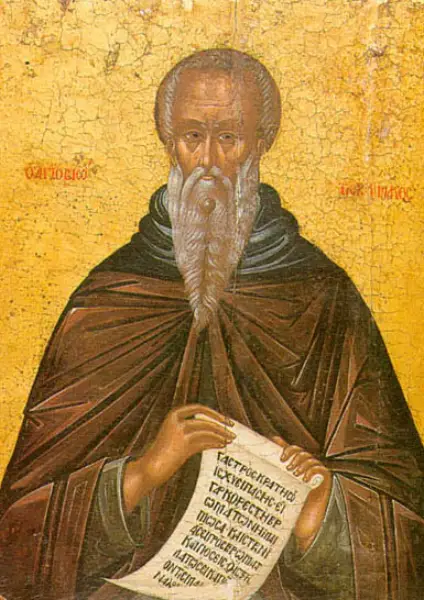
Overview
John Climacus (c. 579 – March 649) — in Greek Ioannes tes Klimakos, honored also as John of the Ladder, as John Scholasticus, and as John Sinaites — was a Christian monk of the sixth and seventh centuries at the monastery on Mount Sinai, honored as a saint by both the Eastern Orthodox and the Catholic Church. His life is poorly documented: the principal source is an ancient vita by Daniel, a monk of the Raithu monastery, who claims to have been a contemporary yet admits he knows nothing of John's origins and offers no chronology. On Daniel's account, John entered the Vatos Monastery at Mount Sinai — today Saint Catherine's Monastery — as a novice of about sixteen, was formed in the spiritual life by the elder monk Martyrius, and after Martyrius's death withdrew to a hermitage at the mountain's foot, where he lived in isolation for some twenty years studying the lives of the saints. Modern scholarship, however, judges this tradition historically implausible: the rhetoric and philosophy of his writings point to a formal academic training in law and administration, probably lived by the sea, perhaps at Gaza, with Sinai entered only once his wife had died, when he was in his early forties. At about sixty-five the monks persuaded him to become their hegumen, or abbot. He is remembered chiefly as the author of The Ladder of Divine Ascent.
The Complete Life
The Man of Hidden Origins
Almost nothing certain is known of John's life, and the ancient tradition is frank about its own blindness. The principal source is a life written by Daniel of the Raithu monastery, a monk who presents himself as a contemporary yet concedes that he knows nothing of where John came from; every later detail about his birth comes from speculation, confined to notices in the Menologion, and Daniel supplies no chronology at all, his knowledge being scanty and vague. If his Life can be trusted — and there is nothing against which to test it — John arrived at the Vatos Monastery at Mount Sinai, the community known today as Saint Catherine's Monastery, as a novice of about sixteen years, and there was schooled in the spiritual life by the senior monk Martyrius. Modern scholarship has mounted a serious challenge to this picture. The artful rhetorical figures and the philosophical cast of John's writings point to a solid academic education of the kind given to future administrators and lawyers, a training Sinai could not have provided. His biographical traces suggest instead a man who lived by the sea, probably at Gaza, and practiced law there, entering Sinai's monastery only when his wife had died, in his early forties — his youthful renunciation a deliberate legend meant to veil his secular formation.
§ History
Hermit, Scholar, and Abbot of Sinai
The traditional narrative continues with Martyrius's death, after which John, hungering for a stricter asceticism, settled into a hermitage at the mountain's foot. There he lived some twenty years in isolation, studying the lives of the saints without ceasing — a seclusion that, on this account, made him one of the most learned of the Church Fathers. Whatever the truth of the setting, the outcome is not in doubt: John became the spiritual authority of Sinai. When he was about sixty-five years old, the monks of the mountain pressed on him the office of hegumen, and he discharged the duties of abbot. It was apparently in the same period, as the abbot of Raithu — John, head of a monastery on the shore of the Red Sea — requested a work of spiritual instruction, that he composed his masterpiece in the early seventh century. Of his literary output only two things survive: the great Ladder, and a shorter treatise, To the Pastor, most likely an appendix to it. From the Ladder we also learn a small detail of his method: the ascetic practice of carrying a little notebook to record the thoughts that surfaced during contemplation.
§ History
The Thirty Steps of the Ladder
The Ladder of Divine Ascent shows how soul and body may be carried upward to God by amassing the virtues of the ascetic life, borrowing its frame from the ladder Jacob saw reaching to heaven. Its structure is a staircase of thirty chapters, each called a 'step', and the number matches the age Christ had reached when baptized and when his earthly ministry began. The book divides into three movements: the first seven steps treat the general virtues the ascetic life requires; the next nineteen, steps eight through twenty-six, instruct the monk in overcoming vice and building its corresponding virtue; and the final four ascend to the higher virtues toward which the whole discipline aims. Above prayer, above stillness, above even dispassion, the topmost rung is love. Written originally for the monks of one neighboring monastery, the Ladder soon stood among the most widely read and best loved books of Byzantine spirituality. Orthodox Christians still read it above all during Great Lent before Pascha; monasteries take it in the trapeza, while elsewhere it is read in church on the Lenten weekdays as the Triodion prescribes. An icon of the same title shows the ladder from earth to heaven, monks climbing amid angels who help and demons who drag and shoot, Christ at the summit, and John himself below, gesturing toward the climb.
§ History
Feast and Veneration
John Climacus has never passed through a formal process of canonization; he belongs to the company of saints whose cult was ratified by the settled devotion of the churches. Both the Eastern Orthodox Church and the Catholic Church number him among their saints. His feast falls on 30 March in both East and West, and the Orthodox Church of the East and the Byzantine Catholic churches add a second commemoration, the Fourth Sunday of Great Lent — a placement that measures his importance, for it sets the Ladder's author before the whole Church in the very season when his book is read in refectory and church alike. His veneration took deep root in Russia, where many churches are dedicated to him, among them a church and belltower within the Moscow Kremlin. He is not to be confused with his near-namesake John Scholasticus, Patriarch of Constantinople, though the epithet 'Scholasticus' attaches to him too — a title that, ironically for the hermit of Sinai, may be the modern scholar's best clue to the legal education that the traditional vita deliberately wished to keep hidden.
§ History
A Book That Still Climbs
The Ladder of Divine Ascent has never left the reading lists of Eastern monasticism. English readers have had several translations, including the 1978 edition of Holy Transfiguration Monastery in Boston, which prints Daniel's Life of the saint, the Ladder, and To the Pastor together, with Orthodox explanatory footnotes and a general index. Modern scholarship has kept pace: Jonathan Zecher has examined Climacus's reformulation of ascetic spirituality as the angelic life; Henrik Rydell Johnsén has read him through rhetorical argumentation and the conventions of monastic formation; Guy Stroumsa has placed the notebook practice of the Ladder within the scriptural movement of late-antique monasticism; and John Chryssavgis has traced his lineage out of Egypt's desert onto the Sinaite mountain. Even in the wider culture his name persists — Søren Kierkegaard published several works under the pseudonym 'Johannes Climacus' and two under 'Anti-Climacus', borrowing the ladder-climber's name for his own dialectical ascents. Among the icons, the twelfth-century panel at Saint Catherine's Monastery shows John at the top of the ladder with other monks following him, and Emmanuel Tzanes painted the theme in 1663 — images of a book that has carried generations of readers upward.
§ History
Timeline
- 579
Born around this date in Syria in the Byzantine Empire; even his ancient biographer knew nothing of his origins.
§ History
- Mar 649
Died at Mount Sinai, then under the Rashidun Caliphate, aged about sixty-nine or seventy.
§ History
The Record
- Major works
- The Ladder of Divine Ascent (Klimax / Scala Paradisi)·To the Pastor (Liber ad Pastorem)
- Symbols
- Clothed as a monk, sometimes with an Abbot's paterissa (crozier)·Holding a copy of his Ladder
- Canonization
- Pre-congregation: revered as a saint by the Eastern Orthodox Church and the Catholic Church without any formal canonization
Prayer
Bibliography
Show 7 sources
- Zecher, Jonathan L. (2013). "The Angelic Life in Desert and Ladder: John Climacus's Re-Formulation of Ascetic Spirituality". Journal of Early Christian Studies. 21 (1): 111-136. doi:10.1353/earl.2013.0006
- Clugnet, Léon (1910). "St. John Climacus". The Catholic Encyclopedia. New York: Robert Appleton Company
- Johnsén, Henrik Rydell (2007). Reading John Climacus: Rhetorical Argumentation, Literary Convention and the Tradition of Monastic Formation. Lund: Lund University Press
- Duffy, John (2010). "Reading John Climacus: Rhetorical Argumentation, Literary Convention and the Tradition of Monastic Formation (review)". Journal of Early Christian Studies. 18 (1): 145-146
- Stroumsa, Guy (2008). "The Scriptural Movement of Late Antiquity and Christian Monasticism". Journal of Early Christian Studies. 16 (1). Johns Hopkins University Press: 61-77
- Chryssavgis, John (2 March 2017). John Climacus: From the Egyptian Desert to the Sinaite Mountain. Routledge. ISBN 978-1-351-92521-1
- Climacus, John (1 October 1991). The Ladder of Divine Ascent. Holy Transfiguration Monastery. ISBN 978-0-943405-03-2
Profile text adapted from the Wikipedia article, licensed CC BY-SA 4.0.
Pray with this saint every day
Save St. John Climacus to your favorites, read the full profile, and get feast-day reminders in the Saints app.
Get the Saints AppFree on the App Store for iPhone and iPad