
1647 – 1693·Feast February 4
St. John de Britto
Portuguese Jesuit missionary and martyr of the Madurai Mission
Overview
John de Britto, known in Tamil as Arul Anandar, was a Portuguese Jesuit who gave his life as a missionary and martyr in southern India. Born into a powerful aristocratic Lisbon family on 1 March 1647 — his father died while governing Brazil as viceroy — he entered the Society of Jesus in 1662 and studied at the University of Coimbra. He reached the Madurai mission in 1673 and embraced Roberto de Nobili's method of adaptation: he learned the native languages, wore the yellow cotton of a Tamil sannyasi, and lived as a strict vegan on legumes, fruits and herbs, abstaining from meat, fish, eggs and wine until his death. Indian Catholics came to call him the Portuguese St. Francis Xavier and the John the Baptist of India. His preaching converted a Maravar prince, and the political fallout of that conversion provoked a persecution in which Britto was seized, taken to Ramnad, and beheaded at Oriyur on 4 February 1693. Pope Pius IX beatified him in 1853 and Pope Pius XII canonized him in 1947. His shrine at Oriyur remains a major pilgrimage centre, drawing Christians, Hindus and Muslims alike.
The Complete Life
A Son of Lisbon's Aristocracy
John de Britto was born in Lisbon on 1 March 1647, a child of one of Portugal's most powerful noble houses. Salvador de Britto Pereira, his father, died in office as viceroy of Brazil, Portugal's colony across the Atlantic, and the boy grew up heir to a name that opened every door in the kingdom. Nothing in that inheritance pointed toward the sulfur flats of the far south of India, yet the young Britto heard a different call. In 1662, at fifteen, he asked to join the Society of Jesus, the order of Francis Xavier whose Asian missions still burned in the Jesuit imagination. He studied at the famous University of Coimbra, where the sons of the Portuguese elite were formed and where vocations to the overseas missions were kindled. That he gave up rank, court favour and a certain career for the hardships of the mission field struck his contemporaries as extraordinary; his family's standing made his choice harder, not easier. The aristocrat became a novice among novices, and the disciplines of the Jesuit life — study, obedience, the long preparation for ordination — took the place of the honors his birth had promised him. By the time he finished his formation he had set his heart on the Madurai mission, the boldest Jesuit undertaking in Asia, and he waited only for the obedience that would send him there.
§ Early life and missionary work
To the Madurai Mission
In 1673 Britto sailed for the missions of Madurai, in the south of present-day Tamil Nadu, and set out to proclaim Christianity across the territory of the Maravar people. From the start he committed himself wholly to the method Roberto de Nobili had proposed: an Indian Catholic Church relatively free of European cultural domination. He took a Tamil name, Arul Anandar, and set about mastering the native languages so that he could teach the faith in categories and concepts that made sense to the people he addressed. He went about dressed in the yellow cotton of a Tamil Thuravi or sannyasi, the garb of a holy man, and he adopted the corresponding discipline of life. The approach met with remarkable success. Caste-conscious communities that would never have entered a Portuguese-style church found in this Sanskrit-and-Tamil-clad missionary a figure they could hear. Britto's expulsion after his 1684 imprisonment might have ended the story, but back in Lisbon he worked as missions procurator, and when King Pedro II pressed him to remain at court he chose instead the harder road: in 1690 he sailed back to the Maravar country at the head of twenty-four fresh missionaries, a reinforcement that doubled the strength of the struggling mission.
§ Early life and missionary work
The Sannyasi of the Maravar Country
The Madurai Mission set out to do something daring: give India a Catholic Church standing on its own culture rather than on European imported forms, and Britto carried that experiment as far as it would go. For the rest of his days he took no meat, no fish, no eggs and no wine, keeping himself alive on a diet of legumes, fruit and herbs — the discipline of a true vegan, which his brother's biography records almost word for word when it tells how he abstained until death from flesh, egg and wine, content with greens and garden fruit. This was no private asceticism but a missionary strategy: by living as the local holy men lived, he removed every cultural obstacle between the Gospel and the people. He preached, taught and disputed in Tamil, adopting the categories of Tamil religious thought to explain Catholic doctrine. Conversions followed, including men of rank. Among them was Thadiyathevan, a Maravar prince with several wives, who, once baptised, was obliged to put away every wife but one. Among the women dismissed was of Raghunatha Kilavan Sethupathi, the king of Ramnad, and for her sake the king unleashed a general persecution of Christians. Britto and his catechists were seized, carried to the capital at Ramnad, and from there taken to Orur, some thirty miles north along the coast.
§ Execution
Martyrdom at Oriyur
At Oriyur, on 4 February 1693, John de Britto was executed — beheaded, tradition says, on the seashore where he had offered his neck modestly to the executioner. He was forty-five years old. The persecution that killed him was dynastic rather than theological in its immediate cause, but Britto had refused every compromise that would have saved him, for the demands of the Gospel on the marriages of converts were not his to bargain away. The place of his death became a shrine almost immediately. The red sand dune where his blood was spilled acquired a lasting significance in local devotion: it is said to have been stained by his blood, and pilgrims hold that incurable diseases have been cured by applying the red sand to the affected parts of the body, and that childless couples have been blessed with children after praying at the spot. A shrine in Portuguese style was built there containing a statue of the martyr, known locally by his Tamil name Arul Anandar. Today it stands as one of the most venerable Christian pilgrimage centres, and the Basilica of St. John de Britto rises in the village where he died, revered by the Kallar, Maravar and Agamudayar communities.
§ Shrine
From Beatification to Canonization
The Church moved slowly but surely toward recognizing the martyr of Oriyur. More than a century and a half after his death, Pope Pius IX beatified John de Britto in Rome on 21 August 1853, confirming the cult that had grown up around him in both Portugal and India. Nearly another century passed before Pope Pius XII canonized him on 22 June 1947, enrolling the Portuguese missionary among the saints of the universal Church in the aftermath of the Second World War. His feast day was fixed on 4 February, the anniversary of his martyrdom. By then his cult had already crossed oceans: pilgrims from Kerala, Tamil Nadu and beyond kept his memory, and institutions bore his name on three continents. The canonization gave formal voice to what Indian Catholics had long called him — the Portuguese St. Francis Xavier, the John the Baptist of India — and confirmed the Madurai mission's way of adaptation as a path the whole Church would later study. At Sakthikulangara in Kerala, where he is patron under the title Pathukavul, his feast is kept each year with a great procession, a celebration so festive that it becomes a social gathering of Christians, Hindus and Muslims together.
§ Execution
A Name on Three Continents
Few Jesuit martyrs have left so wide an institutional footprint. In Portugal, the Jesuit-run St. John de Britto College in Lisbon carries his name, as does St Britto High School in Goa, which owes its title to the seven months he spent in Old Goa completing his theological studies at St Paul's College. In India, churches rise at R S Puram in Coimbatore, Subramaniapuram in Tiruchirapalli district, Laggere in Bangalore, Sesurajapuram in Krishnagiri district and Fort Cochin, and the Jesuits founded Arul Anandar College at Karumathur near Madurai and St. Arul Anandar School at Oriyur itself to serve rural Tamil Nadu. School houses named Britto exist at St Xavier's Durgapur, Campion School Mumbai, St Xavier's Hazaribag, St Stanislaus High School, St. Xavier's Kolkata, and Campion Tiruchirapalli. The reach extends abroad: the Church of St John Britto in Penang was built in 1969 and marked its Golden Jubilee in 2019; a chapel serves Tamil Catholics in Mauritius; São João de Britto Parish was founded in São Paulo in 1952; a Jesuit school in Yogyakarta, Indonesia, bears his name; and Ateneo de Manila, Ateneo de Davao and Xavier University in the Philippines honour him with class sections.
§ Legacy
Timeline
- 1 Mar 1647
Born in Lisbon into a powerful aristocratic Portuguese family
§ Early life and missionary work
- 1662
Entered the Society of Jesus and began studies at the University of Coimbra
§ Early life and missionary work
- 1673
Travelled to the Madurai mission in southern India and took the Tamil name Arul Anandar
§ Early life and missionary work
- 1684
Imprisoned by the ruler of the Maravar country
§ Early life and missionary work
- 1687
Expelled from the mission, returned to Lisbon and served as missions procurator
§ Early life and missionary work
- 1690
Turned down King Pedro II's request to stay and sailed back to the Maravar country with twenty-four new missionaries
§ Early life and missionary work
- 4 Feb 1693
Beheaded at Oriyur after King Raghunatha Kilavan Sethupathi launched a persecution of Christians
§ Execution
- 21 Aug 1853
Beatified in Rome by Pope Pius IX
§ Execution
- 22 Jun 1947
Canonized in Rome by Pope Pius XII
§ Execution
The Record
- Major works
- Madurai Mission (mission among the Maravar people)
- Patron of
- Portugal·Roman Catholic Diocese of Sivagangai·Roman Catholic Archdiocese of Madurai·Sakthikulangara Parish, Kerala
- Symbols
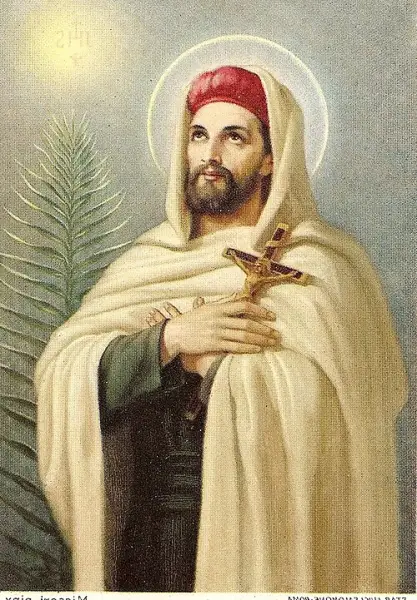
- Christogram·crucifix·staff·sannyasi robes·martyr's palm
- Canonization
- Beatified 21 August 1853 by Pope Pius IX; canonized 22 June 1947 by Pope Pius XII
Prayer
Bibliography
Show 8 sources
- de Britto, Fernando Pereira (1852) [1722]. Historia do nascimento, vida e martyrio do Beato João de Britto da Companhia de Jesus, Martyr da Asia, e protomartyr da missâo do Maduré (in Portuguese) (2nd ed.). Lisbon: A. S. Monteiro. ISBN 978-1-142-04284-4
- Roberts, Holly Harlayne (2004-09-01). Vegetarian Christian Saints: Mystics, Ascetics & Monks. New York: Anjeli Press. ISBN 978-0-9754844-0-1
- Woods, Henry (1910). "Blessed John de Britto". Catholic Encyclopedia. Vol. 8. New York City: Robert Appleton Company
- "Orur". 2011 Census of India
- Raj, Selva J. (2002). "Transgressing Boundaries, Transcending Turner: The Pilgrimage Tradition at the Shrine of St. John de Britto". In Raj, Selva J.; Dempsey, Corinne G. (eds.). Popular Christianity in India: Riting Between the Lines. SUNY Press. ISBN 978-0-7914-5519-7
- Beauvais, Gilles-François de (1746). La vie du venerable pere Jean de Britto, de la Compagnie de Jesus, Mis a mort aux Indes dans le Maduré, en haine de la Foi (in French). Paris: Henri-Simon-Pierre Gissey and Marc Bordelet. OCLC 718297640
- Beauvais, Gilles-François de (1851). The life of the venerable servant of God, John de Britto, S. J. translated from the french of Father de Beauvais, S. J. 1746. London: Thomas Richardson and Son. OCLC 557619949
- Hull, Ernest (1910). "Madura Mission". Catholic Encyclopedia. Vol. 9. New York City: Robert Appleton Company
Profile text adapted from the Wikipedia article, licensed CC BY-SA 4.0.
Pray with this saint every day
Save St. John de Britto to your favorites, read the full profile, and get feast-day reminders in the Saints app.
Get the Saints AppFree on the App Store for iPhone and iPad