
1601 – 1680·Feast August 19
St. John Eudes
Apostle of the Sacred Hearts and founder of the Eudists
Overview
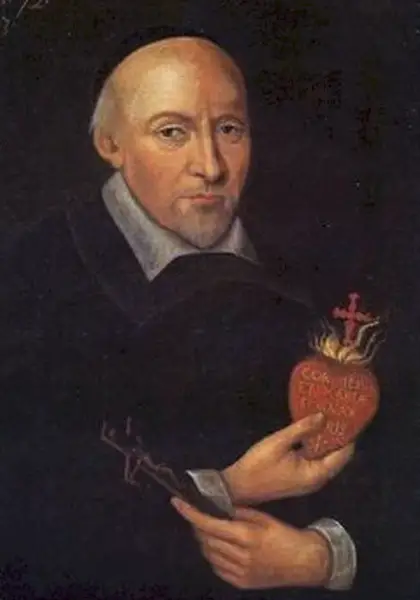
John Eudes, who lived from 14 November 1601 to 19 August 1680, was a French Catholic priest, founder, and missionary, born on a farm near the Normandy village of Ri to Isaac Eudes, a surgeon, and Martha Corbin; among his brothers was the noted historian of France, François Eudes de Mézeray. Educated by the Jesuits at Caen, he joined the Oratory of Jesus in 1623 under the mastership of Pierre de Bérulle and Charles de Condren, was ordained a priest in 1625, and returned to Séez in 1627. During the plagues of 1627 and 1631 he nursed the stricken of his diocese, living in a great cask in a field to avoid infecting his confreres. From 1633 he preached parish missions — more than a hundred across Normandy, the Île-de-France, Burgundy, and Brittany, including three in Paris and one at Versailles before Anne of Austria — winning the name, in Jean-Jacques Olier's phrase, of the prodigy of his age. He founded the Order of Our Lady of Charity in 1641 as a refuge for repentant prostitutes and the Congregation of Jesus and Mary, the Eudists, in 1643 for the training of priests and parish missions. His abiding title to fame is liturgical: he composed the Office and Mass in honor of the Heart of Jesus and of Mary's Immaculate Heart, first celebrated in 1672 and 1648 respectively, earning from Pope Leo XIII the title of author of the liturgical worship of the Sacred Hearts. He died at Caen on 19 August 1680 and was canonized in 1925.
The Complete Life
A Norman Farm and the Jesuit Schoolroom
Jean Eudes first saw light on 14 November 1601, on a farmstead near the Normandy village of Ri, the child of Isaac Eudes, a surgeon born around 1566, and of Martha Corbin. The household was large — four sisters and two brothers — and one sibling achieved fame of his own: François Eudes de Mézeray, who became a noted historian of France. The boy's first recorded religious milestones are precise: his First Communion came on 26 May 1613, the feast of Pentecost, and at fourteen he took a private vow of chastity. His schooling was entrusted to the Jesuits at Caen, the intellectual capital of Normandy, and there the future missionary received the classical formation that his later preaching would deploy. In 1623, at twenty-one, he made the decision that fixed his course: on 25 March he joined the Oratory of Jesus, the congregation recently established in France. His formators were men of the first rank — Pierre de Bérulle, who received him personally into the order, and the contemplative-ascetic Charles de Condren. Under de Bérulle he was formed in the French school of spirituality, with its strongly Christocentric thrust, its adoration, and its pursuit of a personal relationship with Christ extended to the Holy Spirit.
§ Education
Priest of the Oratory
Bishop Jacques Camus de Pontcarré ordained Eudes subdeacon on 21 December 1624 and priest on 20 December 1625; the new priest celebrated his first Mass at Christmas. Illness immediately tested him — he was bedridden until 1626 — after which he was sent to Aubervilliers for theological studies, returning to Séez in 1627. What followed made his reputation. In the severe plague epidemics of 1627 and 1631, when most priests fled the contagion, Eudes volunteered with his superiors' permission to care for the stricken of his own diocese, administering the sacraments to the dying and seeing that the dead were properly buried. To avoid carrying the infection back to his Oratorian colleagues, he took the extraordinary precaution of lodging in an enormous cask set out in an open field. In 1633 he turned to the work that would fill the rest of his life: preaching parish missions. Over the following decades he conducted more than a hundred of them, in his native Normandy and beyond, in the Île-de-France, Burgundy, and Brittany, his missions running from several weeks to several months. Jean-Jacques Olier called him 'the prodigy of his age'; he preached three missions in Paris and one at Versailles, once before Anne of Austria, though her son Louis XIV suspected him of hostility to Gallican policies.
§ Priesthood
Founder for Priests and for the Abandoned
Eudes's missionary eye fell on two neglected fields: the clergy and the women no one would shelter. Disturbed by the inadequacy of seminaries and shelters alike, he acted on both fronts. In 1641, stirred when Madeleine Lamy — who had cared for women escaping prostitution — confronted him with the lack of refuge, he established at Caen the Order of Our Lady of Charity, called of the Refuge, to receive repentant prostitutes; three Visitation nuns assisted briefly, a house opened at Caen in 1644, other ladies joined, and the Bishop of Bayeux gave diocesan approbation on 8 February 1651, followed by papal approval from Alexander VII on 2 January 1666. From this congregation Mary Euphrasia Pelletier would later establish the Good Shepherd Sisters in 1829. On the clerical side, Eudes had long seen that seminaries needed improvement; with the backing of Cardinal Richelieu and individual bishops he severed his ties with the Oratorians and on 25 March 1643 founded at Caen the Congregation of Jesus and Mary — the Eudists — dedicated to the education of priests and to parish missions, going on to establish several seminaries in the region, including one at Rennes. He also brought into being the Society of the Most Admirable Mother, a third-order association that would one day count Jeanne Jugan and Amelie Fristel among its members.
§ Religious congregations
The Two Hearts Made One Devotion
Eudes drew on the French school of de Bérulle, on the mild, devotional warmth of Francis de Sales, and on the revelations granted to Gertrude the Great and to Mechtilde. What he made of these materials was original: taking over Bérulle's devotion to the Incarnate Word, he transformed a devotion that had been largely individual and private into a worship of the whole Church, composing for his communities an Office and a Mass that won the approval of several bishops before spreading more widely. He gave himself to the twin devotion to the Heart of Jesus and to Mary's Immaculate Heart, teaching their mystical unity in words the Church still quotes: what God has so perfectly united must never be separated, for whoever beholds Jesus sees Mary, and whoever loves Jesus loves Mary. The feast in honor of the Immaculate Heart of God's Mother was first kept on 8 February 1648, with the feast of the Heart of Jesus itself following on 20 October 1672, each with the rank of a double of the first class, together with an octave. He set the seminary chapels of Caen and Coutances under the patronage of the Sacred Heart, composed rosaries and prayers for the two Hearts, and wrote his Admirable Heart of the Most Holy Mother of God — the first book ever devoted to the devotion to the Sacred Hearts — all over the opposition of the Jansenists. At the center of it all, as of his whole spiritual teaching, stood Christ.
§ Religious congregations
Caen and the Long Evening
Eudes's health began to fail relatively early: in April 1671, sensing decline, he drew up his last will — the same year a rumor circulated that he might be named Coadjutor Bishop of Evreux with the support of Louis XIV, an honor that never materialized. The work continued: in 1674 he received from Pope Clement X six papal bulls of indulgences for the confraternities and seminaries devoted to the two Sacred Hearts, a sign of how far his devotional cause had traveled. He died at Caen on 19 August 1680, seventy-eight years old, the missionary of more than a hundred parishes and the founder of two congregations. His body did not rest undisturbed: his body was exhumed and shifted in 1810, and moved a final time on 6 March 1884, eventually finding their shrine at Caen's monastery of Notre-Dame de Charité, where his relics are venerated today. The order he left behind, the Eudists, carried his double charism — seminaries and missions — into the modern Church, while Our Lady of Charity grew into a worldwide congregation of the refuge.
§ Death
From Servant of God to Saint
The road to the altars took a century and a half. The informative process opened in the Diocese of Séez on 19 August 1868, and the cause was formally introduced on 7 February 1874 under Pius IX, who gave Eudes the title of Servant of God. On 6 January 1903 Pope Leo XIII confirmed that Eudes had practiced heroic virtue, declaring him Venerable — and, in the same act of proclamation, conferring on him the lasting title of author of the liturgical worship paid to the Hearts of Jesus and Mary, a rare papal summary of a saint's specific achievement. Pius X approved two miracles credited to Eudes's intercession and beatified him in Saint Peter's on 25 April 1909; two further miracles, once ratified, let Pius XI crown the process, canonizing him in the same basilica on 31 May 1925. The Church has kept his memory close since: a statue of Eudes by Silvio Silva has stood in Saint Peter's Basilica since 1932, along the central nave's right flank, and in his General Audience of 19 August 2009, Pope Benedict XVI praised him as a 'tireless apostle of the devotion of the Sacred Hearts' and held him up as an example for priests in the Year for Priests, citing his apostolic zeal in the formation of seminarians.
§ Veneration
Toward the Doctorate
Eudes's literary legacy — the Life and Kingdom of Jesus, the Contract of Man with God in Holy Baptism, the Good Confessor, the Memorial of the Ecclesiastical Life, the Apostolic Preacher, and the Admirable Heart — secured his standing as one of the great spiritual writers of seventeenth-century France, and his supporters have long argued that the writing merits a higher title still. The idea of naming him a Doctor of the Church was first proposed around the time of the Second World War, but the conflict and then the Second Vatican Council suspended the inquiries. The cause has since been taken up formally: The two families he founded — the Congregation of Jesus and Mary (the Eudists) and the Good Shepherd sisters, grown from Our Lady of Charity — have together introduced the cause of their founder for a doctorate, and in 2014–15 the bishops' conferences of France, of Mexico, Venezuela, Ecuador, Benin, Honduras, and Colombia all gave the proposal their full support, the French assembly confirming its backing at its plenary session of 8 November 2014. On 3 December 2016 Camilo Bernal Hadad, then superior general of the Eudists, discussed the project with Pope Francis in company with Luc Crépy, bishop of Le Puy-en-Velay, and in April 2017 a Positio dossier setting out the reasons and the supporting spiritual writings was delivered to the Vatican's Congregation for the Causes of Saints for evaluation.
§ Doctor of the Church
Timeline
- 14 Nov 1601
Born on a farm near Ri in Normandy to Isaac Eudes, a surgeon, and Martha Corbin.
§ Education
- 26 May 1613
Made his First Communion on Pentecost.
§ Education
- 25 Mar 1623
Joined the Oratorians after studies under the Jesuits at Caen.
§ Education
- 21 Dec 1624
Ordained to the subdiaconate by Bishop Jacques Camus de Pontcarré.
§ Education
- 20 Dec 1625
Ordained to the priesthood, celebrating his first Mass at Christmas.
§ Priesthood
- 1627
Returned to Séez and volunteered to nurse plague victims, administering the sacraments and burying the dead.
§ Priesthood
- 1633
Began preaching parish missions, eventually conducting over a hundred across France.
§ Priesthood
- 1641
Established at Caen the Order of Our Lady of Charity, called of the Refuge, as a shelter for prostitutes seeking to leave that life.
§ Religious congregations
- 25 Mar 1643
Left the Oratorians and founded the Congregation of Jesus and Mary (Eudists) at Caen for priestly education and missions.
§ Religious congregations
- 8 Feb 1648
The feast honoring the Immaculate Heart of God's Mother, with the Office and Mass he had composed for it, was kept for the first time.
§ Religious congregations
- 8 Feb 1651
The Bishop of Bayeux granted diocesan approbation to the Order of Our Lady of Charity.
§ Religious congregations
- 2 Jan 1666
Pope Alexander VII granted papal approval to the congregation.
§ Religious congregations
- 20 Oct 1672
The feast of the Heart of Jesus was first kept, ranked as a double of the first class and graced with an octave.
§ Religious congregations
- 1674
Received from Pope Clement X six papal bulls of indulgences for the confraternities and seminaries devoted to the two Sacred Hearts.
§ Priesthood
- 19 Aug 1680
Died at Caen, aged seventy-eight.
§ Death
- 19 Aug 1868
The informative process of his canonization cause opened in the Diocese of Séez.
§ Veneration
- 6 Jan 1903
Pope Leo XIII confirmed his heroic virtue, declared him Venerable, and honored him with the title Author of the Liturgical Worship of the Two Hearts.
§ Veneration
- 25 Apr 1909
Beatified by Pope Pius X in Saint Peter's Basilica after approval of two miracles.
§ Veneration
- 31 May 1925
Canonized by Pope Pius XI in Saint Peter's Basilica upon the ratification of two further miracles.
§ Veneration
In Their Own Words
You must never separate what God has so perfectly united. So closely are Jesus and Mary bound up with each other that whoever beholds Jesus sees Mary; whoever loves Jesus, loves Mary; whoever has devotion to Jesus, has devotion to Mary.
The Record
- Major works
- La Vie et le Royaume de Jésus (1637)·Le contrat de l'homme avec Dieu par le Saint Baptême (1654)·Le Bon Confesseur (1666)·Le Mémorial de la vie Ecclésiastique·Le Prédicateur Apostolique·Le Cœur Admirable de la Très Sainte Mère de Dieu·Propers for the Mass and Divine Office of the Sacred Heart of Jesus and the Immaculate Heart of Mary
- Patron of
- Eudists (Congregation of Jesus and Mary)·Order of Our Lady of Charity·Diocese of Baie-Comeau·Missionaries
- Symbols
- Priest's attire·Sacred Heart
- Canonization
- Canonized by Pope Pius XI on 31 May 1925 in Saint Peter's Basilica; beatified by Pope Pius X on 25 April 1909
Prayer
Bibliography
Show 9 sources
- "Saint John Eudes". Saints SQPN. 3 August 2017. Retrieved 26 August 2017
- Le Brun, Charles (1909). "Blessed Jean Eudes". The Catholic Encyclopedia Volume 5. New York: Robert Appleton Company
- Steele, Francesca (1911). "Sisters of Our Lady of Charity of the Refuge". The Catholic Encyclopedia Volume 12. New York: Robert Appleton Company
- "St. John Eudes – Spiritual Father of the Good Shepherd Sisters". Good Shepherd Sisters
- "Our Founder Speaks..." The Eudist Fathers in the Philippines
- Fr. Don Miller, O.F.M. "Saint John Eudes". Franciscan Media
- "Saint John Eudes". Santi e Beati
- "Benedict XVI – General Audience". Holy See. 19 August 2009
- Amouriaux, Jean-Michel. "Saint John Eudes Doctor of the Church?"
Profile text adapted from the Wikipedia article, licensed CC BY-SA 4.0.
Pray with this saint every day
Save St. John Eudes to your favorites, read the full profile, and get feast-day reminders in the Saints app.
Get the Saints AppFree on the App Store for iPhone and iPad