
1469-1535·Feast June 22
St. John Fisher
Bishop, Cardinal, and Martyr
Overview
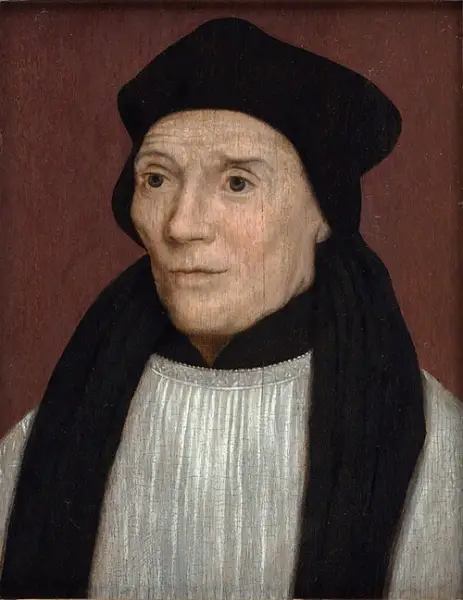
John Fisher, born at Beverley in Yorkshire in 1469, the son of a prosperous mercer, was sent to Cambridge at about twelve and never really left its service again. Ordained priest in 1491 by dispensation for his youth, he took his doctorate in sacred theology, served as vice-chancellor, and became confessor to Lady Margaret Beaufort, the king's mother, through whose generosity he helped bring Christ's and St John's Colleges into being and drew Erasmus to Cambridge. In 1504 he was named to Rochester, the poorest diocese in England, and kept it for the remaining thirty-one years of his life while serving also as the university's chancellor. A stern, ascetic scholar who kept a human skull beside his altar and at his meals, he was among the first English theologians to answer Luther, confuting the reformer's assertions in 1523 and preaching against him at Paul's Cross in 1526. When Henry VIII moved to set aside Catherine of Aragon, Fisher appeared for the queen and said he was ready to lay down his life for the indissolubility of marriage, as John the Baptist had. Refusing the oath acknowledging the king's claim to head the church in England, he spent over a year in the Tower, was tricked into a fatal admission by Richard Rich, was raised to the cardinalate by Paul III — a hat Henry swore should never reach England — and was beheaded on Tower Hill on 22 June 1535, calm and dignified to the last.
The Complete Life
Early Life
Beverley in Yorkshire gave John Fisher to the world in 1469. His father Robert, a mercer of the town in comfortable circumstances, died in 1477 and was buried in the parish church of St Mary, his testament providing for poorhouses, priests, Mass stipends, and churches — the standard, sincerely meant, piety of a late-medieval town. Agnes, widowed with John at eight, married again, to one White, and had four more children; Fisher stayed close to the whole network of kin throughout his life. Beverley's collegiate church school probably gave him his letters. Judging him bookish and able, and being well enough off to pay for it, his mother sent him up to Cambridge in 1482, a boy of twelve or thirteen — arriving, as he told Henry VII a generation later in an oration, at a university in decline: worn by quarrels with the town, by plagues that had thinned its best men, and by the want of patrons. At Michaelhouse the young Fisher fell under William Melton's influence — a divine at once pastoral and hospitable to the new humanist learning — and the bent of his career was fixed: study ordered to the care of souls.
§ Introduction
Conversion and Vocation
His ascent was early and unbroken. Degrees came in sequence — bachelor of arts, 1487; master and fellowship, 1491 — and ordination followed on 17 December of the same year, the canonical age being set aside for him by papal dispensation. A Yorkshire living, resigned in 1494 for the university proctorship, gave way in 1497 to the office of master debator and, at almost the same time, to a decisive appointment: chaplain and confessor to the king's mother, Margaret Beaufort, Countess of Richmond and Derby. Theology's doctorate fell to him on 5 July 1501, and within the fortnight the vice-chancellorship of the university; and in 1504 came the double dignity that would define him — the see of Rochester, conferred at Henry VII's own insistence, and the chancellorship of Cambridge, annually renewed for a decade and then held for life.
§ University of Cambridge
Mission and Ministry
Rochester was the poorest see in England, normally a first step on an episcopal ladder. Fisher stayed for the remaining thirty-one years of his life, by his own choice, and made the small diocese a model of residence and pastoral attention — visiting, confirming, preaching, and correcting in person rather than by proxy. Cambridge was his second charge. Under his guidance Lady Margaret founded Christ's and St John's Colleges and the Lady Margaret Professorships of Divinity at both universities, with Fisher the first occupant of the Cambridge chair; he served as president of Queens' College from 1505 to 1508, drew Erasmus to Cambridge (whose Greek studies survived there, Erasmus said, under Fisher's protection, without the molestation they met at Oxford), endowed chantries, and insisted that the fellows he funded be preachers. He preached the funeral orations for Henry VII and Lady Margaret in 1509, and is said to have tutored the future Henry VIII. Erasmus's verdict allowed no qualification: the one man of the age beyond compare in integrity of life, in learning, and in greatness of soul.
§ University of Cambridge
Spirituality and Teaching
Fisher was a stern, ascetic scholar — the human skull he kept on the altar at Mass and on the table at meals is the detail his biographers never omit — and his theology was exactly fitted to the crisis that came. He had denounced abuses and urged disciplinary reform in the Church before Luther ever wrote, which gave him standing to answer the reformer when he came. He was the first theologian to identify sola fide justification as the Reformation's founding dogma; his 1523 Confutation of the Lutheran Assertions, some two hundred thousand words against Luther's Assertio, went unanswered by Luther, who had quietly dropped his more provocative claims from the German edition. In 1526, at the king's command, Fisher preached against Luther at Paul's Cross in a public spectacle of abjurations and book-burnings — and in the preface to the printed sermon offered to meet any Lutheran privately to compare minds, trusting that one of the two would convert the other. His name has been attached, without convincing proof, to the Assertio septem sacramentorum that won Henry VIII his title Defender of the Faith.
§ Opposition to Lutheranism
Trial and Final Years
The king's attempt to put away Catherine of Aragon drew Fisher into his last battle as the queen's principal champion. Before the legates he argued her cause with a bluntness that startled the court, saying flatly that he was prepared to die for marriage's indissolubility as the Baptist had before him; Henry answered with a long Latin harangue to the legates, Fisher's own copy of which survives, its margins annotating the king's text with scarcely concealed scorn. Rome's seizure of the case ended Fisher's formal part but not the king's grudge. On supremacy the bishop proved immovable: in 1531 he forced the clergy's submission to carry the rider 'so far as God's law permits'; in 1534, refusing the Oath of Succession, he went to the Tower, where a year of sickness, interrogation, and cold broke his body but not his answers. Paul III named him cardinal in May 1535; Henry, vowing the hat should never be worn in England, moved to trial instead. Condemned on 17 June upon Richard Rich's perjured evidence, Fisher went to the block on Tower Hill on 22 June 1535 with a composure witnesses recorded; the quartered remains were displayed, and the head set upon London Bridge.
§ Cardinalate and martyrdom
Canonization
Honored as a martyr from the hour of his death, Fisher waited four hundred years for formal canonization. English Catholics petitioned for it by the hundred thousand, and Pius XI granted it on 19 May 1935, raising Fisher and Thomas More to the altars together as the chosen representatives of all who had died for the old faith in England. The pair keep a shared feast, 22 June, in the current Roman calendar — and Fisher's memory has crossed the confessional divide, finding a place in certain Anglican kalendars of saints as well, one of the few men of that contest whom both traditions claim.
§ Introduction
Legacy
Fisher's legacy is double. As a bishop he remains the English standard of pastoral residence and reform from within — the rich scholar who chose the poorest see and never left it, and who tried to cure the Church's sickness before others prescribed its destruction. As a martyr he is the one bishop of the English hierarchy to die for the supremacy of the pope against the state, which has made him the patron of bishops in difficult times and, with Thomas More, the enduring face of resistance to the theory that the civil power may command conscience. At Cambridge the colleges he built with Lady Margaret — Christ's and St John's — carry his monument in stone.
§ References
Timeline
- 19 Oct 1469
Born at Beverley, Yorkshire, son of the prosperous mercer Robert Fisher and his wife Agnes.
§ Introduction
- 1482
Admitted to the University of Cambridge at about twelve or thirteen by his mother's decision.
§ University of Cambridge
- 1487
Takes his Bachelor of Arts degree at Michaelhouse under the influence of William Melton.
§ University of Cambridge
- 1491
Proceeds Master of Arts and is elected a fellow of his college.
§ University of Cambridge
- 17 Dec 1491
Ordained priest on a papal dispensation for being under the canonical age, and made nominal Vicar of Northallerton.
§ University of Cambridge
- 1494
Resigns the Northallerton benefice to become proctor of the university.
§ University of Cambridge
- 1497
Appointed chaplain and confessor to Lady Margaret Beaufort, mother of Henry VII.
§ University of Cambridge
- 5 Jul 1501
Receives the degree of doctor of sacred theology.
§ University of Cambridge
- 15 Jul 1501
Elected Vice-Chancellor of the university ten days after taking his doctorate.
§ University of Cambridge
- 1504
Elected Chancellor of the University of Cambridge, later receiving a lifetime appointment.
§ Bishop
- 14 Oct 1504
Appointed Bishop of Rochester by papal bull at Henry VII's personal insistence.
§ Bishop
- 24 Nov 1504
Consecrated a bishop by William Warham, Archbishop of Canterbury.
§ Introduction
- 1509
Preaches the funeral orations for both Henry VII and Lady Margaret, who died that year.
§ Bishop
- 1512
Named one of the English representatives at the Fifth Lateran Council, though the journey to Rome is abandoned.
§ Bishop
- 1521
Publishes a sermon against Martin Luther's doctrine.
§ Opposition to Lutheranism
- 1523
Publishes his 200,000-word Confutation of the Lutheran Assertions against Luther.
§ Opposition to Lutheranism
- 11 Feb 1526
Preaches a famous anti-Lutheran sermon at St Paul's Cross at the King's command.
§ Opposition to Lutheranism
- Nov 1529
Warns the new Long Parliament that attacks on the Church's prerogatives will destroy Catholicism in England.
§ Henry's attack on church prerogatives
- 1530
Appeals to the Holy See with the bishops of Bath and Ely against encroachments on the Church, and is arrested with them.
§ Henry's attack on church prerogatives
- Feb 1531
Present at Convocation as the clergy acknowledge Henry as supreme head of the Church, winning the clause 'so far as God's law permits'.
§ Henry's attack on church prerogatives
- Jun 1532
Preaches publicly against the annulment of Henry's marriage.
§ The King's Great Matter
- Mar 1533
Arrested a week after Cranmer's consecration, to keep him from opposing the annulment, then released without charge.
§ The King's Great Matter
- Sep 1533
Encourages Emperor Charles V, through ambassador Eustace Chapuys, to invade England and depose Henry.
§ Intrigues with the Holy Roman Emperor
- Mar 1534
Attainted in Parliament for complicity with the Holy Maid of Kent; forfeits his estate and is fined 300 pounds.
§ The King's Great Matter
- 26 Apr 1534
Refuses the oath under the First Succession Act and is imprisoned in the Tower of London.
§ Succession and supremacy
- 7 May 1535
Falls into Richard Rich's trap and declares that the King is not Supreme Head of the Church.
§ Succession and supremacy
- 21 May 1535
Created Cardinal Priest of San Vitale by Pope Paul III, enraging Henry VIII.
§ Cardinalate and martyrdom
- 17 Jun 1535
Arraigned in Westminster Hall on a treason charge, found guilty, and condemned.
§ Cardinalate and martyrdom
- 22 Jun 1535
Beheaded on Tower Hill; his head is set on London Bridge and his body later laid in St Peter ad Vincula.
§ Cardinalate and martyrdom
- 29 Dec 1886
Beatified by Pope Leo XIII together with Thomas More and 52 other English martyrs.
§ Canonisation
- 19 May 1935
Canonized by Pope Pius XI with Thomas More after a petition from English Catholics.
§ Canonisation
- 1980
Added to the Church of England's calendar of Saints and Heroes, commemorated jointly with Thomas More.
§ Legacy
In Their Own Words
I know that without some fervour in the love of Christ, religion cannot be to you savoury, nor any work of goodness can be delectable, but every virtuous deed shall seem laborious and painful.
And this our Lord God send you a mery Christmas.
The Record
- Major works
- Treatise concernynge the seven penytencyall Psalms (1508)·Sermon against the pernicyous doctrin of Martin Luther (1521)·Assertionis Lutheranae Confutatio (1523)·De Veritate Corporis et Sanguinis Christi in Eucharistia (1527)·De Causa Matrimonii Henrici VIII cum Catharina Aragonensi (1530)·The Wayes to Perfect Religion (1535)·A Spirituall Consolation written to his sister Elizabeth
- Patron of
- Roman Catholic Diocese of Rochester·Rochester, New York
- Symbols
- Bishop's vestments with the cardinal's red hat·A book, for his writings against Luther·The executioner's axe of Tower Hill
- Canonization
- Beatified by Pope Leo XIII on 29 December 1886; canonized by Pope Pius XI with St. Thomas More on 19 May 1935
Prayer
Bibliography
Show 12 sources
- ↑ Based upon his baptismal date as taken from "Lives of the Saints, For Every Day of the Year," edited by the Rev. Hugo Hoever OSB Cist, New York: Catholic Book Publishing Co., 1951
- 1 2 3 4 "CATHOLIC ENCYCLOPEDIA: St. John Fisher" . newadvent.org . Retrieved 12 December 2018 .
- ↑ To "a number of churches and almshouses and to two priests. To a monastery at Hagnaby in Lincolnshire he left ten shillings for a trental of Masses for the repose of his soul, and to a church at Holtoft not far away in the same county, he
- ↑ Neither White's Christian name nor his occupation is known. Of his children by Agnes, John and Thomas became merchants; the third, Richard, became a priest and Elizabeth White entered the Dominican nunnery at Dartford, Kent.
- ↑ Some similar forces had also affected the University of Oxford.
- ↑ "Martyr-in-Waiting – Martyrs of Henry VIII: Repression, Defiance, Sacrifice" . erenow.org . Retrieved 26 October 2023 .
- ↑ "Fisher, John (FSR487J)" . A Cambridge Alumni Database . University of Cambridge.
- ↑ Reynolds, Ernest Edwin (1955). Saint John Fisher . Anthony Clarke Books. p. 6.
- ↑ Saywell, Joseph Lemuel (1885). "Appendix". The history and annals of Northallerton, Yorkshire . London: Simpkin and Marshall. p. xliv (298). OCLC 1045936128 .
- ↑ Seward, Desmond (2007). The Wars of the Roses . Constable and Robinson. p. 437.
- 1 2 3 4 Foley OFM, Leonard, "St. John Fisher", Saint of the Day, Lives, Lessons, and Feast , (revised by Pat McCloskey OFM), Franciscan Media ISBN 978-0-86716-887-7
- 1 2 "Catholic Culture Library: Bishop John Fisher" . Retrieved 3 July 2016 .
Profile text adapted from the Wikipedia article, licensed CC BY-SA 4.0.
Pray with this saint every day
Save St. John Fisher to your favorites, read the full profile, and get feast-day reminders in the Saints app.
Get the Saints AppFree on the App Store for iPhone and iPad