
1597-1640·Feast June 16
St. John Francis Regis
Priest, Religious of the Society of Jesus
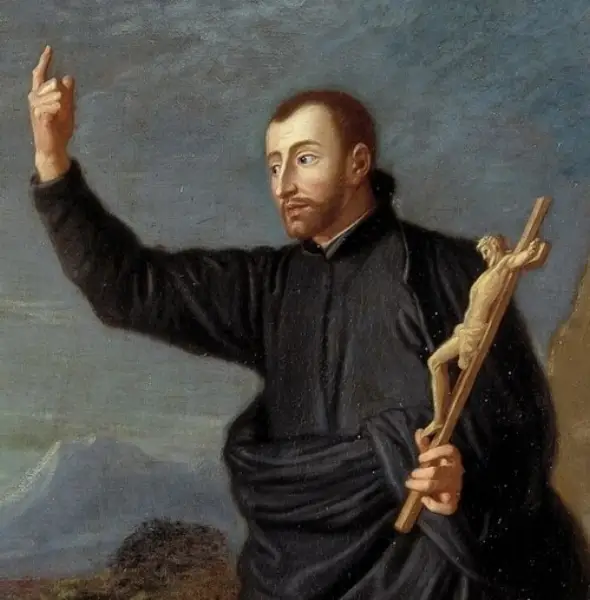
Overview
Jean-François Régis was born on 31 January 1597 at Fontcouverte in Languedoc, the son of a newly ennobled father and a noble mother. Schooled by the Jesuits at Béziers, he entered their novitiate at Toulouse in 1616. Years of teaching grammar at Billom, Le Puy and Auch followed, along with philosophy at Tournon and theology at Toulouse; he was ordained a priest in 1630 at thirty-one. His real life's work began in the summer of 1631, and it was spent almost entirely on the margins. In Toulouse he tended plague victims; from Montpellier he labored for the conversion of Huguenots, preached to children and the poor, and worked to draw wayward women out of prostitution, founding hostels where they could live in safety and training many as lace makers so they might earn a living honestly. He organized the Confraternity of the Blessed Sacrament to channel the charity of the rich into food and alms. From 1633 to 1640 he gave parish missions across more than fifty districts of the Vivarais, the Forez and the Velay, walking rough mountain roads in winter. His bluntness against vice won him enemies and even threats, and though he longed for the missions of Canada he never left France. Worn out, he died of pneumonia at Lalouvesc on 31 December 1640, aged forty-three.
The Complete Life
Early Life
Jean-François Régis was born on 31 January 1597 at Fontcouverte in the Languedoc, the son of Jean Régis, recently ennobled for service during the Wars of the League, and Marguerite de Cugunhan, of a noble family. He studied at the Jesuits' college in Béziers, and on 8 December 1616 — his nineteenth year — he joined the Jesuit novitiate at Toulouse, taking his vows two years later. His formation followed the ordinary Jesuit round: rhetoric at Cahors, then grammar teaching — Billom (1619–22), then Puy-en-Velay (1625–27), and finally Auch (1627–28) — together with philosophy at the Tournon-sur-Rhône scholasticate. His superiors observed in him an intense love of preaching and of teaching the faith, together with a stated desire to save souls; theology at Toulouse followed, and he was ordained priest in 1630 at thirty-one, completing his tertianship the next year.
§ Life
Mission and Ministry
Regis's apostolic career began in the summer of 1631, and from the first it was directed at the margins. As a newly ordained priest in Toulouse he worked with bubonic plague victims. From May 1632 to September 1634 he was based at the Jesuit college of Montpellier, working to convert the Huguenots, visiting hospitals, helping the needy, pulling wayward women and girls out of prostitution, and preaching Catholic doctrine tirelessly to children and the poor. He is best remembered for the institutions he built for women at risk: safe houses, hostels for prostitutes, and training in lace-making that gave thousands a stable income and a way out of exploitation. To fund the work he founded the Confraternity of the Blessed Sacrament, which organized the gathering of money and food from the wealthy. In 1633, at the invitation of Bishop Louis II de la Baume de Suze, he took up missions in the Diocese of Viviers; between 1633 and 1640 he evangelized more than fifty districts across the Vivarais, the Forez and the Velay, walking from town to town through rough mountain country in all seasons, preaching in a style simple and direct enough for the uneducated peasantry, and reaping conversions on a scale that embarrassed more comfortable clergy.
§ Life
Spirituality and Teaching
Regis's spirituality was Jesuit apostolic zeal with little ornament: the desire to save souls, expressed in going where the need was greatest and staying until the work could sustain itself. His method was as practical as his preaching — organize the wealthy to fund the poor, train the vulnerable to earn, confront the vice that trapped them — and his institutional legacy (confraternities, hostels, the lace trade) outlived his sermons. His boldness, read by some as arrogance, brought him conflict with brother priests, tension with a local bishop, and threats of violence from men whose vices he denounced — costs he bore as part of the job. He longed for the missions of Canada, but was kept in France all his life.
§ Life
Trial and Final Years
The mountain missions consumed him. In December 1640, after a mission preached in mid-winter, Regis fell ill and died of pneumonia at Lalouvesc on 31 December 1640, aged forty-three — the eve of the year's end and of his own forty-fourth birthday month. His last weeks had been spent as his whole ministry had been, in the villages of the Velay.
§ Life
Canonization
The cult at Lalouvesc grew immediately after his death. He was beatified by Clement XI on 18 May 1716 and canonized by Clement XII on 5 April 1737. His feast is kept on 16 June, and his shrine at Lalouvesc remains a place of pilgrimage for the Massif Central. He is the eponym and patron of Regis University and of Regis high schools in the United States, and the patron of lacemakers — the trade he gave to the women he rescued.
§ Introduction
Legacy
Regis fixed a type: the mission preacher of rural France who combined evangelization with social organization. The lace-making he introduced into the Velay became a regional industry, and the institutions he founded for women were an early form of what later centuries would call rescue work. A whole American educational tradition carries his name through the Jesuits. Above all he stands for the priesthood that walks — the missionary who covered fifty mountain districts on foot and died at forty-three of the winters he worked in.
§ Life
Timeline
- 31 Jan 1597
Born at Fontcouverte in Languedoc, son of Jean Régis and the noble Marguerite de Cugunhan.
§ Life
- 8 Dec 1616
Enters the Jesuit novitiate at Toulouse in his nineteenth year.
§ Life
- 1618
Takes his vows in the Society of Jesus two years after entering the novitiate.
§ Life
- 1619
After rhetoric at Cahors, begins teaching grammar at Billom, later holding posts at Puy-en-Velay and Auch.
§ Life
- 1628
Begins the study of theology at Toulouse.
§ Life
- 1630
Ordained a priest at the age of thirty-one.
§ Life
- 1631
Enters upon his apostolic career in the summer, working with bubonic plague victims in Toulouse.
§ Life
- May 1632
From May 1632 until September 1634 his headquarters is the Jesuit college of Montpellier, whence he works for the conversion of Huguenots.
§ Life
- 1633
At the invitation of the bishop of Viviers he begins giving missions, and over the next seven years evangelizes more than fifty districts.
§ Life
- 31 Dec 1640
Dies of pneumonia at Lalouvesc, aged forty-three.
§ Life
- 18 May 1716
Beatified by Pope Clement XI in Rome.
§ Veneration
- 5 Apr 1737
Canonized by Pope Clement XII in Rome.
§ Veneration
The Record
- Major works
- Founded hostels for women escaping prostitution and trained them as lace makers·Established the Confraternity of the Blessed Sacrament for organized charity
- Patron of
- Lacemakers·Medical social workers·Illegitimate children·Regis University and Regis Jesuit High School
- Symbols
- Jesuit cassock·Lace-making bobbins
- Canonization
- Beatified 18 May 1716 by Pope Clement XI; canonized 5 April 1737 by Pope Clement XII
Prayer
Bibliography
Show 12 sources
- 1 2 3 Van Ortroy, Francis (1910). "St. John Francis Regis" . The Catholic Encyclopedia . Vol. 8. New York: Robert Appleton Company . Retrieved 7 August 2014 – via Newadvent.org.
- ↑ Hoever 1955 , p. 229.
- 1 2 3 Hoever 1955 , p. 230.
- 1 2 3 4 5 "A Tireless Saint from Southern France" . Regis.edu . Regis University, Denver, Colorado . Retrieved 7 August 2014 .
- ↑ Phyllis G. Jestice, Holy People of the World: A Cross-Cultural Encyclopedia (2004), p. 164
- 1 2 3 " "St. John Francis Regis" Catholic News Agency" . Catholicnewsagency.com. 16 June 2014. Archived from the original on 11 August 2014 . Retrieved 7 August 2014 .
- 1 2 William C. Sturtevant, Handbook of North American Indians , 1978, p. 473. "It was named Saint Regis in memory of Jean Francois Regis, a French ecclesiastic canonized in 1737 who before his death in 1640 at the age of 43 had wanted to be
- ↑ Saint of the Day, Lives, Lessons, and Feast . Americancatholic.org. 2009. ISBN 978-0-86716-887-7 . Retrieved 7 August 2014 .
- ↑ "Death of Saint Jean François Regis by Giacomo Zoboli, in the Church of the Gesù in Rome" .
- ↑ Justin Baker/Strive Creative (7 December 2012). "St. John-Francis Regis, Patron" . Stregis.org . Retrieved 7 August 2014 .
- ↑ Pope Gregory XVI, Epistola Libentissime fraternitatis (in Italian), published on 28 May 1845, accessed on 28 July 2026
- ↑ "St. John Francis Regis Catholic church, Arnaudville, Louisiana" . Johnfrancisregis.net. Archived from the original on 8 August 2014 . Retrieved 7 August 2014 .
Profile text adapted from the Wikipedia article, licensed CC BY-SA 4.0.
Pray with this saint every day
Save St. John Francis Regis to your favorites, read the full profile, and get feast-day reminders in the Saints app.
Get the Saints AppFree on the App Store for iPhone and iPad