
1802-1840·Feast September 11
St. John Gabriel Perboyre
Priest and Martyr
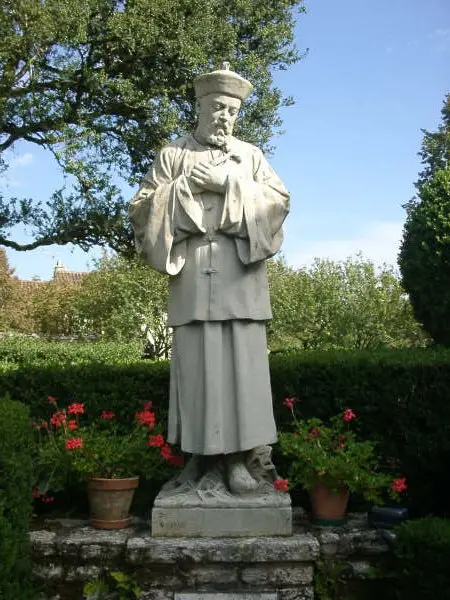
Overview
Jean-Gabriel Perboyre was born in 1802 at Le Puech in the Lot, one of eight children of Pierre Perboyre and Marie Rigal, farmers whose household would give five children to the Vincentians or the Daughters of Charity. An unremarkable boy, he was changed in 1816 when he accompanied his younger brother Louis to the Vincentian minor seminary at Montauban, founded by their uncle, and found himself called to the same life. He entered the Congregation of the Mission's novitiate in December 1818, made its four promises on the feast of the Holy Innocents in 1820, and was ordained a priest on 23 September 1825. Long held back from the China missions by weak health, he volunteered after Louis died on the voyage out. He reached Macau in August 1835, studied Chinese, and traveled five months by junk to Henan, serving the poor; in 1838 he moved to Hubei. When persecution broke out in September 1839 a catechist betrayed his hiding place. Bound and dragged from tribunal to tribunal, tortured and condemned at Wuchang, he died by strangulation upon a cross on 11 September 1840, put to death alongside seven criminals. His remains were later returned to the Vincentian motherhouse in Paris.
The Complete Life
Early Life
The birth of Jean-Gabriel Perboyre came in 1802, at Le Puech (today Montgesty), in the hill country of the Lot in southern France, one of the eight children of Pierre Perboyre and Marie Rigal, farmers of the kind France has always called its bone — religious, numerous, and attached to their land. The household would eventually give five children to the Vincentians or the Daughters of Charity, the two congregations of Saint Vincent de Paul, whose memory ran strong in those parishes. Jean-Gabriel himself was, by every account, an unremarkable boy. The turn came in 1816, when he accompanied his younger brother Louis to the Vincentian minor seminary at Montauban, which their uncle had founded: having walked his brother to the gate, he discovered that the life inside was calling him too.
§ Early life
Conversion and Vocation
Perboyre entered the Congregation of the Mission's novitiate in December 1818 and made its four promises on the feast of the Holy Innocents in 1820. He was ordained a priest on 23 September 1825 at Montauban, and spent the next decade as a formator — directing the novices, first in the provinces and then in Paris, a role for which his mildness and steadiness suited him. The China missions were the Congregation's great ambition, and Perboyre asked repeatedly to be sent; his superiors refused as repeatedly, on account of his weak health. What changed the calculation was his brother Louis: when Louis died on the voyage out to China, Jean-Gabriel volunteered to take his place, and this time the refusal did not hold. The family that had given five children now gave a second son to the same journey.
§ Apostolic life
Mission and Ministry
Perboyre reached Macau in August 1835, studied Chinese, and then traveled five months by junk into the interior to the mission of Henan, where the Vincentians served the poor of the Chinese countryside. In 1838 he was transferred to Hubei. The work was the ordinary Vincentian round in extraordinary conditions: instruction, the sacraments, the training of Chinese catechists, and the care of the abandoned, carried on under a legal ban that made every convert and every priest a criminal. Perboyre's letters home — the classic missionary correspondence of the era — record the language wrestled with, the slow growth of the communities, and the awareness, common to all of them, that the mission's cost was paid in the coin the era demanded.
§ Missionary
Spirituality and Teaching
Perboyre's spirituality was Vincentian to the marrow: the service of the poor and the missions as the extension of that service, and the imitation of Christ in his abandonment. In his years as novice director he had formed others in that school; in China he lived it. His writings from the missions show a man who had consciously offered his life and now simply worked — a spirituality of ordinariness under terminal conditions, sustained by the Vincentian practice of seeing Christ in the poor person in front of him. The tradition records that during his captivity he continued, as far as a prisoner could, to minister to his fellow prisoners, including the criminals with whom he would die.
§ Missionary
Trial and Final Years
In September 1839 the persecution of the missionaries broke out in his district, and a catechist, tortured or bribed into betrayal, revealed his hiding place. Perboyre was bound and dragged from tribunal to tribunal — the Chinese procedure that moved the accused across jurisdictions, each with its interrogations — and tortured at each stage for the names of other missionaries and the Christian communities. Condemned at Wuchang, he died by strangulation on a cross-shaped scaffold on 11 September 1840, executed together with seven common criminals, the legal equation of the priest with the worst of felons. He was thirty-eight. His remains were later recovered and returned to the Vincentian motherhouse in Paris, where they are still venerated.
§ Missionary
Canonization
Perboyre was beatified in 1889, and his cause held a special place in Vincentian memory as the first martyr of the Congregation's China mission. On 2 June 1996 Pope John Paul II canonized him in Saint Peter's Square — the first saint of the Congregation of the Mission, one hundred and fifty-six years after his death, at a ceremony that also served as the formal recognition of the whole Vincentian missionary enterprise in China. His feast is kept on 11 September, the anniversary of his death, and his canonization was received in China itself as the recognition of the first martyr of the China missions so honored.
§ Introduction
Legacy
Perboyre is the patron and type of the Vincentian missions, and his death on the cross-shaped scaffold fixed his iconography. The Chinese church he served grew, after the persecutions, into the largest Catholic community in East Asia's mainland, and the Vincentians' work in Hubei and Henan continued for a century on foundations he helped lay. For the wider Church his life is remembered as a chain of substitutions: taking the place of a dead brother on the voyage, taking the place of the poor in the interior, and finally accepting the place of a criminal on the scaffold — the logic of the faith he had given his life to explain.
§ Introduction
Timeline
- 6 Jan 1802
Born at Le Puech, near Montgesty in the Lot, to Pierre Perboyre and Marie Rigal, farmers.
§ Introduction
- 1816
Accompanies his younger brother Louis to the new Vincentian seminary at Montauban and feels drawn to religious life himself.
§ Early life
- Dec 1818
Enters the Congregation of the Mission novitiate housed at the Montauban minor seminary.
§ Apostolic life
- 28 Dec 1820
Makes the Congregation's four promises, hoping for overseas mission work.
§ Apostolic life
- 23 Sep 1825
Ordained a priest in the chapel of the Daughters of Charity by Bishop Louis Dubourg.
§ Apostolic life
- 24 Sep 1825
Celebrates his first Mass the day after ordination.
§ Apostolic life
- 1832
Named by his superiors to head the Congregation's novitiate in Paris.
§ Apostolic life
- Aug 1835
Lands at Macau and takes up study of Chinese.
§ Missionary
- 21 Dec 1835
Sets out by junk for his assigned mission in Henan, a five-month voyage.
§ Missionary
- Jan 1838
Transferred to the Hubei mission.
§ Missionary
- Sep 1839
Seized by soldiers during the provincial persecution after a tortured catechist reveals where he hides.
§ Missionary
- 1840
Death sentence confirmed by imperial edict.
§ Missionary
- 11 Sep 1840
Dies by strangulation on a cross at Wuchang, led out with seven common criminals.
§ Missionary
- 10 Nov 1889
Beatified in Rome by Pope Leo XIII.
§ Veneration
- 11 Mar 1891
Cause for his canonization formally opened.
§ Veneration
- 2 Jun 1996
Canonized by Pope John Paul II.
§ Veneration
In Their Own Words
O my Divine Savior, transform me into Yourself. May my hands be the hands of Jesus. Grant that every faculty of my body may serve only to glorify You.
Do not imagine each moment that all the Chinese are at my heels and think only of destroying me. These are the men whom I love much more than I fear.
The Record
- Major works
- Prayer of St. John Gabriel Perboyre to Jesus
- Symbols
- Vincentian (Congregation of the Mission) habit·Cross and rope (strangled on a cross at Wuchang)
- Canonization
- Beatified 10 November 1889 by Pope Leo XIII; canonized 2 June 1996 by Pope John Paul II
Prayer
Bibliography
Show 10 sources
- ↑ Miller, Charles Edward (2004). Mass on Sunday: And Other Ways of Being Catholic . Paulist Press. pp. 45–46 . ISBN 0-8091-4237-6 .
- 1 2 3 4 5 "Our Heritage:John Gabriel Perboyre" . Vincentian Center for Church & Society . Archived from the original on 2013-11-10.
- 1 2 3 "John Gabriel Perboyre (1802-1840): priest, martyr of the Congregation of the Mission" . Vatican News Service .
- ↑ "THE TSCHAN-ZE OR CARPET OF HONOR" .
- ↑ Glass, Joseph. "St. Jean-Gabriel Perboyre." The Catholic Encyclopedia Vol. 8. New York: Robert Appleton Company, 1910. 23 October 2021 This article incorporates text from this source, which is in the public domain .
- ↑ Paul, John (1 November 2002). "Decree of the Canonization of Blessed John Gabriel Perboyre" . Vincentiana . 46 (6).
- ↑ Index ac status causarum beatificationis servorum dei et canonizationis beatorum (in Latin). Typis polyglottis vaticanis. January 1953. p. 116.
- ↑ Guerra, Giuseppe (1 November 2002). "History of the Cause of Beatification and Canonization of St. John Gabriel Perboyre" . Vincentiana . 46 (6).
- ↑ Mass on Sunday: And Other Ways of Being Catholic by Charles Edward Miller 2004 ISBN 0-8091-4237-6 Paulist Press pages 45-46
- ↑ Galatians: Free in Christ by Kevin Perrotta 2006 ISBN 0-8294-2007-X page 53
Profile text adapted from the Wikipedia article, licensed CC BY-SA 4.0.
Pray with this saint every day
Save St. John Gabriel Perboyre to your favorites, read the full profile, and get feast-day reminders in the Saints app.
Get the Saints AppFree on the App Store for iPhone and iPad