
c. 985 – 1073·Feast July 12
St. John Gualbert
Founder of the Vallumbrosan Order
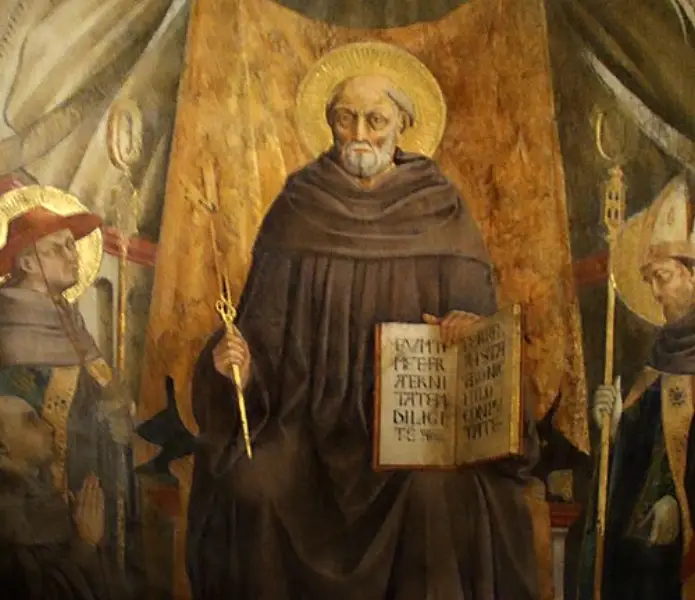
Overview
Giovanni Gualberto was an Italian abbot born into the Florentine nobility around 985. Raised in comfort, he showed little interest in religion as a young man until his elder brother Ugo was murdered. Setting out to kill the murderer, he met him in a lane near Florence on Good Friday and, when the man pleaded for mercy in the name of the crucified Christ, Gualbert forgave him. A crucifix at San Miniato al Monte was said to have bowed to him in acknowledgment of the act, and he resolved to become a monk there despite his father's resistance. As a Benedictine he campaigned against simony, and when his own abbot and the Bishop of Florence were implicated in it, he left in search of a stricter life. After a period with the monks of Camaldoli he settled at Vallombrosa, where in 1036 he founded the congregation that became the Vallumbrosan Order. He had his monks plant woods rather than gardens, cared devotedly for the poor and the sick, and won the admiration of a series of popes. He refused ordination throughout his life, remaining a simple monk, and died at the age of eighty-eight in 1073.
The Complete Life
A Noble Youth in Tuscany
Giovanni Gualberto entered the world around 985 as the son of nobles belonging to the Visdomini house, and his birthplace was the castle known as Poggio Petroio in the Tuscan lands near Florence. The family was of considerable standing, and its connections reached into church affairs, since Gualbert was related to Pietro Igneo, who would later distinguish himself in the cause of reform. He had one sibling, an older brother named Ugo, and as the child of a wealthy household he received an education and a Catholic upbringing. Religion, however, meant little to him in those years. His adolescence was spent on frivolous pursuits: he chased pleasure, indulged in vain amusements, and drifted through a series of romantic intrigues. Nothing in his conduct suggested the monk he would become. The turning point arrived with violence, when Ugo was murdered. Under the customs of the age, vengeance against the killer was expected of a man of honor, and Gualbert armed himself and his followers and set out for Florence intending to carry out that revenge. The encounter that followed in a narrow lane on Good Friday would redirect his entire life.
§ Life
Mercy in a Narrow Lane
The decisive meeting came as Gualbert was entering Florence with armed companions. In a narrow lane he found himself suddenly before his brother's killer. The murderer threw himself down, extended his arms in the shape of a cross, and appealed for pardon in Jesus's name, recalling to Gualbert that on this day Christ himself had died. Struck by the plea, Gualbert renounced his revenge and granted pardon. He then entered the Benedictine church of San Miniato al Monte to pray, and according to the tradition the crucifix was seen to bow its head in acknowledgment of the mercy he had shown. Overwhelmed, he begged pardon for his sins, and within the week had cut off his hair and put on a borrowed habit. His father opposed the decision and hastened to find him, but when he listened to his son's reasoning and perceived how firmly he was resolved, he gave his blessing and counseled him only to do good. Gualbert became a Benedictine at San Miniato, where he soon found himself opposing the simoniacal conduct of his abbot Oberto and of Pietro Mezzabarba, Bishop of Florence.
§ Life
Vallombrosa and the New Congregation
When the guilt of both the abbot and the bishop in matters of simony was discovered, Gualbert refused any compromise and departed in search of a more solitary and strict way of life. He spent time with the monks at Camaldoli, but his attraction was for the cenobitic rather than the eremitic life, and he made his home at last on the mount of Vallombrosa, raising a convent there in 1036. The foundation became the seed of the Vallumbrosan Order. In place of a traditional garden he had his monks plant trees, chiefly firs and pines, an image that became permanent in the identity of the house. He went on to establish further convents for the congregation, among them houses at Rozzuolo and San Salvi. His reputation for compassion toward the poor and the ill spread widely, and papal esteem followed: Pope Leo IX traveled to Vallombrosa to meet the monk, while Pope Stephen IX, Pope Alexander II, and Pope Gregory VII all held him in the greatest regard. Gregory VII praised the pureness and meekness of his faith and held him up as a standing model of compassion and goodness.
§ Life
Austerity, Humility, and the Fathers
Gualbert's spiritual life was marked by austerity joined to humility. He fasted often and imposed strict penances upon himself, and the early years of his monastery were so severe that few could endure them, which limited the order's growth until he mitigated the rule somewhat. He admired the teachings of the Church Fathers and cherished above all the memory of Basil of Caesarea and Benedict of Nursia, drawing on their example for his congregation. His preference was always for the common life of monks living under a rule rather than for solitary eremitic existence. Perhaps the most telling sign of his humility was his consistent refusal of ordination: he never wished to be made a priest and would not accept even the minor orders, choosing to remain a simple brother within the church whose cause he served so effectively. His battle against simony flowed from the same conviction that the church must be free of corruption, and he would not compromise even when his own abbot and the Bishop of Florence stood accused. Contemporaries described his faith as pure and meek, and later generations remembered him chiefly as a man whose gentleness matched the rigor of his discipline.
§ Life
Last Years and Death
Gualbert lived to an advanced age for his century and died on 12 July 1073 at the age of eighty-eight, at the Badia di Passignano in the Tuscan hills of Tavarnelle Val di Pesa. By then his congregation was firmly established. The original austerity had been moderated, additional monasteries had been founded, and others had been reformed and united to the order, so that the movement begun at Vallombrosa had taken permanent root in Tuscany. The holy lives of the first monks had attracted wide attention and many requests for new foundations, even though the extraordinary severity of the life at first deterred postulants. The standing of the community had been raised still further by the hardships its members endured at the hands of the anti-reform party, who burned the monastery of San Salvi and ill-treated its monks. Gualbert witnessed the celebrated ordeal by fire successfully undergone by Peter Igneus in 1068, an event that crowned the order's contribution to the papal struggle against simony. Reports of miracles began at his tomb soon after his death, and devotion to him spread through Tuscany and beyond.
§ Life
Recognition by the Church
Miracles were reported at Gualbert's tomb after his death, and his cult developed steadily among the faithful. The ceremony of canonization was carried out by Pope Celestine III at the Old Saint Peter's Basilica in the Papal States on 24 October 1193, some hundred and twenty years after his death. As a confessor rather than a martyr, he was honored for the holiness of his life rather than for a martyr's death, and his cult centered on Vallombrosa and the abbey of Passignano. The Tridentine calendar had never contained his feast; he entered the General Roman Calendar only in 1595. In 1969 the feast was removed from that universal calendar owing to its limited worldwide importance, yet the date of 12 July was retained, and by the norms issued with the Missal of 1969 his own Mass could still be celebrated across the globe unless an important celebration coincided with the day. The Benedictines observe his memory as an Optional Memorial. The canonization confirmed a reputation that a series of popes had already acknowledged during his lifetime. In this way the abbot who had refused every honor in life received the highest honor the church could give, and the mercy he had shown beside a Florentine lane was repaid with a place on the calendar of the saints.
§ Veneration
Patron of Forests and of Mercy
The order Gualbert founded flourished long after him. Urban II's bull of 1090, which entrusted the monastery to papal guardianship, enumerated fifteen monasteries besides the motherhouse. The struggle of the popes against simony, in which the early Vallumbrosans took a considerable part, produced the most famous incident in the order's history: the ordeal by fire successfully undergone by Peter Igneus in 1068, shortly after the burning of San Salvi and the mistreatment of its monks by the anti-reform party. These events greatly increased the repute of Vallombrosa. Gualbert's patronage extended in modern times to the natural world his monks had planted: in 1951 Pope Pius XII named him patron of the Italian Forest Corps, and in 1957 he was named patron of the Brazilian forests. He remains the patron of forest workers, foresters, park rangers, and parks, as well as of the Vallumbrosan Order and the Badia di Passignano. His pardon of his brother's killer became a celebrated subject in art, most notably in Edward Burne-Jones's painting The Merciful Knight, and Shorthouse adapted the tale in his novel John Inglesant.
§ Vallombrosians
Timeline
- 985
Born at the castle of Poggio Petroio near Florence, to nobles of the Visdomini house.
§ Life
- 1036
Founded his own convent at Vallombrosa, origin of the Vallumbrosan Order.
§ Life
- 1068
Peter Igneus successfully underwent the ordeal by fire in the order's struggle against simony.
§ Vallombrosians
- 12 Jul 1073
Died aged eighty-eight at the Badia di Passignano, Tavarnelle Val di Pesa.
§ Life
- 1090
Pope Urban II's bull placed Vallombrosa under papal protection, listing fifteen monasteries besides the motherhouse.
§ Vallombrosians
- 24 Oct 1193
Canonized by Pope Celestine III at Old Saint Peter's Basilica.
§ Veneration
- 1595
His feast of 12 July was added to the General Roman Calendar.
§ Veneration
- 1951
Pope Pius XII named him patron of the Italian Forest Corps.
§ Veneration
- 1957
Named patron of the Brazilian forests.
§ Veneration
- 1969
His feast was removed from the General Roman Calendar owing to limited worldwide importance.
§ Veneration
The Record
- Major works
- Founding of the Vallumbrosan Order at Vallombrosa (1036)·Convents at Rozzuolo and San Salvi
- Patron of
- Forest workers·Foresters·Park rangers·Parks·Italian Forest Corps·Brazilian forests·Vallumbrosan Order·Badia di Passignano
- Symbols
- Benedictine habit
- Canonization
- Canonized by Pope Celestine III on 24 October 1193 at Old Saint Peter's Basilica, Papal States.
Prayer
Bibliography
Show 9 sources
- Rev. Alban Butler. Lives of the Saints. Bartleby. Retrieved 26 September 2017.
- San Giovanni Gualberto. Santi e Beati. Retrieved 26 September 2017.
- St. John Gualbert. Catholic News Agency, 12 July 2017. Archived from the original on February 13, 2019.
- Stracke, Richard. St. John Gualbert: The Iconography. Christian Iconography, Augusta University.
- Webster, Douglas Raymund. Vallumbrosan Order. The Catholic Encyclopedia, Vol. 15. New York: Robert Appleton Company, 1912.
- Calendarium Romanum. Libreria Editrice Vaticana, 1969, p. 129.
- Martyrologium Romanum. Libreria Editrice Vaticana, 2001. ISBN 88-209-7210-7.
- General Instruction of the Roman Missal, 355 c.
- Proper Masses for the Use of the Benedictine Confederation. Collegeville, Minnesota: The Liturgical Press, 1975, p. 9.
Profile text adapted from the Wikipedia article, licensed CC BY-SA 4.0.
Pray with this saint every day
Save St. John Gualbert to your favorites, read the full profile, and get feast-day reminders in the Saints app.
Get the Saints AppFree on the App Store for iPhone and iPad