
1801-1890·Feast October 9
St. John Henry Newman
Cardinal, Theologian and Doctor of the Church
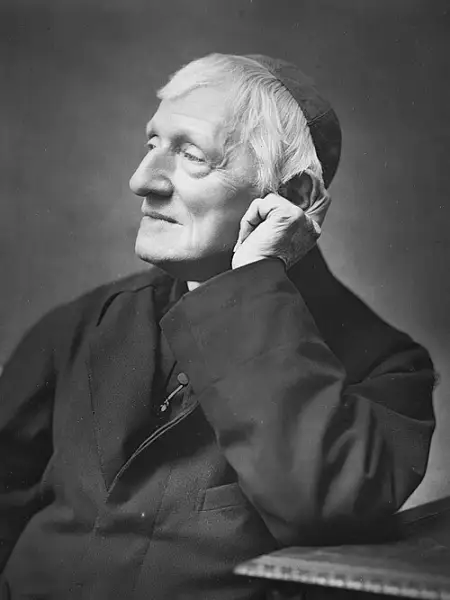
Overview
John Henry Newman was born in the City of London on 21 February 1801, eldest child of a banker and a mother of Huguenot descent. Converted to evangelical Christianity at fifteen, he went up to Trinity College, Oxford, won a fellowship at Oriel in 1822, and was ordained an Anglican priest in 1825. From 1833 he led the Oxford Movement with Keble and Pusey, writing tracts that sought to restore Catholic doctrine and liturgy to the Church of England; his Tract 90 of 1841, he later said, left him on his deathbed as regards Anglican membership. Becalmed in the Strait of Bonifacio in 1833 he wrote the hymn 'Lead, Kindly Light'. In 1845 he resigned Oxford and was received into the Catholic Church; ordained a Catholic priest in Rome in 1847, he founded the Birmingham Oratory and helped establish the Catholic University of Ireland in 1854. His account of his journey, Apologia Pro Vita Sua (1864), and his Grammar of Assent (1870) set out a theology of conscience and doctrinal development that reshaped Catholic thought. Leo XIII made him cardinal in 1879. He died at Edgbaston on 11 August 1890.
The Complete Life
Early Life
John Henry Newman was born in the City of London on 21 February 1801, the eldest of the three sons and three daughters of John Newman, a banker of Lombard Street, and Jemima Fourdrinier, of a Huguenot refugee family. At seven he was sent to Great Ealing School, where he read Walter Scott and Southey but stood apart from the school's casual games, and at fourteen worked through the sceptics Thomas Paine, David Hume, and perhaps Voltaire. At fifteen, in his last year at school, he underwent a conversion to Evangelical Christianity which he would describe in the Apologia as surer even than that he had hands or feet. Almost at once, in March 1816, the family bank crashed, though it paid its creditors. Under his teacher Walter Mayers, a Clapham Sect Calvinist, he became an evangelical Calvinist, reading through the English Calvinist tradition and sharing the usual belief that the Pope was antichrist. To his life's end he looked back on that conversion of 1816 as the saving of his soul, even as he came to see Evangelicalism, in Eamon Duffy's phrase, as a Trojan horse for undogmatic religious individualism.
§ Early life and education
Conversion and Vocation
Newman's rise at Oxford was swift: fellow of Oriel, vicar of St Mary's University Church from 1828, with Littlemore attached. But the 1830s carried him out of the low church, through dismissal from the Church Missionary Society secretaryship in 1830 and withdrawal from the Bible Society, into the patristic reading that reshaped him. A Mediterranean tour with the Froudes in 1832-33, a grave fever at Leonforte in Sicily, and a becalmed orange boat in the Strait of Bonifacio produced the verses Lead, Kindly Light. He was back in Oxford on 9 July 1833, the eve of the movement that would bear his name. The Tracts for the Times began at once, and for a decade Newman was the organising mind of the Oxford Movement, arguing the apostolic succession and the Church of England's catholic inheritance against the era's liberalism. By 1841 and Tract 90 he had carried the argument past what the Church of England would bear.
§ Oxford Movement
Mission and Ministry
After his resignation of St Mary's, Newman withdrew in 1842 to Littlemore with a small band, living in semi-monastic conditions in adapted buildings he called the house of the Blessed Virgin Mary at Littlemore, a place Oxford nicknamed Newmanooth. There, working on his Essay on the Development of Doctrine, he published in 1843 a formal retractation of the hard things he had said against Rome. On 9 October 1845 he was received into the Catholic Church by the Italian Passionist Dominic Barberi. The cost was great: broken relationships with family and friends, and a polarised Oxford. Ordained Catholic priest in Rome on 30 May 1847, he founded the Birmingham Oratory and spent his Catholic decades as its head, preaching, writing, and bearing the suspicion that English Protestants and many Catholics alike attached to a famous convert.
§ References
Spirituality and Teaching
Newman's teaching turned on development, conscience, and assent. The theory of the development of doctrine, worked out at Littlemore, let him hold that the Church of Rome was the true growth of the apostolic church rather than a corruption of it. The Grammar of Assent of 1870 argued the rationality of religious faith by paths different from those of the Catholic theologians of his day, notably through the illative sense, the mind's power of accumulating convergent probabilities into certitude. His motto as cardinal, Cor ad cor loquitur, heart speaks unto heart, marks the personalist strain in his thought. At the First Vatican Council he was uneasy at the formal definition of papal infallibility, judging the time inopportune, and in a private letter to Bishop Ullathorne that saw print without his consent, he denounced the insolent and aggressive faction behind the question; once the doctrine was defined he gave no sign of disapproval and advocated a minimizing reading of its scope.
§ Later years and death
Trial and Final Years
Newman's trials were literary and ecclesiastical rather than physical: the Achilli trial, the suspicion of Roman authorities, and the long attack by Charles Kingsley in 1864, which drew from him the Apologia Pro Vita Sua, the religious autobiography that reversed his standing in the English public mind. Honors came late: honorary fellowship of Oriel in 1878, his first return to Oxford in thirty-two years, on the very day Pius IX died; and in 1879, through Leo XIII, the cardinalate, offered despite his being neither bishop nor Roman resident, which Manning had not encouraged. He accepted it as a vindication, asking not to be consecrated bishop. From the latter half of 1886 his health went into decline; he offered Mass for the last time on Christmas Day 1889, and died of pneumonia at the Birmingham Oratory on 11 August 1890. A week and a day afterward he was laid to rest, by his express wish, in the same grave as his lifelong friend Ambrose St John at Rednal.
§ References
Canonization
The cause moved in the modern manner. John Paul II proclaimed Newman venerable in 1991, after his life and work had been thoroughly examined. In 2001 Jack Sullivan, an American deacon from Marshfield, Massachusetts, credited his cure from a disorder of the spinal cord to Newman's intercession; the miracle was accepted for the beatification, which Benedict XVI celebrated on 19 September 2010 at Cofton Park in Birmingham, during his visit to Britain. Another miracle — the healing of a gravely ill pregnant woman — gained approval in November 2018, and Pope Francis canonized Newman in Saint Peter's Square on 13 October 2019. His feast in the Catholic Church is 9 October, the anniversary of his reception into full communion, and he is honored also by the Church of England and the Episcopal Church.
§ Canonisation
Legacy
Newman is the most influential English churchman of the nineteenth century, and his influence runs on both sides of the Tiber: the Oxford Movement reshaped Anglicanism, and his Catholic writings on development, conscience, and the idea of a university became standard furniture of modern theology. The Personal Ordinariate of Our Lady of Walsingham, the structure for Anglicans entering full communion, has him as patron, and he has been named patron of poets and of the Pontifical Urban University. His dictum on conscience, and his conviction that heart speaks to heart, have made him the theologian cited whenever the church debates the relation of authority and inner sense. The bicentenary of his birth and the canonization of 2019 fixed his place in both the English and the Catholic imagination.
§ Introduction
Timeline
- 21 Feb 1801
Born in the City of London on 21 February, eldest of three sons and three daughters of John and Jemima Newman.
§ Early life and education
- 1816
Fell under the influence of an evangelical Calvinist creed in the autumn, a conversion he later looked back on as the saving of his soul.
§ Early life and education
- 12 Apr 1822
Elected fellow of Oriel College, Oxford on 12 April.
§ At university
- 13 Jun 1824
Made an Anglican deacon at Christ Church Cathedral, Oxford on 13 June.
§ Anglican ministry
- 29 May 1825
Ordained an Anglican priest on Trinity Sunday at Christ Church Cathedral by Bishop Edward Legge.
§ Anglican ministry
- 1833
Composed 'Lead, Kindly Light' while becalmed at sea on his homeward journey from Palermo.
§ Mediterranean travels
- 14 Jul 1833
Back in Oxford, heard Keble's assize sermon on national apostasy on 14 July, the inauguration of the Oxford Movement and the Tracts for the Times.
§ Tracts for the Times
- 1841
Published Tract 90, his last and most controversial attempt to read Catholic sense into the Anglican formularies.
§ Doubts and opposition
- 1842
Settled at Littlemore with a handful of disciples, leading a quasi-monastic life there.
§ Doubts and opposition
- 9 Oct 1845
Received into the Catholic Church on 9 October by Dominic Barberi at Littlemore, having that year published the Essay on the Development of Christian Doctrine.
§ Conversion to Catholicism
- 30 May 1847
Ordained a Catholic priest in Rome on 30 May and awarded the Doctorate of Divinity by Pope Pius IX.
§ Oratorian
- 1854
Took up the rectorship of the Catholic University of Ireland in Dublin, which the Irish bishops had asked him to lead.
§ Educator
- 1864
Answered Charles Kingsley's accusation with the Apologia Pro Vita Sua, his spiritual autobiography.
§ Introduction
- 1870
Published the Grammar of Assent, a closely reasoned case for religious belief.
§ Introduction
- 12 May 1879
Created cardinal by Pope Leo XIII in the consistory of 12 May, assigned the Deaconry of San Giorgio al Velabro.
§ Cardinalate
- 11 Aug 1890
Died of pneumonia at the Birmingham Oratory on 11 August.
§ Death
- 19 Sep 2010
Beatified by Pope Benedict XVI at Cofton Park, Birmingham, on 19 September.
§ Introduction
- 13 Oct 2019
Canonized by Pope Francis on 13 October.
§ Introduction
- 1 Nov 2025
Proclaimed a Doctor of the Church in Rome on 1 November.
§ Introduction
In Their Own Words
Lead, Kindly Light, amid the encircling gloom,Lead Thou me on!The night is dark, and I am far from home—Lead Thou me on!Keep Thou my feet: I do not ask to seeThe distant scene,—one step enough for me.
I was on my death-bed, as regards my membership with the Anglican Church.
The Record
- Major works
- Tracts for the Times (1833-1841)·Essay on the Development of Christian Doctrine (1845)·Apologia Pro Vita Sua (1864)·An Essay in Aid of a Grammar of Assent (1870)·The Dream of Gerontius (1865)·Lead, Kindly Light and other poems
- Patron of
- Poets·The Personal Ordinariate of Our Lady of Walsingham·The Pontifical Urban University (named 2025)
- Symbols
- Cardinal's red·Oratorian habit·The motto Cor ad cor loquitur - 'heart speaks unto heart'
- Canonization
- Beatified by Pope Benedict XVI at Cofton Park, Birmingham on 19 September 2010; canonized by Pope Francis on 13 October 2019; proclaimed Doctor of the Church by Pope Leo XIV in 2025
Prayer
Bibliography
Show 12 sources
- ↑ Burger, John (14 September 2019). "Prince Charles plans to attend Cardinal Newman's canonization" . Archived from the original on 15 September 2019 . Retrieved 13 October 2019 .
- ↑ "Chirograph of the Holy Father establishing Saint John Henry Newman as Patron Saint of the Pontifical Urbaniana University" . 3 November 2025.
- ↑ Joshua P. Hochschild, "The Re-Imagined Aristotelianism of John Henry Newman" .
- ↑ John Henry Newman, Empiricist Philosophy, and the Certainty of Faith , University of Oxford, 1974.
- ↑ Parkinson 1988, p. 344
- 1 2 3 4 5 "St. John Henry Cardinal Newman [ Catholic-Hierarchy ] " . www.catholic-hierarchy.org . Archived from the original on 11 April 2016 . Retrieved 29 January 2021 .
- ↑ Gilley 2003 , p. 201.
- ↑ John Henry, Newman (1864). Apologia Pro Vita Sua . pp. Part 6, Article 1.
- ↑ Martin 1990 , pp. 96–112.
- 1 2 3 4 5 6 7 8 Barry, William (1911). "John Henry Newman" . In Herbermann, Charles (ed.). Catholic Encyclopedia . Vol. 10. New York: Robert Appleton Company.
- ↑ Ker, Ian (February 1996). "Newman and the Fullness of Christianity" . Pro Ecclesia: A Journal of Catholic and Evangelical Theology . 5 (1): 118– 119. doi : 10.1177/106385129600500117 . ISSN 1063-8512 .
- ↑ "Pope to Canonize Newman and Four Others on 13 October – Vatican News" . www.vaticannews.va . 1 July 2019. Archived from the original on 1 July 2019 . Retrieved 1 July 2019 .
Profile text adapted from the Wikipedia article, licensed CC BY-SA 4.0.
Pray with this saint every day
Save St. John Henry Newman to your favorites, read the full profile, and get feast-day reminders in the Saints app.
Get the Saints AppFree on the App Store for iPhone and iPad