
c. 1487 – 1535·Feast May 4
St. John Houghton
Carthusian Protomartyr of England
Overview
John Houghton was an English Catholic priest of the Carthusian order, born in Essex around 1487. Educated, it seems, at Cambridge, he avoided an arranged marriage after finishing his studies and found refuge with a devout priest before entering the London Charterhouse in 1516. He served the community as sacristan and then as procurator, became prior of Beavale in Nottinghamshire in 1531, and within months was elected prior of the London house and named Provincial Visitor of the English Carthusians. When Henry VIII's religious settlement demanded the king's supremacy over the church, Houghton could not comply. In 1534 he and his community accepted the oath of succession only with the clause 'as far as the law of Christ allows'; in 1535, faced with the Act of Supremacy, he and the priors Robert Lawrence and Augustine Webster pleaded for exemption and were arrested. Condemned by a special commission, Houghton suffered death by hanging, drawing, and quartering at Tyburn on 4 May 1535, the first martyr to die under the Act of Supremacy and the first Carthusian martyr. Beatified in 1886, he was raised to the altars in 1970 with the company of forty martyrs of England and Wales.
The Complete Life
Origins in Essex
John Houghton was born in Essex around 1487. The details of his early life are sparse, and even the basic outlines rest on limited evidence. According to one of his fellow Carthusians, he was educated at Cambridge, yet he cannot be identified among the surviving university records, and no certain documentation of his ordination to the priesthood has been found. A later account relates that when his education was complete he escaped an arranged marriage that his family had prepared for him, taking refuge with a devout priest. The story, whatever its precise details, suggests a young man already resolved to give his life to God rather than to the worldly prospects his station offered. What is certain is that he was a priest when he presented himself to the Carthusians, the strictest of the contemplative orders in the Western church, whose members live as hermits within a community, bound to silence, solitude, and perpetual prayer. In Houghton the order would find one of its most resolute sons, and England one of the most celebrated of its martyrs. Cambridge, the priesthood, and the cloister marked out the road he traveled; nothing in the records suggests that he ever turned back from it once he had set out.
§ Early life
The Carthusian Life
Houghton entered the London Charterhouse in 1516 and rose steadily in the service of the community. He was appointed sacristan in 1523, entrusted with the care of the church and its sacred furnishings, and in 1528 became procurator, the monastery's business manager, responsible for its temporal affairs. In 1531 he was made prior of the Beavale charterhouse in Nottinghamshire, but his stay there was brief: that same November brought his election as prior of the London community, and back to London he went. When spring came he received a further charge as Provincial Visitor over the whole English branch of the order. The trajectory shows a monk whose prudence and competence were trusted at every level, from the practical administration of the London house to the oversight of the whole English province of the order. These were precisely the qualities that would be tested when the religious revolution of Henry VIII reached the cloister. As prior of the London Charterhouse and head of the English Carthusians, Houghton became the natural spokesman for his order when the crown demanded an oath that no faithful Carthusian could give without reservation.
§ Monastic life
Conscience Before the Crown
In April 1534 two royal agents came to the Charterhouse to require the oath imposed by the new Act of Succession. Houghton replied that questions of the king's marriage lay wholly outside a monk's calling, his own and his brethren's alike, and that the cloister could not and should not busy itself with whom the king divorced or wed, provided no opinion was demanded of it. He petitioned that his community be spared the oath, and for this answer he and his procurator, Humphrey Middlemore, were seized and confined in the Tower of London. By the close of May, however, they had accepted the assurance that the oath could be sworn in keeping with the Catholic faith once the qualifying words 'so far as the law of Christ permits' were added, and back at the Charterhouse, under the eyes of a strong armed guard, every member of the community swore as required. It was a compromise of conscience, made under duress, that bought the community a single year of repose before a harsher demand arrived. The concession satisfied neither side for long, and the compromise itself became the measure of how far a conscientious monk could go in a kingdom whose king was beginning to claim a supreme spiritual authority.
§ Monastic life
The Martyr's Inner Life
Everything recorded of Houghton's inner life belongs to the Carthusian tradition of hidden holiness. The order's vocation is silence and separation from the world, and his first response to the royal agents reflected exactly that instinct: the king's marriages and divorces were not a monk's business, and he wanted only to be left to his cloister. Yet the same tradition taught that when the faith itself is at stake, silence ends. His insistence on the qualifying words 'so far as the law of Christ permits' shows a conscience that would bend in incidental matters but never in the substance of belief. When the oath required by the Act of Supremacy acknowledged Henry as Supreme Head of the Church of England, he and Robert Lawrence of Beauvale and Augustine Webster of Axholme, the priors of the order's two other English houses, pleaded once more for exemption, and once more were refused. Clad in their habits, and never stripped of their priesthood or religious state as the custom of the day demanded, the three superiors went to Tyburn. From the Tower, Thomas More watched them dragged on hurdles and told his daughter they went to death as cheerfully as bridegrooms to their marriage.
§ Arrest and execution
Trial and Execution at Tyburn
A year later the demand returned in harsher form: the oath now required by the Act of Supremacy acknowledged Henry as Supreme Head of the Church of England. Houghton, accompanied by Robert Lawrence and Augustine Webster, pleaded again for exemption, and this time the three were summarily arrested. In April 1535 a special commission condemned the three of them to death, together with Richard Reynolds, a monk of Syon Abbey. On 4 May 1535 Houghton, the two other Carthusian priors, Reynolds, and John Haile of Isleworth were hanged, drawn, and quartered at Tyburn. Houghton was the first to die. He was cut down from the gallows still breathing, and the business of quartering then began. Catholic tradition tells that, his chest laid open and his heart about to be torn from his body, he prayed, asking his Lord what he would do with that heart. His companions were butchered after him, and what remained of his body was divided and displayed at various points across London. He was forty-seven or forty-eight years old, and the first of many who would die rather than deny the papal supremacy.
§ Arrest and execution
From Beatification to Canonization
Houghton's cause advanced in the modern era. Pope Leo XIII proclaimed him blessed on 29 December 1886, among the English martyrs honored in that era, and on 25 October 1970 Pope Paul VI enrolled him among the saints as one of the Forty Martyrs of England and Wales, the group of men and women put to death for the Catholic faith between 1535 and 1679 and raised to the altars together. As the first of the Carthusians to die for the faith and the first martyr under the Act of Supremacy, he holds the place of protomartyr among the Carthusian Martyrs of London. His feast is kept on 4 May, the anniversary of his execution, with a second observance on 25 October, the date of the canonization of the Forty Martyrs. The recognition closed a circle that had opened at Tyburn in 1535, when the monk who had asked only to be left in his cloister became the first public witness of the English Catholic resistance. That his cause succeeded at all owed much to the endurance of the English Catholic community, which preserved his memory through centuries in which the faith he died for could not be openly practiced in his native land.
§ Legacy
Memory in Art and Church
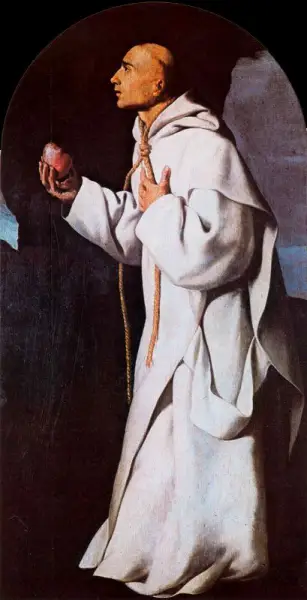
Devotion to Houghton has left visible marks in churches across England. A mosaic of him adorns the Holy Name of Jesus church on Oxford Road in Chorlton-on-Medlock, Manchester. The Spanish painter Francisco Zurbarán showed the Carthusian protomartyr holding his heart in one hand, the rope still at his neck, the image that has become the standard iconography of the saint. At St. Hugh's Charterhouse in England, the chapter house preserves a painting of the three priors' martyrdom. Stained glass windows commemorate him at St. Dominic's Priory Church in London, at the Cambridge church of Our Lady and the English Martyrs, at Belmont Abbey outside Hereford, at St. Mark's Church in Mansfield, and at Shrewsbury Cathedral, where he appears beside Thomas More in the fifth window. St John Houghton Catholic Voluntary Academy bears his name, keeping his memory alive in Catholic education. Among the Carthusian Martyrs and the Forty Martyrs of England and Wales, he remains the emblem of the order's fidelity under persecution. Taken together, these memorials show how deeply the image of the prior who died first entered the imagination of English Catholics, for whom he became the very face of fidelity under the Tudor persecution.
§ Legacy
Timeline
- 1487
Born in Essex, England, around this year.
§ Early life
- 1516
Entered the London Charterhouse as a Carthusian monk.
§ Monastic life
- 1523
Appointed sacristan of the London Charterhouse.
§ Monastic life
- 1528
Named procurator, the monastery's business manager.
§ Monastic life
- 1531
Became prior of the Charterhouse of Beavale in Nottinghamshire.
§ Monastic life
- Nov 1531
Elected prior of the London Charterhouse and returned there.
§ Monastic life
- 1532
Appointed Provincial Visitor over the English Carthusians.
§ Monastic life
- Apr 1534
Questioned by royal agents over the oath under the Act of Succession; arrested with Humphrey Middlemore and taken to the Tower of London.
§ Monastic life
- May 1534
Released after accepting the oath with the clause 'as far as the law of Christ allows'; the whole community then took the oath.
§ Monastic life
- Apr 1535
Arrested with priors Robert Lawrence and Augustine Webster for refusing the oath of supremacy; condemned to death by a special commission.
§ Arrest and execution
- 4 May 1535
Hanged, drawn, and quartered at Tyburn with two Carthusian priors, Richard Reynolds, and John Haile.
§ Arrest and execution
- 29 Dec 1886
Beatified by Pope Leo XIII.
§ Legacy
- 25 Oct 1970
Enrolled among the saints by Pope Paul VI with the company of forty martyrs of England and Wales.
§ Legacy
In Their Own Words
O Jesus, what wouldst thou do with my heart?
The Record
- Major works
- Prior of the London Charterhouse·Provincial Visitor of the English Carthusians
- Patron of
- Carthusian Martyrs·Forty Martyrs of England and Wales
- Symbols
- Carthusian habit·noose in neck·heart in hand·knife·book·martyr's palm
- Canonization
- Beatified by Pope Leo XIII on 29 December 1886; canonized by Pope Paul VI on 25 October 1970.
Prayer
Bibliography
Show 7 sources
- Hendriks, Lawrence. The London Charterhouse. London, Kegan Paul, Trench & Co., 1889.
- Gasquet, Francis Aidan. Henry VIII and the English Monasteries. G. Bell, 1906, p. 60.
- St. John Houghton. FaithND.
- Houghton, John (HTN531J). A Cambridge Alumni Database. University of Cambridge.
- Camm, Bede (1904). Lives of the English martyrs declared blessed by Pope Leo XIII, in 1886 and 1895. London, Burns and Oates; New York, Benziger brothers.
- Wainewright, John. Blessed John Houghton. The Catholic Encyclopedia, Vol. 8. New York: Robert Appleton Company, 1910.
- Cranmer, Thomas (1833). The Remains of Thomas Cranmer, Archbishop of Canterbury. Oxford University Press.
Profile text adapted from the Wikipedia article, licensed CC BY-SA 4.0.
Pray with this saint every day
Save St. John Houghton to your favorites, read the full profile, and get feast-day reminders in the Saints app.
Get the Saints AppFree on the App Store for iPhone and iPad