
died September 7, 1186·Feast September 7
St. John II of Novgorod
First Archbishop of Novgorod
Overview
John II of Novgorod, known in Russian Orthodox hagiography as Ioann and before 1185 as Ilya, was Archbishop of Novgorod from 1165 until his death in 1186. The son of a priest, he had been the priest in charge of St. Blaise's church by the Novgorod Kremlin before his elevation; Ilya was probably the monastic name he first took, while his baptismal name has not come down to us. In 1165 Metropolitan Ioann of Kiev appointed him to the bishopric of Novgorod, and when the office was raised to archiepiscopal dignity a few months later he became the first archbishop of the city. With his brother Gavril, who succeeded him in the see, he carried out various building works about the city of Novgorod, including the consecration of the Khutyn Monastery. During the Suzdalian siege of 1169 he was remembered as the one who bore the icon of the Mother of God of the Sign into the cathedral of Holy Wisdom. In 1185 he received the Great Schema, assuming the name Ioann. He died on September 7, 1186, found burial in the cathedral of Holy Wisdom, and was enrolled among the saints at the Moscow Council of 1547.
The Complete Life
A Priest's Son in Novgorod
The man who would become the first archbishop of Novgorod was born into a clerical family, the son of a priest, in the great merchant city on the Volkhov. He himself became a priest, serving the Church of St. Blaise, which stood south of the Novgorod Kremlin. That parish church had a long and troubled history after him: it was destroyed, rebuilt in 1407, destroyed again during the Second World War, and rebuilt once more. Of his early years little else is recorded. Even his names are a matter of inference, for Ilya, the name by which he was known before 1185, was probably his first monastic name, while his baptismal name has not survived. The obscurity of his origins is itself instructive: Novgorod's episcopal office drew its holders from the city's own clergy, and the son of a priest could rise from a parish south of the Kremlin to the highest ecclesiastical dignity in the land. By the time of his elevation in 1165 he was evidently a man of proven standing in the church of Novgorod. Whatever the exact circumstances of his upbringing, the parish church of St. Blaise stood at the center of his early ministry, and its later fortunes kept the memory of its famous priest alive long after his elevation.
§ Life
Elevation to the Archiepiscopate
In 1165 Metropolitan Ioann of Kiev named Ilya bishop of Novgorod. His appointment came at a moment of change for the see: a few months after he took office, the dignity of the Novgorod church was elevated to an archbishopric, and Ilya stood as the first archbishop the city had had. The honor had a precedent only in Niphont, an earlier bishop who had borne the archiepiscopal title as a personal distinction rather than as the dignity of the office itself. From 1165 to his death in 1186 he thus governed the Novgorod church in its new rank, a church that stood at the head of the great northern republic's religious life. The chronicle sources that preserve his dates treat his twenty-one years in office as the foundation of a new era for the see, and his brother's succession after him established a family connection to the archbishopric that made the office, in his line at least, a continuous work of two brothers rather than the achievement of one man. In the political life of Novgorod the archbishop stood second to no man, and John's long tenure gave the young archiepiscopal dignity the stability and prestige it needed to endure.
§ Life
Builder and Shepherd of the City
Ilya's archiepiscopate was marked by building. Working beside his brother Gavril, called also Grigorii, he carried out various building works about Novgorod, among them the consecration of the Khutyn Monastery, which took its place among the religious houses of the region. The brothers' works left a material stamp on the city that outlasted the political order in which they were made. His pastoral leadership was tested in 1169, when a Suzdalian army laid siege to Novgorod. In the memory of the city, preserved in chronicle accounts, in the tale that grew around the event, and above all in the two great icons of the Novgorodians' battle with the Suzdalians, painted in the fifteenth and sixteenth centuries and kept today in the Novgorod Museum and the Russian Museum at Saint Petersburg, the archbishop carried from the church of the Transfiguration on Ilin Street the icon of the Mother of God of the Sign and brought it into the cathedral of Holy Wisdom while the enemy stood at the walls. The Mother of God was said to have saved the city, and John's part in the deliverance became one of the defining images of his episcopate.
§ John in literature and art
Into the Great Schema
In 1185, toward the end of his life, Ilya entered the Great Schema, the most rigorous degree of Eastern monastic profession, and took the name Ioann, the name by which Russian Orthodox hagiography has known him ever since. The step marked the archbishop as a monk in the fullest sense, one who in his final years embraced the strictest rule of prayer and ascetic discipline that the tradition provided. It is fitting that the church remembers him under his schema name rather than under the name of his active years. Medieval Novgorod likewise surrounded his figure with tales of wonder that express the spirituality attributed to him. The most famous relates how he conquered a devil and compelled it to take the shape of a horse and bear him to Jerusalem and home again within one night, there to measure out the Holy Sepulchre, a legend devised to explain the chapel in the cathedral that matched those measurements exactly. Whatever the tales add, the historical core is clear: an archbishop whose last years were given to monastic consecration and whose memory was steeped in prayer.
§ Life
Death and Burial
John died on September 7, 1186, after twenty-one years as bishop and archbishop of Novgorod. His grave was made in the cathedral of Holy Wisdom, the great church at the heart of the city's religious life, within the west gallery hard by the Predtechenskaia Porch. He had first been laid beneath the pavement of the Martirievskii Porch, where his brother and successor Gavril, archbishop from 1186 to 1193, still lies, but his remains were later moved to the spot in the west gallery where they were venerated. The succession of the see to Gavril meant that the two brothers governed the Novgorod church in unbroken sequence, and the elder brother's tomb stood near the younger's within the same cathedral. The veneration of his remains continued through the centuries, surviving even the upheavals of the modern era, so that the cathedral preserved both the memory of the first archbishop and the physical witness of his cult in its galleries and porches. The movement of his remains within the cathedral, from the porch where his brother lay to the gallery where pilgrims approached him, tells its own story of a cult that grew with the centuries.
§ Life
Sainthood and the Fate of the Relics
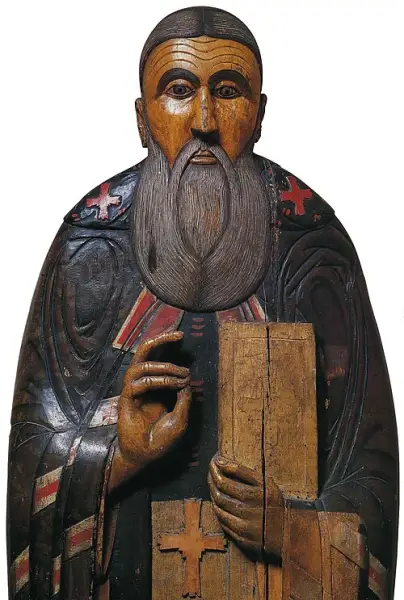
The Moscow Council of 1547, the great assembly at which the Russian church formalized the veneration of many of its native saints. His feast falls on September 7 by the Julian reckoning, corresponding to September 20 in the Gregorian, the anniversary of his death. His cult did not escape the trials of the twentieth century: on April 3, 1919, his relics were profaned amid the Soviet campaign against religion, which plundered the shrines of the Russian church as part of the assault on institutional religion. The relics nonetheless survived and are now kept in a different sarcophagus in Novgorod, covered since the 1990s by a sarcophagal effigy, the wooden figure of the saint from whose reliquary the effigy of 1559 also came. Thus the archbishop whom the Soviets dishonored has been honored again in his cathedral, and the church that elevated the see of Novgorod in 1165 still keeps the memory of its first archbishop at its heart. In his own city his name remained attached to the see he had made illustrious, and the desecration his relics suffered in 1919 was itself a backhanded tribute to the standing his memory still held.
§ Life
The Quintessential Archbishop in Tale and Art
In a whole series of medieval tales, some imagined centuries after his time, John figures as Novgorod's archbishop par excellence, almost always under the name Ioann. The most famous story tells how he conquered a devil and compelled it to take the shape of a horse and bear him to Jerusalem and home again within one night; there he measured out the Holy Sepulchre, and the tale served to explain a chapel matching those exact measurements in the Cathedral of Holy Wisdom. His monastic cell in the archiepiscopal palace was preserved and later consecrated as a church, centuries after his time, and visitors were still being shown, well into the twentieth century's early decades, the copper basin in which he was reputed to have caught the devil. In art he appears in the battle icons of Novgorodians and Suzdalians, bearing the icon of the Mother of God of the Sign to the cathedral during the siege of 1169, and in a nineteenth-century wall fresco in the Predtechenskaia Porch of the cathedral. He remains the model of the Novgorod archbishop: builder, intercessor, and monk.
§ John in literature and art
Timeline
- 1165
Named to the Novgorod bishopric by Metropolitan Ioann of Kiev, becoming its first archbishop when the see was elevated months later.
§ Life
- 1169
During the Suzdalian siege of Novgorod, bore the icon of the Mother of God of the Sign into the cathedral of Holy Wisdom.
§ John in literature and art
- 1185
Received the Great Schema, assuming the name Ioann (John).
§ Life
- 7 Sep 1186
Died at Novgorod and found burial in the cathedral of Holy Wisdom.
§ Life
- 1547
Canonized at the Moscow Council.
§ Life
- 3 Apr 1919
His relics were profaned amid the Soviet campaign against religion.
§ Life
The Record
- Major works
- Construction projects in Novgorod undertaken with his brother Gavril·Consecration of the Khutyn Monastery
- Patron of
- Archbishopric of Novgorod
- Symbols
- Icon of Our Lady of the Sign·model of the Cathedral of Holy Wisdom
- Canonization
- Canonized at the Moscow Council of 1547.
Prayer
Bibliography
Show 6 sources
- Michael C. Paul, Episcopal Election in Novgorod Russia 1156-1478. Church History: Studies in Christianity and Culture 72, No. 2 (June 2003), 259.
- Arsenii Nikolaevich Nasonov, ed. Novgorodskaia Pervaia Letopis, Starshego i Mladshego Izvodov. Moscow and Leningrad: ANSSR, 1950, 31-38, 219-.
- Valentin Lavrent'evich Ianin, Nekropol Novgorodskogo Sofiiskogo sobora: tserkovnaia traditsiia i istoricheskaia kritika. Moscow: Nauka, 1988.
- T. Iu. Tsarevskaia, St. Sofia's Cathedral in Novgorod, trans. D. G. Fedosov. Moscow: Severnyi Palomnik, 2005.
- Account of the desecration of the relics (online).
- The legend of the journey to Jerusalem (online).
Profile text adapted from the Wikipedia article, licensed CC BY-SA 4.0.
Pray with this saint every day
Save St. John II of Novgorod to your favorites, read the full profile, and get feast-day reminders in the Saints app.
Get the Saints AppFree on the App Store for iPhone and iPad