
died 2 September 595·Feast September 2
St. John IV of Constantinople
John the Faster, first Ecumenical Patriarch
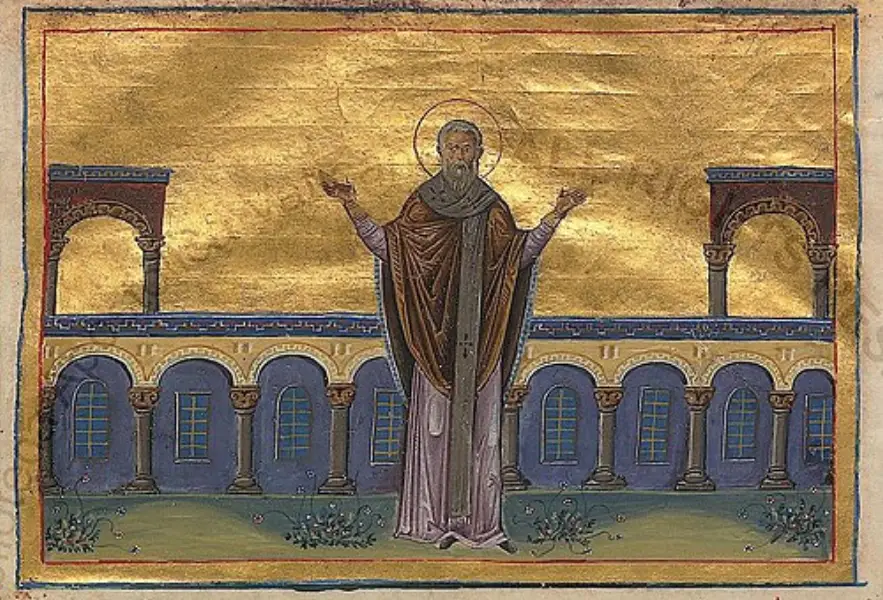
Overview
John IV of Constantinople, remembered in Greek as John Nesteutes — Ioannes the Faster — and surnamed in Latin sources the Jejunator and sometimes Cappadox, served as patriarch of Constantinople from 12 April 582 until his death on 2 September 595. Born in the capital to artisan parents, he earned his living as a goldsmith before being drawn into the service of the Great Church, where his austere personal discipline made his name proverbial. Rising from deacon of Hagia Sophia to sakellarios, the patriarchal vicar responsible for monasteries, he was chosen by Emperor Tiberius II Constantine to succeed Eutychius on the patriarchal throne. His thirteen-year tenure remains historically significant for a singular distinction: he was the first bishop of Constantinople to assume the title Ecumenical Patriarch, an act that provoked a celebrated and lasting dispute with Pope Gregory the Great. Yet his reputation in the East rested less on titular controversy than on asceticism and almsgiving, and on pastoral writings on confession and penance that shaped Orthodox practice for centuries. The Eastern Orthodox Church venerates him as a saint, keeping his memory on 2 September, the day of his falling asleep in the Lord.
The Complete Life
From Goldsmith's Bench to the Great Church
The man history calls John the Faster was born at Constantinople into a family of artisans, and his first trade was the crafting of gold. The workshop gave way to the church: under Patriarch John Scholasticus, who held the see from 565 to 577, the young goldsmith served as a deacon at Hagia Sophia, the cathedral of the imperial capital. His gifts did not go unnoticed for long. He was advanced to the office of sakellarios, an official who functioned as the patriarch's vicar for the monasteries — a post that put him in constant contact with the ascetic communities whose rigor so evidently matched his own temperament. His austere manner of life became so conspicuous that the people gave him the surname by which Greek tradition has known him ever since: the Faster, Nesteutes. When Patriarch Eutychius returned to the throne for his second tenure (577–582), John stood among the most considerable figures of the capital's clergy. It was therefore no surprise when, at Eutychius's death, Emperor Tiberius II Constantine marked him out as the next patriarch. The craftsman's son had become the first bishop of a Christian empire.
§ Life
Enthroned by Imperial Choice
John IV's elevation to the patriarchate on 12 April 582 was the act of Emperor Tiberius II Constantine, and the new patriarch remained a favored figure at court under Tiberius's successor Maurice, who reigned from 582 to 602. But the office never softened the ascetic. Contemporaries testify that he retained throughout his patriarchate the two reputations that had marked him as a deacon: an unbroken discipline of fasting, and a lavish charity toward the poor of the capital. One story from his patriarchate captures the force of his personality. A horse show had been scheduled in the Hippodrome on the eve of the Feast of Pentecost, and the patriarch judged such entertainment unfitting for his flock on so great a vigil. Rather than issue orders, he turned to prayer. According to the account, a fearsome thunderstorm broke over the city, driving rain and hailstones upon the crowds until the spectacle dissolved in panic and the spectators scattered, grasping at last how ill-suited such amusements were to the day. Whatever one makes of the tale, it preserves the memory of a bishop who believed the city's soul was his charge, and who carried his people's recreation to God in prayer when persuasion would not serve.
§ Life
The Title That Shook Rome
In 587 or 588 John convened the bishops of the East, styling himself in the convocation Ecumenical Patriarch, to hear certain charges brought against Gregory, the Patriarch of Antioch. Gregory was acquitted and returned to his see, but a report of the proceedings traveled to Rome, where Pope Pelagius II solemnly annulled the acts of the gathering. The title itself was the deeper offense, and it outlived the quarrel's first round. When Gregory the Great succeeded Pelagius in 590, relations began on a friendly footing, for the new pope had come to know John during his own years as papal legate at Constantinople. Goodwill did not survive the title. In 593 Gregory severely rebuked the patriarch for allowing Anastasius, an Isaurian presbyter accused of heresy, to be flogged with ropes within the church of Constantinople — a scandal of both discipline and sanctuary. By 595 the controversy over the title raged again: Gregory ordered his legate Sabinianus to break off communion with the patriarch, and in the affair of a presbyter called Athanasius, condemned as in part a Manichaean, the pope argued that the patriarch's carelessness had confused the Nestorian council of Ephesus with the Orthodox one. John held his ground; the title remained.
§ Life
The Discipline of Penance
John's enduring spiritual influence rests on the body of pastoral writing transmitted under his name, much of it concerned with the practice of confession. His Penitential — the Libellus Poenitentialis, described in Leo Allatius's work as the Praxis Graecis Praescripta in Confessione Peragenda — together with his Instructio on how penitents should confess fully and devoutly, and how priests should receive confessions, impose penance, and grant reconciliation, shaped the machinery of Byzantine penitential discipline for generations; the Orthodox of the Middle Ages attributed both works to the patriarch without hesitation. Two homilies circulate in the tradition as well, one on penitence, continence, and virginity — so often bound up with the works of John Chrysostom that scholars took centuries to disentangle it — and another on false prophets and false doctrine, which Vossius, Petavius, and Cave assigned to John. A set of Precepts to a Monk survives in a Paris manuscript. Isidore of Seville, writing in the seventh century, knew John only through a letter on baptism addressed to St. Leander, in which, as Isidore reports, he propounded nothing of his own but simply repeated the teaching of the ancient Fathers on trine immersion. That deference to received wisdom was the mark of his whole spiritual temperament.
§ Works
Controversy and a Quiet Death
The last years of John's patriarchate were consumed by the dispute with Rome. The conflict over the Ecumenical Patriarch title, dormant since the affair of the Antiochene council, broke out afresh in 595, and Pope Gregory the Great took the extraordinary step of instructing his legate Sabinianus to break off communion with the patriarch altogether. In the same season the two prelates clashed once more over a priest called Athanasius, condemned in part on a Manichaean accusation: Gregory contended that the accuser was himself tainted with Pelagianism, and that through the carelessness, ignorance, or fault of John's church, the records of the Nestorian council of Ephesus had been mistaken for those of the Orthodox council. These were sharp blows, exchanged across a distance of a thousand miles between two men who in other circumstances might have been allies against the empire's real adversaries. John did not live to see the quarrel resolved. He died at Constantinople on 2 September 595, after thirteen years in office, and was buried amid the honors of his see. The patriarchal throne passed to Cyriacus II, who inherited along with it the unresolved dispute over the title John had dared to assume.
§ Life
The Faster Who Named the See
Whatever judgment history renders on the title Ecumenical Patriarch — and Pope Gregory the Great's protest against it is still cited today — there is no disputing that John IV was the first bishop of Constantinople to assume it, fixing the style by which his successors have been known for fourteen centuries. In the Orthodox East, however, he is remembered less as a protagonist of jurisdictional rivalry than as an ascetic and a pastor. His fasting was legendary in his own lifetime, and the epithet the Faster attached itself to his name so firmly that Greek tradition has rarely spoken of him otherwise. His penitential writings made him, in effect, one of the architects of Byzantine sacramental practice: the manual of confession and the instructions for priests who receive penitents flowed into the mainstream of Orthodox pastoral theology, and medieval Orthodox writers received them as the patriarch's own work without reservation. The Orthodox Church numbered him among its saints from an early date, and keeps his memory on 2 September, the anniversary of his death. Synaxarion and icon alike present him as John the Faster, Patriarch of Constantinople — the goldsmith's son who governed the imperial church and taught it the arithmetic of tears.
§ Life
Timeline
- 12 Apr 582
Enthroned as patriarch of Constantinople, chosen by Emperor Tiberius II Constantine to succeed Eutychius.
§ Life
- 588
Summoned the bishops of the East in 587 or 588, in the name of the title Ecumenical Patriarch, to examine charges against Gregory, Patriarch of Antioch, who was ultimately acquitted.
§ Life
- 590
Pope Gregory I succeeded Pelagius II at Rome, opening a relationship that began cordially, for the pope had known John during his service as legate at Constantinople.
§ Life
- 593
Incurred the severe reproach of Pope Gregory I for letting Anastasius — an Isaurian priest suspected of heresy — be flogged with ropes within Constantinople's church.
§ Life
- 595
The dispute over the Ecumenical Patriarch title flared anew; Gregory the Great forbade his legate Sabinianus to hold communion with John.
§ Life
- 2 Sep 595
Died at Constantinople after thirteen years on the patriarchal throne; the Orthodox Church keeps his feast on this day.
§ Life
The Record
- Major works
- Libellus Poenitentialis (Penitential), also known as Praxis Graecis Praescripta in Confessione Peragenda·Instructio, a guide to the right conduct of confession for penitent and priest alike·Homily on penitence, continence, and virginity (long misprinted among the works of John Chrysostom)·Homily on False Prophets and False Doctrine·Precepts to a Monk (preserved in a Paris manuscript)·A letter on baptism and trine immersion addressed to St. Leander (no longer extant)
- Canonization
- Pre-congregation; venerated as a saint by the Eastern Orthodox Church, which keeps his feast on 2 September
Prayer
Bibliography
Show 11 sources
- Adrian Fortescue, "John the Faster", Catholic Encyclopedia, Vol. 8, New York: Robert Appleton Company, 1910
- "St John the Faster the Patriarch of Constantinople", Orthodox Church in America
- Wace, Henry; Piercy, William C., eds. (1911). "Joannes, the Faster, bishop of Constantinople", Dictionary of Christian Biography and Literature to the End of the Sixth Century, 3rd ed., London: John Murray
- Jacques Paul Migne, Patrologia Graeca, lxxxviii, 1089 (Penitential, Instructions for Confession, Homily on Penitence)
- Caesar Baronius, ad. ann. 588–593
- Acta Sanctorum (Bollandist), 1 August, p. 69
- Fleury, ii, bk. xxxiv, c. 44
- Rémy Ceillier, xi, 427
- Johann Albert Fabricius, Bibl. Graec., xi, 108; xii, 239
- Dokos, G., Exomologetarion – A Manual of Confessions by our Righteous God-bearing Father Nikodemos the Hagiorite, Thessalonica: Uncut Mountain Press, 2006
- Agapius and Nicodemus, The Rudder (Pedalion) – All the Sacred and Divine Canons, Chicago: The Orthodox Christian Educational Society, 1957
Profile text adapted from the Wikipedia article, licensed CC BY-SA 4.0.
Pray with this saint every day
Save St. John IV of Constantinople to your favorites, read the full profile, and get feast-day reminders in the Saints app.
Get the Saints AppFree on the App Store for iPhone and iPad