
c. 1530 – 1598·Feast July 12
St. John Jones
Welsh Franciscan friar and martyr of England
Overview
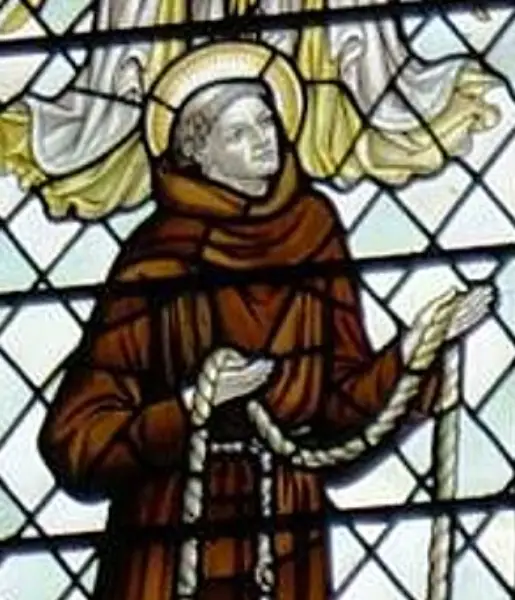
John Jones, a Franciscan priest put to death at Southwark on 12 July 1598, is one of the Forty Martyrs of England and Wales. Born around 1530 at Clynnog Fawr in Caernarfonshire, into a Welsh family that had kept the Catholic faith through the Reformation, he was ordained a diocesan priest and repeatedly imprisoned for the exercise of his ministry: in the Marshalsea from 1582 under the alias Robert Buckley, and later at Wisbech Castle. Leaving England in 1590, he joined the Conventual Franciscans at Pontoise at the age of sixty, taking the religious name Godfrey Maurice, and afterward lived among the Observant Friars at Rome's Ara Coeli before his superiors sent him back to the perilous English mission. He reached London at the end of 1592 and ministered to Catholics across the countryside until the priest-catcher Richard Topcliffe had him arrested in 1596. Tortured, scourged, and held for nearly two years, he was tried on 3 July 1598, convicted of high treason for his priesthood, and executed by hanging, drawing, and quartering at St. Thomas's Watering. Named Venerable by Pope Leo XIII, he was beatified in 1929 and canonized in 1970 by Pope Paul VI.
The Complete Life
A Recusant Household in Caernarfonshire
John Jones was born around 1530 at Clynnog Fawr in Caernarfonshire, in what is now Gwynedd, Wales, into a recusant family — one of those Welsh households that refused to abandon the old faith as the Protestant Reformation swept the religious institutions of the realm. What such fidelity cost a family in Elizabethan Wales is not hard to imagine: recusancy meant fines, suspicion, and exclusion, and for a young man of Catholic conviction the path to any public life was barred. The path to the priesthood, for one determined, ran abroad. Jones was ordained a diocesan priest, and from that moment his life became a cat-and-mouse contest with the Elizabethan state, which had made the celebration of Catholic rites an act of danger. The first arrest came in 1582, when he was committed to the Marshalsea prison under the name Robert Buckley — one of the several identities under which he appears in the records, including John Buckley, John Griffith, and Griffith Jones. His offense was the plainest possible: administering the sacraments to English Catholics who hungered for them. He remained in the Marshalsea until about 1585, passed a period out on bond by the summer of 1586, and was confined again in 1587, this time at Wisbech Castle, one of the principal prisons for Catholic clergy in England.
§ Life
A Friar at Sixty
In 1590, whether by escape or by exile, Jones got out of England — and then did something remarkable for a man of his years. At sixty he entered the Conventual Franciscans at Pontoise, receiving the religious name Godfrey Maurice. The Franciscan habit was no retirement. After a time among the friars at Pontoise he traveled to Rome and lived among the Observant Friars of the Ara Coeli, and there his superiors discerned that the Church's greatest need of him lay back across the Channel. He was to be sent on the English mission, into a country where the mere fact of his priesthood — conferred abroad by Roman authority — constituted treason under the statutes of Elizabeth I. Before he departed, he was received in audience by Pope Clement VIII, who embraced the aging friar and gave him his blessing for the work ahead. It was the blessing of a man who understood precisely what he was bestowing: other priests sent on that mission had already gone to the scaffold. Jones crossed to the continent having already spent three decades in peril for the sacraments; he now returned to that peril as a Franciscan, with the fullness of religious profession behind him and the city of his death already waiting.
§ Life
The English Mission and the Spy's Report
Jones reached London near the end of 1592 and lodged for a time at a house that the Jesuit John Gerard had provided for the shelter of missionary priests, managed by the future martyr Anne Line. From that foothold he ranged out to minister to Catholics across the English countryside, keeping the old faith alive in farmhouses and private rooms for some four years. The end came through the priest-catcher Richard Topcliffe, the government's most notorious hunter of Catholics, who received a spy's word that Jones had visited two Catholics and celebrated Mass in their home. The charge was in fact hollow — it was later shown that the two alleged hosts were in prison at the very time the offense supposedly took place — but hollow charges did not protect Catholic priests in Elizabethan England. Jones was seized, harshly tortured, and flogged; Topcliffe then had him brought to his own house for further examination, where the interrogator enjoyed a grim distinction noted by the historian Evelyn Waugh: the legal privilege of keeping a private rack at home. Through the ordeal Jones's constancy held. What the torture could not extract, the prisons could not wear down, and for nearly two years he remained a captive — and remained a priest, sustaining the young Catholic John Rigby in his faith, a man who would himself later die for the faith and join the Forty Martyrs.
§ Life
Trial, Scaffold, and Relics
On 3 July 1598 Jones was brought to trial on the statute charge of leaving England in the first year of the Queen's reign, receiving priestly orders by Roman authority abroad, and coming back against the law. The verdict was a foregone conclusion: conviction for high treason, with the sentence of hanging, drawing, and quartering. So weary had the London public grown of the spectacle of butchery that the execution was scheduled for an early hour of the morning on 12 July, at St. Thomas's Watering — a modest bridge spanning the Neckinger at the point where the Old Kent Road joined the Roman road, at the boundary of the City's authority, a site long used for gibbets. Even then, providence delayed the kill: the hangman had forgotten his rope, and the execution stalled for roughly an hour. Jones spent the interval preaching to the people and answering their questions, and when the cart was finally drawn away the hangman whipped the horses on — yet bystanders held the team back until the friar had said his last word. His dismembered remains were set on poles on the roads toward Newington and Lambeth, but Catholics recovered them, at the cost of a long imprisonment for at least one of the men involved, and one relic eventually reached Pontoise, where he had made his vows.
§ Execution
From Venerable to the Altar
The Church's process of recognition moved across three centuries. Pope Leo XIII first declared John Jones Venerable, the formal acknowledgment of a life — and death — of heroic virtue. The beatification followed on 15 December 1929, when Pope Pius XI raised him to the honors of the blessed and assigned his feast to 12 July, the anniversary of his execution. The completion came on 25 October 1970, when Pope Paul VI canonized him among the Forty Martyrs of England and Wales, the group canonization that gathered men and women put to death under the Tudor and Stuart persecutions — clergy and laity alike — into a single company of saints, commemorated each year on that date. His cause thus spans the whole arc of modern Catholic renewal: named in the nineteenth century, beatified between the wars, and canonized in the aftermath of the Second Vatican Council, when the Church sought to present to the modern world witnesses whose fidelity had been tested to the shedding of blood. His memory is kept on 12 July, and with the Forty Martyrs on 25 October, and his cult is attached to Pontoise, the French house where the Welsh friar took the habit so late in life.
§ Veneration
Memory in England, Wales, and Pontoise
John Jones belongs to that company of Elizabethan martyrs whose deaths, intended to extinguish Catholicism in England, instead furnished it with its most durable witnesses. His story binds together the remnant Catholic world of post-Reformation Wales, the prison network of Marshalsea and Wisbech, the exiled religious houses of France and Rome, and the missionary underground of London and the countryside — the whole geography of survival by which English Catholicism outlasted the persecution. He is honored in art with the rope, the Franciscan habit, and the martyr's palm, emblems of the manner of his death and the order he embraced at sixty. His relics, rescued from the poles by the roadside, found their way at length to Pontoise, closing a circle that began when he crossed the Channel to take the Franciscan habit there. Among the Forty Martyrs of England and Wales he stands as one of the few friars, and one of the oldest at the time of death, dying at roughly sixty-eight after a lifetime of imprisonments. For Welsh Catholics he is a native son of Clynnog Fawr; for Franciscans, a brother whose vocation ripened rather than faded with age; and for the Church at large, proof that fidelity has no retirement age.
§ Veneration
Timeline
- 1582
Imprisoned in the Marshalsea under the alias Robert Buckley for administering the sacraments; held until about 1585.
§ Life
- 1587
Confined at Wisbech Castle after a period out on bond.
§ Life
- 1590
Left England, by escape or exile, and became a Conventual Franciscan at sixty, entering the friars at Pontoise.
§ Life
- 1592
Arrived in London at about the end of the year to begin his mission, lodging at a house managed by Anne Line.
§ Life
- 12 Dec 1595
His injured leg was healed by his fellow prisoner Jane Wiseman.
§ Life
- 1596
Arrested after the priest-catcher Richard Topcliffe received a spy's report; severely tortured and scourged, then held for nearly two years.
§ Life
- 3 Jul 1598
Tried and convicted of high treason for being made a priest abroad and returning to England; sentenced to be hanged, drawn, and quartered.
§ Life
- 12 Jul 1598
Executed at an early morning ceremony at St. Thomas's Watering on the Old Kent Road, preaching to the crowd from the scaffold as he waited.
§ Execution
- 15 Dec 1929
Beatified by Pope Pius XI, with a feast day assigned on 12 July.
§ Veneration
- 25 Oct 1970
Raised to the altars by Paul VI among the Forty Martyrs of England and Wales.
§ Veneration
In Their Own Words
To him (Topcliffe) was granted the privilege, unique in the laws of England, or, perhaps, of any country, of maintaining a private rack in his own home for the more convenient examination of prisoners.
The Record
- Symbols
- rope·Franciscan habit·martyr's palm
- Canonization
- Canonized 25 October 1970 by Pope Paul VI as one of the Forty Martyrs of England and Wales; beatified 15 December 1929 by Pope Pius XI
Prayer
Bibliography
Show 9 sources
- Hope, Anne (1878). Franciscan Martyrs in England. Oxford University
- "John Jones", The Rambler, 1859
- "Saints John Jones and John Wall", Franciscan Media, archived from the original on 23 April 2019
- Brown, C. F. Wemyss. "Venerable John Buckley." The Catholic Encyclopedia, Vol. 8. New York: Robert Appleton Company, 1910
- Waugh, Evelyn, Edmund Campion, Longmans, Green and Co., 1935, p. 110
- Walker, Claire (2004). "Wiseman [née Vaughan], Jane (d. 1610), recusant and priest harbourer", Oxford Dictionary of National Biography (online ed.), Oxford University Press. doi:10.1093/ref:odnb/69040
- Pollen, John Hungerford. "Venerable John Slade and Venerable John Bodey", Acts of English Martyrs Hitherto Unpublished, Burns and Oates, 1891, p. 57
- Dillon, Anne (2017). The Construction of Martyrdom in the English Catholic Community, 1535–1603. Routledge. ISBN 9781351892391
- Butler, Alban. Butler's Lives of the Saints, revised ed., Collegeville: Burns & Oats, 2000, p. 89
Profile text adapted from the Wikipedia article, licensed CC BY-SA 4.0.
Pray with this saint every day
Save St. John Jones to your favorites, read the full profile, and get feast-day reminders in the Saints app.
Get the Saints AppFree on the App Store for iPhone and iPad