
1654 – 1739·Feast March 5
St. John Joseph of the Cross
Alcantarine Franciscan of Ischia and wonderworker
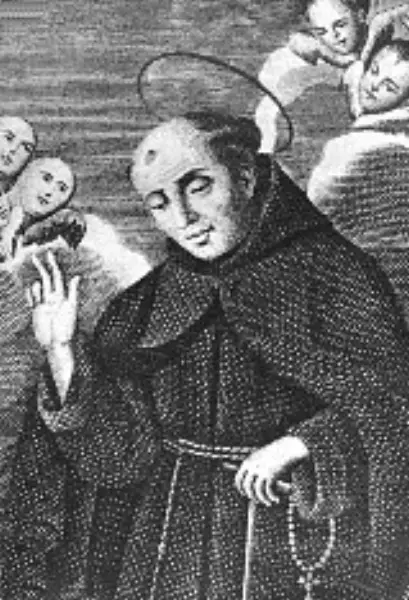
Overview
John Joseph of the Cross, born Carlo Gaetano Calosirto on 15 August 1654, was an Italian priest of the Order of Friars Minor who came from the island of Ischia in the Bay of Naples. Entering the Franciscans in Naples before his sixteenth birthday, he took the religious name by which he is venerated and became the first Italian to embrace the reform movement of St. Peter of Alcantara, the most austere branch of the Franciscan family. In 1674 he was dispatched to raise a convent at Afila, in Piedmont, lending his hands to the building work, and was ordained a priest, a dignity he accepted reluctantly. When the Italian Alcantarine houses were formed into a province independent of the Spanish ones in 1702, he was named Vicar Provincial for the whole peninsula. His leadership was marked by radical humility: he performed the lowliest tasks in his convents, forbade that any beggar be turned from the gate empty-handed, and traveled the country incognito to avoid the honors paid to his office. Renowned for austerity and credited with the gift of miracles and numerous prophecies, he labored to hide both, dying on his native Ischia on 5 March 1739. He was beatified in 1789 and canonized in 1839.
The Complete Life
A Boy of Ischia
Carlo Gaetano Calosirto came into the world on 15 August 1654 on Ischia, the volcanic island rising out of the bay west of Naples. He grew up in the Kingdom of Naples at a moment when the great currents of Catholic reform — the disciplined spiritualities of the sixteenth century and their heirs — were still reshaping religious life, and one current in particular would claim him early. The reform of St. Peter of Alcantara, the Spanish Franciscan whose followers embraced poverty, smallness, and bodily austerity in their most literal form, had till then drawn its Italian followers from elsewhere; the boy from Ischia would become the first Italian to follow the Alcantarine way. Before he had turned sixteen, Carlo Gaetano left home for Naples and entered the Order of Friars Minor, putting on the habit and taking the name by which centuries of the faithful would know him: John Joseph of the Cross. The name was a program in itself, binding the discipline of the cross to the sweetness of the patriarch Joseph. In the friary his gifts for direction and government soon showed themselves, and in time he would serve as novice master, forming the next generation of friars in the severe and joyful school of Alcantarine poverty.
§ Life
Builder of the Alcantarine House
In 1674, still a young friar, John Joseph was sent to Afila in Piedmont to establish a convent for the reform — a foundation in the alpine north for a branch of the order whose Italian presence he himself represented. The sources preserve the telling detail that he assisted in the actual construction of the house, hauling and building alongside the workmen, so that the walls of the first Alcantarine convent of his foundation literally passed through his hands. Then came the priesthood, and he resisted it: he was ordained to the order's ministry, the record notes, much against his own will, so little did he aspire to ecclesiastical rank. Once ordained, he set the tone of his whole life of office. As a superior he performed the lowliest tasks of the house, doing by choice what others assigned to servants. This paradox — a man entrusted with authority who made himself the servant of servants — became the signature of his leadership. When the Alcantarine houses of Italy were detached from their Spanish mother-houses and erected into a separate province in 1702, John Joseph was the natural choice to govern it, and he was appointed Vicar Provincial of the reform for the entire Italian peninsula.
§ Life
Provincial Without a Title
As Vicar Provincial, John Joseph traveled the Italian peninsula visiting the houses of the reform, and he made those journeys a sustained exercise in self-erasure. At the inns where he lodged along the way he declined to make himself known, for he disliked distinction of any kind and did not believe such honors should be paid to him; the provincial of a religious province passed the night as just another traveler. At home his government was summed up in a single standing order: not a single beggar might leave the convent gate empty-handed. In times of real want he carried the principle to heroic lengths, giving to the poor at the door the food allotted to himself and even the provisions of his convent. The Alcantarine reform asked everything of its members — bare cells, coarse habits, unbroken fasting — and John Joseph asked it of himself before he asked it of anyone else. The province he governed learned its spirituality less from his directives than from his example: a Franciscan authority exercised from the bottom of the house, where the poor stood waiting and the superior knelt among them.
§ Life
Hiding the Gifts
John Joseph's reputation for austerity was matched on all sides by reports of the supernatural, and his handling of both is the key to his interior life. He was widely credited with the gift of miracles and with numerous prophecies, yet he labored systematically to conceal them. Those whom he restored to health he required to take some ordinary medicine, so that the recovery might be attributed to a natural cause rather than to any power of his. His prophecies he dressed in disguise as well: when his predictions proved true, he affected to have judged them from analogies and past experience, the ordinary deductions of a shrewd observer, rather than from any illumination. This calculated modesty was not coyness but doctrine. It expressed the Alcantarine conviction that every gift is God's, that the creature who serves as its channel deserves nothing, and that the appetite for spiritual reputation corrupts more surely than the appetite for wealth. In the friary he practiced what he preached of others' souls as novice master and superior, forming young friars in a piety of silence, penance, and hiddenness. The people of Naples and Ischia saw through the disguise anyway; sanctity, however carefully veiled, made itself known, and crowds found their way to the friar who claimed to be no one.
§ Life
Raised to the Altars
John Joseph of the Cross died on Ischia on 5 March 1739, and the Church moved — by the standards of the age, quickly — to recognize him. He was beatified on 24 May 1789 by Pope Pius VI, in a ceremony at Saint Peter's Basilica in the Papal States, half a century after his death; the intervening decades had allowed the memory of his miracles, his prophecies, and his hidden life to mature into a solid and widespread cult. Canonization followed on 26 May 1839 under Pope Gregory XVI, again at Saint Peter's, when the friar of Ischia was enrolled among the saints of the Catholic Church. The intervals between his death and each elevation measure, in their way, the endurance of his fame: he was beatified a full fifty years after his death, canonized a full century after it, in every generation of which devotion to the humble Alcantarine had continued to grow rather than fade. His feast is kept on 5 March, the day of his blessed death, and he is invoked as the special patron of Ischia, the island that gave him to the Church.
§ Sainthood
Patron of an Island
The legacy of John Joseph of the Cross lives most concretely on the island of his birth. At the Aragonese Castle, the ancient fortress that stands on its volcanic islet off Ischia, a small chapel is consecrated to the friar, a place of prayer and pilgrimage for islanders who claim him as their own and honor him as their patron. In the wider Franciscan family he is remembered as the first Italian to embrace the Alcantarine reform, the man who transplanted Peter of Alcantara's rigorous Spanish spirituality onto Italian soil and governed its growth as the first Vicar Provincial of the Italian province. His manner of holiness — severity toward himself, tenderness toward the poor at the gate, and a resolute refusal of every honor — remains the substance of his cult. He belongs to the long line of Franciscan saints who made the order's poverty credible by living it to the point of eccentricity: the provincial who slept unannounced in inns, the wonderworker who prescribed medicine to cover his miracles. On 5 March each year his feast gathers the memory of all of this into a single day, on an island that has never forgotten the boy from Ischia who came home a saint.
§ Sainthood
Timeline
- 15 Aug 1654
Born on Ischia, in the Bay of Naples, and named Carlo Gaetano Calosirto.
§ Life
- 1674
Sent to found a convent for the reform at Afila in Piedmont, where he assisted in the construction work with his own hands.
§ Life
- 1702
When the Italian convents were formed into a province separate from the Spanish houses, he was appointed Vicar Provincial of the Alcantarine Reform in the Italian peninsula.
§ Life
- 5 Mar 1739
Died on his native island of Ischia, after decades of Franciscan ministry and leadership.
§ Life
- 24 May 1789
Beatified by Pope Pius VI at Saint Peter's Basilica.
§ Sainthood
- 26 May 1839
Canonized by Pope Gregory XVI at Saint Peter's Basilica.
§ Sainthood
The Record
- Major works
- Convent of the Alcantarine Reform at Afila in Piedmont (founded 1674)
- Patron of
- Ischia
- Symbols
- Franciscan habit
- Canonization
- Canonized 26 May 1839 by Pope Gregory XVI at Saint Peter's Basilica; beatified 24 May 1789 by Pope Pius VI
Prayer
Bibliography
Show 3 sources
- Hess, Lawrence. "St. John Joseph of the Cross." The Catholic Encyclopedia, Vol. 8. New York: Robert Appleton Company, 1910
- Foley, O.F.M., Leonard. Saint of the Day: Lives, Lessons, and Feast, revised by Pat McCloskey, O.F.M., Franciscan Media. ISBN 978-0-86716-887-7
- Butler, Alban. The Lives or the Fathers, Martyrs and Other Principal Saints, Vol. I, D. & J. Sadlier & Company, 1864
Profile text adapted from the Wikipedia article, licensed CC BY-SA 4.0.
Pray with this saint every day
Save St. John Joseph of the Cross to your favorites, read the full profile, and get feast-day reminders in the Saints app.
Get the Saints AppFree on the App Store for iPhone and iPad