
1871 – 1917·Feast October 31
St. John Kochurov
Missionary priest of Chicago and hieromartyr
Overview
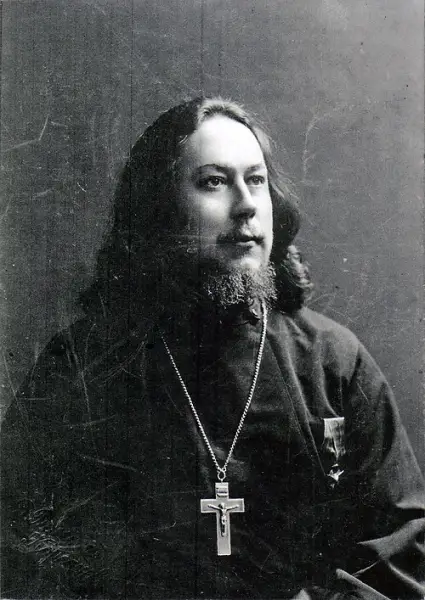
John Kochurov, born Ivan Alexandrovich Kochurov on 13 June 1871 in Ryazan Governorate to a priest's family, stands at the crossroads of two churches' histories: a builder of Orthodoxy in America and the first hieromartyr of the Bolshevik persecution in Russia. Educated at the Ryazan Theological Seminary and the St. Petersburg Theological Academy, he was ordained in 1895 and answered the call to missionary work in the United States, where he became the first permanent priest of St. Vladimir's Church in Chicago — later Holy Trinity Cathedral, a landmark designed by architect Louis Sullivan and funded in part by Tsar Nicholas II. Across a dozen years in the American Midwest he planted parishes, founded a mutual aid society for immigrants with Alexis Toth, translated services into English, and helped organize the first All-American Council. Returning to Russia in 1907, he taught catechism in Estonia before his 1916 transfer to St. Catherine's Cathedral at Tsarskoye Selo. When the October Revolution broke over the town, he was arrested by the Bolsheviks on 31 October 1917 and shot outside the town — the first priest put to death in the revolution. The Russian Orthodox Church glorified him in December 1994 among the New Martyrs and Confessors of Russia.
The Complete Life
A Priest's Son from Ryazan
Ivan Alexandrovich Kochurov was born on 13 June 1871 at Bigil'dino Surky in Ryazan Governorate, the son of an Orthodox priest, and his whole formation ran along the track that pious Russian clergyman's sons followed. At the Ryazan Theological Seminary he proved an able student, completing the course in 1891, and he went on to the St. Petersburg Theological Academy, excelling in his studies there as well. He finished at the academy in 1895, the year that set the course of his life three times over: he married Alexandra Chernyshova, the daughter of a clergyman; he was ordained deacon and then priest, on 27 August 1895, at St. Petersburg's Alexander Nevsky Lavra, Bishop Nicholas (Ziorov) — whose diocese spanned the Aleutians and Alaska — presiding; and he expressed his desire to serve as a missionary priest in the United States. That last wish, spoken to the bishop whose diocese stretched across North America, would carry the young priest from the seminary world of imperial Russia to the immigrant parishes of the American Midwest almost immediately after his ordination.
§ Early years
Missionary to the Emigrants
Kochurov belonged to a distinct generation: the young, educated Russian priests who crossed the Atlantic in the late 1890s to minister among émigrés from Carpathian Ruthenia and Galicia. In Chicago he took charge in 1895 of St. Vladimir's Church as its first permanent priest, serving a community that as yet had no building of its own. Building became his first great project. Under Bishop Tikhon — the future Patriarch of Moscow and saint, who guided the American mission — Kochurov engaged the celebrated architect Louis Sullivan to design the church, and he raised the money with characteristic persistence, obtaining donations from Tsar Nicholas II himself and from Americans of standing, among them Harold Fowler McCormick and Charles R. Crane, the American ambassador to China. Construction began in April 1902 and finished the following year, when Bishop Tikhon consecrated the new church, which would become Holy Trinity Cathedral. The building was emblematic of the man: Orthodox in substance, American in address, and paid for by East and West together. Kochurov was present, as Tikhon's chaplain, at public occasions that bound the mission to the wider city, and his Chicago years made him one of the recognizable figures of Orthodoxy in the New World.
§ America
Planting Parishes in the Midwest
The Chicago cathedral was the center, not the limit, of Kochurov's American apostolate. He performed the first service of the community that grew into the Archangel Michael Orthodox Church in southwest Chicago, and he was active in forming parishes in Madison, Streator, and Joliet in Illinois, while also lending his aid to communities in Buffalo, New York, and Hartshorne, Oklahoma. Beyond buildings, he built institutions. Together with Alexis Toth, the great organizer of the Carpatho-Russian returns to Orthodoxy, he was a moving force behind a major Orthodox mutual-aid society built to support the throngs of recently arrived immigrants upon whose labor and loyalty the young parishes depended. And he prepared for the Church's future in its new land by translating religious texts into English, looking ahead to the day when the Orthodox Church in America would be made up of English-speaking members. He rose in the mission's leadership as well: made an archpriest on 6 May 1906, he became dean of the New York area, and before leaving America he helped organize the first All-American Council, held in 1907 at Mayfield, Pennsylvania — a foundational gathering of the Church that would one day call itself the Orthodox Church in America.
§ America
Narva, Tsarskoye Selo, and the Martyr's Road
In 1907 Kochurov returned to Russia and was assigned to Narva, now in Estonia, where he put the teaching skills honed in America to work instructing children in catechism in the schools. In 1916 came the transfer that fixed his place in history: St. Catherine's Cathedral in Tsarskoye Selo, the residence town of the imperial family just outside St. Petersburg. There he established himself as a popular priest whose sermons moved all who heard them. The revolution found him at his post. When the Bolshevik uprising seized Petrograd in October 1917, it spilled at once into Tsarskoye Selo, which came under attack by Bolshevik detachments; crowds filled the churches while the clergy held prayer services and walked processions through the town, praying for peace. On 31 October 1917 (Old Style), the Bolsheviks entered the town in force and arrested Kochurov. They marched him out of town and summarily shot him, offering as the pretext an assertion that he had begged God for Cossack victory in the fighting. The priest who had offered processions for peace became the first hieromartyr of the October Revolution, days afterward his body was laid to rest in the crypt of St. Catherine's Cathedral.
§ Russia and martyrdom
First of the New Martyrs
For three-quarters of a century the memory of the priest shot at Tsarskoye Selo was kept in the Orthodox world by whatever means persecution and silence allowed. When the Soviet order neared its end, the Russian Orthodox Church moved to honor its first victim formally. In December 1994 the Council of Bishops, meeting at St. Daniel's Monastery in Moscow, glorified John Kochurov as a saint — naming him expressly the earliest martyr of the Church's 20th-century calendar, the protocol saint of that vast company of clergy and laity who suffered under the Bolshevik revolution and the Soviet yoke. His relics were enshrined in St. Sophia Cathedral in Pushkin, the modern name of Tsarskoye Selo, in the town where he died. The Orthodox Church in America, which had received his apostolic labors a lifetime earlier, keeps his feast with equal devotion: his memory falls on 31 October, the day of his execution; he is honored too on the 12 December Synaxis that gathers the first martyrs of the American lands, and again with the New Martyrs and Confessors of Russia, whose feast follows the Sunday nearest 25 January, the date of the martyrdom of Metropolitan Vladimir of Kiev, the first bishop among the New Martyrs.
§ Russia and martyrdom
Two Homelands of Memory
John Kochurov is honored on two continents, and the two honors illuminate one another. In the United States he is remembered as a missionary and an inspired preacher — the man who gave Orthodoxy in Chicago its first permanent priest, its most beautiful early cathedral, and a network of parishes across Illinois and beyond, and who had the foresight to translate the faith into the language of the country's future. In Russia he is remembered as the protomartyr of the revolution's assault on the Church, the priest killed within days of the Bolshevik seizure of power, whose death foretold the persecution that would claim thousands. The liturgical texts of his veneration hold both memories together: the troparion acclaims him as one burning with love of God who yielded his life, Christ's martyr and his neighbor's servant, and the kontakion praises the zealous fulfillment of his pastoral service, the soul brought to God as a well-pleasing sacrifice. For the Orthodox Church in America he is among the first martyrs of the American lands; for the Russian Church, the first of the New Martyrs. Few saints of the modern era so completely embody the unity of the two churches' histories.
§ Russia and martyrdom
Timeline
- 13 Jun 1871
Born in Ryazan Governorate into the family of a priest.
§ Early years
- 1891
Graduated from the Ryazan Theological Seminary before continuing to the St. Petersburg Theological Academy.
§ Early years
- 27 Aug 1895
Ordained a priest at St. Petersburg's Alexander Nevsky Lavra by Bishop Nicholas (Ziorov), whose see covered the Aleutians and Alaska, and soon took up the post of first permanent priest at St. Vladimir's Church in Chicago.
§ Early years
- Apr 1902
Oversaw the start of construction of the new Chicago church, designed by Louis Sullivan and funded by donations from Tsar Nicholas II and American benefactors; it was completed the following year and consecrated by Bishop Tikhon.
§ America
- 1903
Awarded the Order of Saint Anna of the Third Degree.
§ Honours
- 6 May 1906
Elevated to archpriest and made dean of the New York area.
§ America
- 1907
Returned to Russia to serve in Narva, in present-day Estonia, after helping organize the first All-American Council held that year in Mayfield, Pennsylvania.
§ Russia and martyrdom
- 1916
Transferred to St. Catherine's Cathedral in Tsarskoye Selo, the royal residence town just outside St. Petersburg, where he became known for moving sermons.
§ Russia and martyrdom
- 31 Oct 1917
Arrested by the Bolsheviks as they entered Tsarskoye Selo, taken out of town, and shot — reportedly on the charge of having prayed for the Cossacks — becoming the first hieromartyr of the October Revolution.
§ Russia and martyrdom
- Dec 1994
Glorified by the Russian Church's Council of Bishops, sitting at Moscow's St. Daniel's Monastery, as the first among the 20th century's new martyrs.
§ Russia and martyrdom
In Their Own Words
Aflame with love for God, You gave your life as a martyr for Christ and neighbor; O Hieromartyr, John, Entreat the Most Merciful God To preserve the Holy Church in peace and save our souls.
The Record
- Major works
- Holy Trinity Cathedral, Chicago (begun 1902, consecrated by Bishop Tikhon)·Translations of Orthodox religious texts into English·A major Orthodox mutual aid society for immigrants, established with Alexis Toth
- Patron of
- Tsarskoye Selo
- Canonization
- Glorified December 1994 by the Council of Bishops of the Russian Orthodox Church at St. Daniel's Monastery, Moscow, as the first of the new martyrs of the 20th century
Prayer
Bibliography
Show 7 sources
- "St. John Kochurov", Orthodox Church in America, retrieved December 16, 2025
- "Priestmartyr John Kochurov", Orthodox Church in America, retrieved December 16, 2025
- Erickson, John H. (2010). Orthodox Christians in America: A Short History. Oxford University Press, p. 78. ISBN 978-0-19-995132-1
- Namee, Matthew (2 November 2010). "St John comes to Chicago, 1895", Orthodox History
- Commission on Chicago Historical and Architectural Landmarks (1980). Chicago Landmarks, 1980: Documenting the Landmarks of Our City as Designated by the City Council of Chicago, p. 5. ISBN 978-0-934076-01-2
- "St. John Kochurov", Ortho Christian, retrieved December 16, 2025
- "St. John Kochurov", Church of Our Lady of Kazan, retrieved December 16, 2025
Profile text adapted from the Wikipedia article, licensed CC BY-SA 4.0.
Pray with this saint every day
Save St. John Kochurov to your favorites, read the full profile, and get feast-day reminders in the Saints app.
Get the Saints AppFree on the App Store for iPhone and iPad