
c. 1270 – before 1341·Feast October 1
St. John Koukouzeles
Reformer of Byzantine chant and angel-voiced monk
Overview
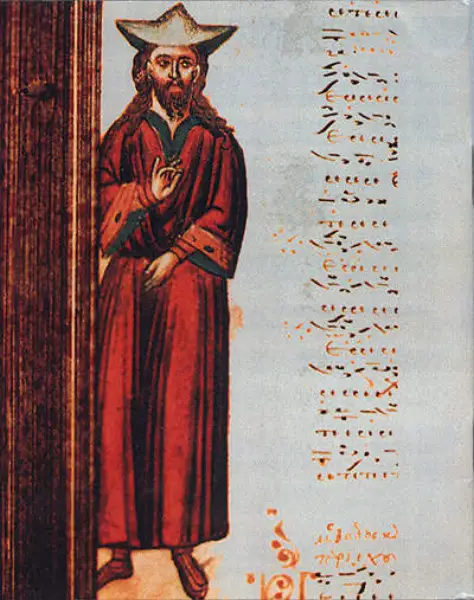
John Koukouzeles Papadopoulos — Byzantine composer, cantor, and reformer of chant — counts among the most illustrious musicians of the Palaiologan era and the most consequential musical figure of his age. His true surname was Papadopoulos — probably the son of a priest — while the nickname Koukouzeles, whatever its exact origin, became the name by which Albanians, Bulgarians, Greeks, Macedonians, Romanians, and Serbs have cherished his memory. His life is veiled in uncertainty: the chief biographical source, a late anonymous Life of dubious authority, places his birth in Dyrrhachium (modern Durrës, Albania) in the late thirteenth century, to a probably Greek father and a Bulgarian mother, while some scholars argue for an Anatolian birth; the musicologist Gregorios Stathis places him around 1270 and before 1341. What is certain is his brilliance: educated at the imperial court school in Constantinople, he became a favorite of the emperor and principal chanter of the choir, famed for an angel-voiced quality of singing. He then withdrew to the Great Lavra on Mount Athos as the monk Ioannikios, where he forged the new kalophonic style of psalmody that transformed Byzantine music. The Eastern Orthodox Church numbers him among its saints, with a feast on 1 October.
The Complete Life
A Name Wrapped in Folklore
Almost everything personal about John Koukouzeles is contested, beginning with his name. His real surname, preserved by the musical manuscripts, was Papadopoulos, hinting that his father was likely a priest. The name the world remembers, Koukouzeles, was a nickname whose origin has invited legend: one folk tale derives it from the Greek word for broad beans and a Slavic word for cabbage, recounting that the schoolboy, asked what he was eating, answered with the words that became his name. Modern scholarship treats this as folk etymology and prefers a derivation from the Greek koukoutzi, meaning seed, joined to the common suffix -elis, with a possible relation to koukoutseli, a word for a kind of bird. The anonymous Life, a late biography of dubious authority, places his birth at Dyrrhachium — modern Durrës on the Albanian coast — in the late thirteenth century, to a father of unknown, probably Greek, origins and a Bulgarian mother; it also relates that he was orphaned in childhood. A modern German historian has argued instead for a birth in Anatolia under the Empire of Nicaea, reasoning from the chromatic intervals of the music he wrote. The musicologist Gregorios Stathis, weighing the evidence, holds it unlikely that he lived in the twelfth or early thirteenth centuries, or after the late fourteenth, and proposes instead a life spanning the late 1200s and the years before 1341.
§ Name and etymology
From the Emperor's Court to the Holy Mountain
Whatever the facts of his birth, his talent announced itself early and carried him to the summit of Byzantine musical life. As a boy he was marked out and admitted to the school of the imperial court at Constantinople; the training he received there made him a recognized authority in his art. According to the manuscript tradition he studied with Xenos Koronis under the cantor John Glykes — likely the future Patriarch John XIII of Constantinople — an apprenticeship at the very fountainhead of the psaltic art. His gifts made him a favorite of the Byzantine emperor and the principal chanter of the choir, and his singing earned him a title the tradition has never let go: Angel-voiced. At the height of this worldly success, he made the decision that defines his vocation. He renounced the capital and its applause, moved to Mount Athos, and embraced the monastic life at the Great Lavra, taking the monastic name Ioannikios. The court lost a celebrity; the Church gained a reformer. It was in the quiet of the Holy Mountain, with the ancient chant tradition at hand and the noise of the city far away, that Koukouzeles undertook the work for which generations of singers have revered him.
§ Life and career
The Kalophonic Revolution
Koukouzeles' reform was musical, and its consequences were liturgical. Out of the sticherarion — the great book of the sung stichera — he established a new melodious manner of singing that posterity named kalophonic, the beautiful-sounding style. It was no mere ornament. A generation after the fall of Constantinople, the musician Manuel Chrysaphes would credit Koukouzeles with inventing two new genres of psaltic art, the sticheron kalophonikon and the anagrammatismos: the master had not simply written pieces but founded kinds of composition. His name gathered to itself an enormous repertory. The wheel, or trochos, survives as the solfège of Master John Koukouzeles; compositions attributed to him range from elaborate Polyeleoi — including the famous Polyeleos of the Bulgarian, traditionally dedicated to his mother and said by Bulgarian researchers to carry echoes of traditional mourning song — to the cherubikon palatinon, the Mega Ison, the Anoixantaria, and settings of Anothen oi prophetai. Authorship is often disputed, and scholars distinguish what can be verified as his from what belongs to the school his method founded; but that very abundance of followers and imitators is itself the measure of the revolution he began, a school with so many disciples that his name became the banner of a whole musical age.
§ Musical style and compositions
Saint of the Singers
Koukouzeles is judged the most consequential musical figure of his age, and the Orthodox Church added to that artistic title the only greater one: sanctity. Recognized as a saint after his death, he is honored with a feast on 1 October, and his memory is cherished far beyond any single nation — his music remains in high esteem among Albanians, Bulgarians, Greeks, Macedonians, Romanians, and Serbs alike, a rare monument shared across the Balkan world. Later generations of singers and scribes kept his art alive by transcription: the great Chourmouzios the Archivist labored over exegetic transcriptions of his works in the nineteenth century, and editors from Sarafov onward preserved the repertory ascribed to him, though the sheer length of his compositions — some of the exercise books of the kalophonic school run to nineteen hundred pages — means that modern chant books print only a few of them, with the short Sunday koinonikon the one piece regularly sung. His name has also been fixed on the map of the modern world: a musical school in his native Durrës, the Shkolla Jon Kukuzeli, bears his name, and Kukuzel Cove in Livingston Island in the South Shetland Islands of Antarctica commemorates him in its Bulgarian form. The angel-voiced monk of Athos thus sounds wherever Orthodox song is raised.
§ Sainthood and legacy
Timeline
- 1270
Believed to have been born around this time, in Dyrrhachium according to the anonymous Life, though scholars have disputed both the era and the place.
§ Life and career
- 1341
Believed to have died before this date, according to the chronology proposed by the musicologist Gregorios Stathis.
§ Life and career
- 1458
More than a century after his death, Manuel Chrysaphes credited Koukouzeles with creating two new genres of psaltic art, the sticheron kalophonikon and the anagrammatismos.
§ Musical style and compositions
The Record
- Major works
- The Mega Ison, exemplar of the kalophonic melos·The sticheron kalophonikon, a new genre of psaltic art·The anagrammatismos, a new genre of psaltic art·Poleleos of the Bulgarian (Voulgara), traditionally linked to his mother·The cherubikon palatinon·The Anoixantaria·The Sunday koinonikon·Melismatic settings of Anothen oi prophetai·The trochos (wheel) known as the solfège of Master John Koukouzeles
- Canonization
- Pre-congregation; recognized as a saint by the Eastern Orthodox Church after his death, with a feast on 1 October
Prayer
Bibliography
Show 8 sources
- Williams, Edward V. (2001). "Koukouzeles [Papadopoulos], Joannes", Grove Music Online, revised by Christian Troelsgård, Oxford University Press. doi:10.1093/gmo/9781561592630.article.15428
- Lingas, Alexander (31 January 2021). "Koukouzeles, St. John", in Graham Speake (ed.), Encyclopedia of Greece and the Hellenic Tradition, Routledge, pp. 911–912. ISBN 978-1-135-94206-9
- Kazhdan, Alexander, ed. (1991). "Koukouzeles, John", Oxford Dictionary of Byzantium, Oxford University Press, p. 1155. ISBN 978-0-19-504652-6
- Stathis, Gregorios (1986). The magister John Papadopoulos Koukouzelis: His life and works. Athens: Periodikon Epherios, pp. 1–38 (in Greek)
- Casiday, Augustine (2012). The Orthodox Christian World. Routledge. ISBN 9780415455169
- Conomos, Dimitri, ed. (1985). The Treatise of Manuel Chrysaphes, the Lampadarios, Monumenta Musicae Byzantinae – Corpus Scriptorum de Re Musica, vol. 2, Vienna: Verlag der Österreichischen Akademie der Wissenschaften. ISBN 978-3-7001-0732-3
- "Venerable John (Koukouzelis)", Orthodox Church in America
- Alexandru, Maria (2011). "Byzantine Kalophonia, illustrated by St. John Koukouzeles' piece", Studii şi cercetări de istoria artei, Serie novă, 49–50: 57–105
Profile text adapted from the Wikipedia article, licensed CC BY-SA 4.0.
Pray with this saint every day
Save St. John Koukouzeles to your favorites, read the full profile, and get feast-day reminders in the Saints app.
Get the Saints AppFree on the App Store for iPhone and iPad