
1541 – 1609·Feast October 9
St. John Leonardi
Founder of the Lucca Fathers and apostle of reform
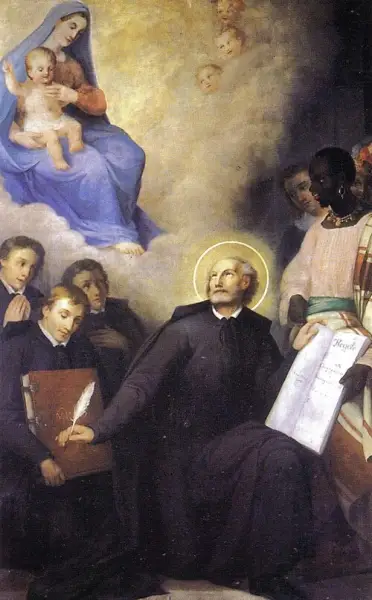
Overview
John Leonardi, born in 1541 at Diecimo in the Republic of Lucca, the youngest of seven children of a middle-class family, combined in one career the apothecary's mortar and the priest's chalice. Trained for a decade as a pharmacist's assistant before his ordination in 1572, he brought to the Counter-Reformation both a healer's instinct and an organizer's discipline. His first work was the Christian formation of young people in his Lucca parish and the gathering of laymen for service in hospitals and prisons; in 1574 he founded a group devoted to deepening faith and devotion, spreading love of the Blessed Virgin Mary, the Forty Hours devotion, and frequent communion. His blueprint for a body of secular priests dedicated to converting sinners and restoring Church order took shape as the Lucca Fathers, recognized in 1583 and confirmed by Clement VIII in 1595, when Leonardi took the name Giovanni of the Mother of God. Driven from Lucca by civic opposition, he labored from Rome, reforming religious houses, befriending Philip Neri, and founding in 1603 the Propagation-of-the-Faith seminary formed to prepare priests for the missions. He died 9 October 1609 of the influenza he caught in Rome's epidemic while tending his ailing brothers, and was canonized in 1938.
The Complete Life
The Youngest of Seven, from Diecimo
Giovanni Leonardi was born in 1541 at Diecimo, a village in the Apennine foothills that today belongs to the Borgo a Mozzano comune, inside the old Republic of Lucca. He was the youngest of seven children of middle-class parents, and from his earliest years he showed a temperament that set him apart: he sought solitude and wished to give himself to prayer and meditation, the instincts of a contemplative in the body of a boy who would spend his life in restless active reform. At seventeen he was apprenticed into a ten-year course of study in Lucca to qualify as a certified pharmacist's assistant — a formation that gave him the precise, compounder's habits of the apothecary and a lifelong association with the world of medicine. The mortar and pestle that appear among his emblems recall those years. Yet the dispensary was never to be his vocation in itself; behind the counter he was preparing for something else. When his pharmaceutical training was complete he turned to the study of the priesthood, and in 1572 he was ordained, enrolled among the Apostolic Clerics of St. Jerome, a body that has since passed out of existence. The healer's training and the priest's ordination had now been joined, and he would spend the rest of his life applying one to the other.
§ Biography
A Priest for the Counter-Reformation
Ordained in 1572, the young priest threw himself into the work that post-Tridentine Italy most urgently needed: the re-evangelization of a Catholic people whose faith had grown careless. His first field was his own parish in Lucca, where he gave himself to forming the city's adolescents in the Christian life, convinced that the Church's recovery would begin with its youngest members. Around himself he gathered a company of laymen and set them to work in the hospitals and prisons of the city — the places where neglect and suffering were greatest and where the Counter-Reformation's charity was most visible. In 1574 he gave this fervor structural form, founding a group charged specifically with deepening Christian faith and devotion, an enterprise that belonged squarely to the wider movement of Catholic reform of his age. Through this band he promoted love of the Blessed Virgin and the Forty Hours adoration — the solemn forty-hour exposition of the Blessed Sacrament — and he pressed constantly the case for receiving communion often — a Eucharistic emphasis that placed him among the forerunners of the great age of frequent communion that the Church would later encourage everywhere. Council of Trent reforms were his program; Lucca was his first laboratory.
§ Biography
The Lucca Fathers
Leonardi's ambition was institutional. The reforms the Council of Trent had enacted inspired him to propose a fresh congregation of secular priests, whose work would be the conversion of sinners and the restoration of ecclesial discipline — clerics who would live religiously while remaining available for every pastoral work. In 1583 his association, remembered as the Lucca Fathers, won recognition from the bishop of that city with Gregory XIII's sanction. Twelve years later, in 1595, the congregation was confirmed by Pope Clement VIII, and its founder assumed the religious name by which he is known in Italian tradition: Giovanni of the Mother of God. The institute's early history was complicated; on 14 January 1614, encouraged by the cardinal protector Giustiniani, Pope Paul V decreed approval for joining the Lucca Fathers to Joseph Calasanz's Piarists — a bond that held only until early 1617, when a further decree made the Piarists a congregation of their own. In 1621, after the founder's death, his community was formally designated the Clerks Regular of the Mother of God; its final Rule was published in 1851, and from two houses at his death it grew by three more during the seventeenth century.
§ Founding the order
Mary, the Forty Hours, and Frequent Communion
The spirituality Leonardi preached was simple, Eucharistic, and Marian. Through the association he founded in 1574 he worked to spread devotion to the Blessed Virgin Mary, the maternal presence at the center of Counter-Reformation piety, and the Forty Hours devotion, by which the Blessed Sacrament was solemnly exposed for adoration across the forty hours that recalled Christ's time in the tomb. Above all he urged the importance of frequent communion, insisting that ordinary Christians, not only religious, should approach the altar often — a conviction that was ahead of the general practice of his time and that has become the ordinary expectation of the Church. This was the interior engine of his institutes: not legislation first, but devotion — a people taught to love the sacraments would regenerate its own Christian life. His own character supplied the authority for the program. Philip Neri, who directed him spiritually during his Roman years, esteemed him greatly for his firmness and his sound judgment — the paired virtues of a founder who could both hold a line and see a path. The pharmacist of Diecimo had become, in effect, a physician of ecclesial life, diagnosing the Church's weakness in neglected doctrine and infrequent sacraments, and prescribing the oldest remedies with new precision.
§ Biography
Exile, Reform, and the Epidemic
The political authorities of Lucca opposed the establishment of Leonardi's new religious order, and though their efforts to stop it ultimately failed, they drove him to pass most of his remaining years beyond his native city — with special exceptions granted by its government once he stood under the protection of the pope. The exile opened his apostolate to the wider Church. In Rome he formed a deep friendship with St. Philip Neri, who became his spiritual director. Clement VIII in 1596 made him Commissary Apostolic charged with reforming the Benedictine houses of Monte Vergine; then in 1601 the order’s Cardinal Protector gave him like work to do among the Vallombrosans, so that the founder of a struggling congregation became a trusted reformer of other men's monasteries. In 1603, with Cardinal J. Vivès, he established the Propagation-of-the-Faith seminary, where priests bound for the missions received their philosophical and theological preparation — a work of enduring significance for the Church's missionary endeavor. He died on 9 October 1609 in Rome, of influenza contracted while ministering to his brothers who were suffering in the epidemic then raging through the city. The priest had caught the sickness in the very act of tending its victims: the apothecary's apprentice died as he had lived, among the sick.
§ St. Giovanni Leonardi
An Honor Popes Reserve for Popes
The veneration that surrounded Leonardi after his death was extraordinary even before formal canonization. He was honored for his miracles and his religious fervour, and Rome treasured his memory so deeply that Leo XIII inserted his name in the Roman Martyrology and directed the clergy of the city to keep his Mass and Office — a distinction otherwise reserved almost exclusively for beatified popes, and a measure of how deeply the founder of the Lucca Fathers had embedded himself in the devotion of the Eternal City. The Church's formal process followed in two stages across two centuries: he was beatified on 10 November 1861 by Pope Pius IX at Saint Peter's Basilica, and canonized on 17 April 1938 by Pope Pius XI, again at Saint Peter's, in the full tide of the missionary century whose seminaries his foundation of 1603 had anticipated. His liturgical feast is kept on 9 October, the day of his death. His relics rest beneath an altar at Rome's church of Santa Maria in Campitelli, and the modern city honors him with a parish church of his own, San Giovanni Leonardi, in Zone XV Torre Maura in the east of Rome.
§ Death and sainthood
Pharmacists, Priests, and the Missions
John Leonardi's legacy runs on three channels. The first is his institute: the Clerics Regular of the Mother of God of Lucca, the congregation born in 1583 as the Lucca Fathers, confirmed in 1595, formally designated in 1621, and still bearing his charism of converting sinners and restoring Church discipline; their members count him as their father, and he is named their patron in the Church's calendar of intercessions. The second is the missions: the Propagation-of-the-Faith seminary, founded with Cardinal Vivès in 1603 to form priests for evangelization, placed the training of evangelizers on an institutional footing generations before the great missionary societies of the modern era, and its idea has echoed through every subsequent effort to prepare priests for other peoples and lands. The third is his patronage of pharmacists, the guild of his first profession, who look to the apothecary of Diecimo as one of their own — a saint whose instruments, the mortar and pestle beside the quill and the priest's cassock and the Rule of his Order, tell the whole story of a man who moved from compounding medicines to compending reforms. Canonized in 1938, he stands among the great organizers of the Counter-Reformation: a founder whose congregations outlived the political hostility that exiled him, and whose remedies are still dispensed in the Church he served.
§ Death and sainthood
Timeline
- 1572
Ordained a priest as a member of the Apostolic Clerics of St. Jerome.
§ Biography
- 1574
Brought together a fellowship charged with deepening the Christian faith and devotion of the faithful, promoting love of Mary, the Forty Hours adoration, and communion received often.
§ Biography
- 1583
His association — remembered as the Lucca Fathers — won recognition from the bishop of that city, sanctioned by Pope Gregory XIII.
§ Founding the order
- 1595
The congregation received Clement VIII's confirmation, and Leonardi took the religious name Giovanni of the Mother of God.
§ Founding the order
- 1596
Named by Clement VIII as Commissary Apostolic charged with reforming the Benedictines of Monte Vergine.
§ St. Giovanni Leonardi
- 1601
Appointed by their Cardinal Protector to carry out a similar reform among the Vallombrosans.
§ St. Giovanni Leonardi
- 1603
Together with Cardinal J. Vivès, founded the Propagation-of-the-Faith seminary to give missionary priests their philosophical and theological preparation.
§ St. Giovanni Leonardi
- 9 Oct 1609
Died in Rome of influenza contracted while ministering to his brothers during the epidemic then raging in the city.
§ Death and sainthood
- 10 Nov 1861
Beatified by Pope Pius IX at Saint Peter's Basilica.
§ Death and sainthood
- 17 Apr 1938
Canonized by Pope Pius XI at Saint Peter's Basilica.
§ Death and sainthood
The Record
- Major works
- Clerics Regular of the Mother of God of Lucca (the Lucca Fathers)·Seminary of the Propagation of the Faith, founded 1603 with Cardinal J. Vivès
- Patron of
- Pharmacists·Clerics Regular of the Mother of God of Lucca
- Symbols
- priest's cassock·Rule of the Order·quill·mortar and pestle
- Canonization
- Canonized 17 April 1938 by Pope Pius XI at Saint Peter's Basilica; beatified 10 November 1861 by Pope Pius IX
Prayer
Bibliography
Show 9 sources
- "On St. John Leonardi", ZENIT, 7 October 2009
- "St John Leonardi", Catholic Online, retrieved 31 January 2022
- "St. John Leonardi", CNA (Catholic News Agency)
- Delaney, John J. (1980). Dictionary of Saints. New York: Doubleday, p. 357. ISBN 0-385-13594-7
- "Saint John Leonardi's Story", Franciscan Media
- "Saint John Leonardi", Encyclopaedia Britannica
- Carmichael, Montgomery. "Clerks Regular of the Mother of God of Lucca." The Catholic Encyclopedia, Vol. 4. New York: Robert Appleton Company, 1908
- Schofield, Nicholas. "Santa Maria in Campitelli: an old Roman church with strong British connections", Venerable English College, Rome, 26 February 2020
- "Chiesa di San Giovanni Leonardi a Torre Maura", GCatholic
Profile text adapted from the Wikipedia article, licensed CC BY-SA 4.0.
Pray with this saint every day
Save St. John Leonardi to your favorites, read the full profile, and get feast-day reminders in the Saints app.
Get the Saints AppFree on the App Store for iPhone and iPad