
1585 – 1645·Feast September 18
St. John Macias
Dominican lay brother and almsgiver of Lima
Overview
John Macias, born Juan de Arcas y Sánchez, was a Spanish Dominican lay brother whose quiet doorkeeping and lavish charity made him one of the best-loved figures of colonial Lima. Orphaned in early childhood in Extremadura, he was raised by an uncle whose surname he adopted and worked as a shepherd, passing the long hours alone on the hillsides in prayer of the rosary. At about twenty-five he took ship for the New World, landing at Cartagena de Indias and traveling through Pasto and Quito before reaching Lima, where he spent the rest of his life. In 1622 he was received into the Dominican Priory of St. Mary Magdalene as a lay brother and made perpetual vows the following year. For more than two decades he served as porter of the priory, admitting visitors, feeding some two hundred poor people daily with the help of a donkey sent out to collect donations, and offering counsel to rich and poor alike who crowded the monastery gates. A contemporary and friend of St. Martin de Porres, he combined austere penance with an unusually warm practical charity. He died of natural causes in 1645, was beatified with Martin de Porres in 1837, and was declared a saint by Pope Paul VI in 1975. His remains rest in the Basilica of Our Lady of the Rosary in Lima.
The Complete Life
An Orphan of Extremadura
Juan de Arcas y Sánchez was born on 2 March 1585 in the small town of Ribera del Fresno, in the Spanish region of Extremadura, then under the jurisdiction of the Palencia Diocese. His parents, Pedro de Arcas and Juana Sánchez, were poor farmers, and both died while their children were still small: Juan was only four years old. He and his sister Mary were taken in by an uncle, whose surname, Macias, the two children adopted as their own, the name by which the saint would forever be known. His uncle trained him as a shepherd, and the boy spent long solitary days watching his uncle's flocks on the hillsides. Those empty hours became the seedbed of his interior life, for Juan filled them with prayer, and especially with the rosary, which he began to recite as a child and would continue to love for the rest of his life. The solitude, poverty, and loss of his earliest years seem to have formed in him both a deep attraction to communion with God and an instinctive compassion for anyone in need. When he was about sixteen, while attending Mass in a neighboring village, he met a Dominican friar, and for the first time the possibility of entering the Order of Preachers took shape in his mind. He believed that as he sought to discern God's will he received visits from the Blessed Virgin Mary and from his patron, St. John the Evangelist.
§ Biography
Across the Atlantic to Lima
At the age of twenty-five Macias went to work for a wealthy businessman who offered him the chance to travel to South America. In 1619 he set out for the New World, among the crowds of soldiers, merchants, missionaries, and the poverty-stricken who filled the transatlantic ships of that era hoping for better luck. He landed first at Cartagena de Indias, in what was then the Reino de Nueva Granada in present-day Colombia, then passed through Pasto and Quito in Ecuador, before finally arriving in Lima, Peru — the city he would never leave again. Settling in a new world left a permanent mark on his spirit. Father Vincent de Couesnongle later observed that Macias knew what it meant to be uprooted from everything familiar, to plunge into the unknown with a mixture of hopes and fears, and to struggle to put down roots in a new land. On 23 January 1622 he was received into the Dominican Priory of St. Mary Magdalene in Lima. He entered not as a candidate for priesthood but as a lay brother, one of the non-ordained friars whose hands supplied the manual labor that kept the community alive. A year later, to the very day — 25 January 1623 — he professed his final vows, binding himself permanently to the Order. In the priory he became a contemporary and friend of St. Martin de Porres, the famed mulatto lay brother of the Priory of Santo Domingo.
§ Biography
Porter of the Priory Gate
Macias was known above all for two things. The first was his love of the rosary, the prayer he had taken up as a child shepherding sheep in Spain and never laid aside. The second was his generosity to the poor: every day he fed some two hundred of Lima's destitute. To gather the means for this daily table he enlisted a small donkey, which he sent out through the streets of the city bearing a sign asking for donations for the poor. The animal, knowing its route perfectly, would make the rounds and return loaded with benefactions, and it would often halt at certain houses and bray loudly until the residents came out to give. Within the priory he gave his days to fervent prayer, frequent penance, and charity. Beggars, disabled people, and the disadvantaged crowded to him at the monastery gates, where he waited on them as assistant porter, a post that kept him living in the gatehouse. The poor came for food; the rich came for advice, and he gave counsel to both without distinction. His austerity, however, took a physical toll: he fell seriously ill and had to undergo a risky surgery. Even then he did not stop caring for the sick and needy who gathered at the friary gates, continuing the quiet ministry of mercy that made his name throughout Lima.
§ Counsel to the rich and poor
Obedience Against Inclination
The inner shape of Macias's holiness was defined by a tension between his natural desires and his vow. He confessed to Father Abbot Ramírez that he longed to spend his days in contemplative solitude rather than in the constant conversation that the porter's duty demanded. Ramírez replied that if he had never followed his vow of obedience, nobody would ever have seen his face. The observation captured the essence of the man: sanctity for Macias was not the fulfillment of his preferences but the faithful performance of a duty that went against them. For more than twenty years he held the office of porter, standing where the community met the city, and he came to see this unwelcome post as the very instrument of his discipline, finding in it a joyful sense of fulfillment. His spiritual life rested on practices formed in childhood and refined in the priory: the daily rosary, learned on the hillsides of Extremadura; fervent prayer; and frequent penance, so severe that it damaged his health and required surgery. Yet the austerity never curdled into harshness. The same rigor that marked his own life opened him to the sufferings of others, so that the gatehouse where he mortified himself became a place of refuge where beggars and the wealthy alike found food, comfort, and honest counsel from a lay brother who asked nothing for himself.
§ Counsel to the rich and poor
The Last Years at the Gate
The closing chapter of Macias's life continued the pattern of all that preceded it. He remained at his post as porter of the Priory of St. Mary Magdalene, though the office had cost him much: the austerities he practiced in his early years at Lima had brought on serious illness, and the risky surgery he underwent was a permanent reminder of the price of his penance. Friends recalled that his deepest desire had always been for quiet and contemplation, and that he accepted the interruptions of the gate only because obedience required it, the obedience that his superior said had made his sanctity visible to the world. He died of natural causes on 16 September 1645, after some twenty-three years of religious life in Lima, still a lay brother, still without the preaching or priesthood that the world associates with religious fame. His body was laid to rest in Lima, and in time his remains came to rest in the Basilica and Convent of Santo Domingo in the Peruvian capital, beside the memory of the city's other great Dominican saints. The friar who had crossed the Atlantic as a poor emigrant had become, by the simple fidelity of an unremarkable life, one of the treasures of the Church in Peru.
§ Biography
From Beatification to the Altars
Miracles were attributed to Macias both during his lifetime and after his death, and these reports sustained the cause that would eventually carry him to the altars. On 29 October 1837 Pope Gregory XVI beatified him, and significantly chose to raise him at the same ceremony as his friend and fellow lay brother Martin de Porres, linking the two humble doorkeepers of Lima forever in the Church's memory. The delay of nearly two centuries between beatification and canonization did not dim his local following. On 28 September 1975 Pope Paul VI canonized John Macias, declaring him a saint of the universal Church nearly three hundred and thirty years after his death. By that time his cult in Peru was firmly established: his image stood above the chief altar of Lima's Basilica of Our Lady of the Rosary, honored there by the local laity, and in 1970 a church had been built in his honor in the San Luis district of the capital. His feast day is kept on 18 September, close to the anniversary of his death. The Vatican's act of canonization stands as the formal recognition of a life spent in manual labor, almsgiving, and prayer, none of it visible to the world until the Church herself held it up.
§ Veneration
A Saint of the Streets of Lima
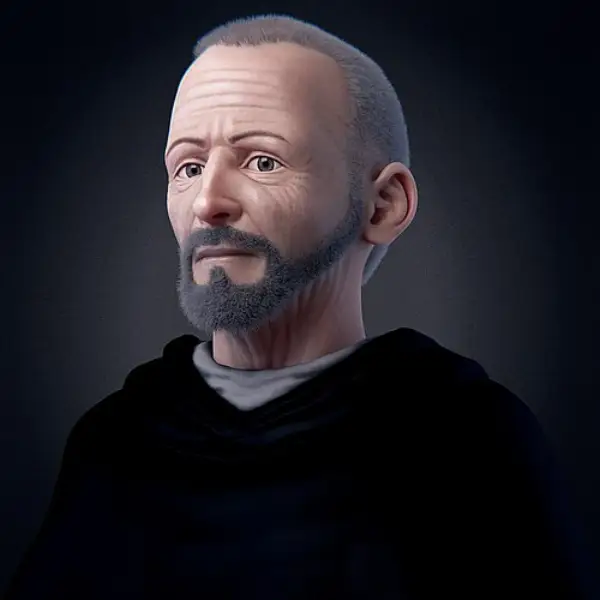
John Macias remains a living presence in the religious life of Peru. Each year, on the third Sunday of November, an annual public procession makes its way through the streets of Lima, carrying his image together with that of St. Martin de Porres, his friend and fellow Dominican lay brother, while the faithful of the city venerate the two saints who served its poor. His remains lie in the Basilica and Convent of Santo Domingo in Lima, a place of pilgrimage where the doorkeeper still receives the visitors he never refused in life. Modern devotion has taken new forms as well: forensic facial reconstruction of his features, undertaken with the help of Dominican friars, has given the faithful an idea of the face that once greeted beggars and grandees alike at the priory gate. Beyond Peru, he is remembered as a patron figure for migrants and emigrants, on the strength of the reflection by Father Vincent de Couesnongle, former Master of the Order of Preachers, who saw in Macias the experience of the millions of people uprooted and shuttled from country to country not for adventure but by necessity. The saint of the gatehouse thus speaks to the contemporary world with unexpected directness, a reminder that holiness can be built from displacement, manual work, and daily bread shared with the hungry.
§ Veneration
Timeline
- 2 Mar 1585
Born Juan de Arcas y Sánchez at Ribera del Fresno, Extremadura, to poor farming parents Pedro de Arcas and Juana Sánchez.
§ Biography
- 1619
Set out from Spain for the Americas, landing at Cartagena de Indias before traveling through Pasto and Quito toward Lima.
§ Biography
- 23 Jan 1622
Entered the Dominican Priory of St. Mary Magdalene in Lima as a lay brother.
§ Biography
- 25 Jan 1623
Made his final vows as a Dominican lay brother, one year after entering the priory.
§ Biography
- 29 Oct 1837
Beatified by Pope Gregory XVI, together with his fellow Dominican Martin de Porres.
§ Veneration
- 28 Sep 1975
Canonized by Pope Paul VI in Rome.
§ Veneration
In Their Own Words
He knew what it meant to be uprooted and torn away from his natural surroundings, from everything he was used to. He knew what it is like to plunge into the unknown. He experienced the normal mixture of hopes and fears, and the difficulty of putting down roots and adapting to new ways. He was one of those millions of people who down through the ages have been shuttled from one country to another, not for the fun of it, or for adventure's sake, but because they had to.
The Record
- Major works
- Daily almsgiving that fed two hundred poor of Lima
- Symbols
- Rosary·donkey
- Canonization
- Canonized 28 September 1975 by Pope Paul VI
Prayer
Bibliography
Show 7 sources
- Floyd, Emily C., "Reconstructing the Faces of the Saints", MAVCOR
- "St. John Macias", Dominican Sisters of St. Cecilia
- "Blessed John Macias (1585-1645)", Dominicans of Canada
- Couesnongle, O.P., Vincent de, "The social message of John Macias", A Plea for Itinerant Preaching Conference, Rome 1975
- "Dominican Saints 101: St. Juan Macias", Dominican Friars Province of St. Joseph, September 18, 2011
- Dorcy, Jean Marie. "Blessed John Macias", St. Dominic's Family, Tan Books and Publishers, 1983
- "Canonización de Juan Macías", vatican.va
Profile text adapted from the Wikipedia article, licensed CC BY-SA 4.0.
Pray with this saint every day
Save St. John Macias to your favorites, read the full profile, and get feast-day reminders in the Saints app.
Get the Saints AppFree on the App Store for iPhone and iPad