
628 – 707·Feast March 2
St. John Maron
First Maronite Patriarch of Antioch
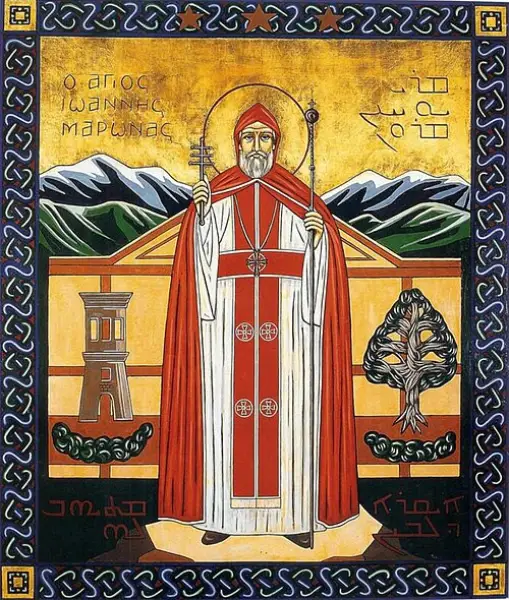
Overview
John Maron was a Syriac monk of the seventh and early eighth centuries whom the Maronite Church venerates as its first patriarch. According to tradition he was born in 628 at Sirmaniyah or Sarmin in the Byzantine Empire, in present-day Syria, though another tradition places his birth in Antioch. He entered the convent of Saint Maron and took the monastic name Yohanon Moroun. Either in 685, or between 687 and 701 by other accounts, he declared himself Patriarch of Antioch for the Maronite community, a people who upheld the Council of Chalcedon's teaching, refused the later councils, and held to the doctrine of a single will in Christ. This position drew him into conflict both with the Byzantine Empire and with the Syriac Miaphysites to the east. Other scholarship connects his patriarchate with the repulse of invasions by the Byzantine emperor Justinian II, after which the Maronites gained a greater degree of political independence. The Maronite Church credits him with three works in Syriac, on spirituality and faith, against the Jacobites, and against the Nestorians, though his authorship is contested. He is thought to have died in 707 and been laid to rest at Kfarhy close to Batroun in Lebanon; a shrine there honors him. His existence has been questioned by some Western scholars, but the Maronite tradition has never wavered in his commemoration on 2 March.
The Complete Life
Origins in a Divided Empire
John Maron was born in 628, according to the dates preserved by tradition, at Sirmaniyah or Sarmin, a town of the Byzantine Empire in what is now Syria. A second, competing tradition holds that he was born in Antioch, the ancient see whose patriarchal throne he would one day claim. He grew to manhood in the generations after the Arab conquests had redrawn the map of the Near East, when the Christian communities of Syria and Lebanon lived under shifting political masters and deep theological divisions separated Chalcedonians, Miaphysites, and the Church of the East. In this world he sought the monastic life, entering the convent of Saint Maron, the community that carried the name of the fourth-century hermit Maron and that had become the spiritual center of the Maronite people. There he received the religious name Yohanon Moroun. The monastery formed him in the Syriac language and liturgical inheritance of Antioch and in the distinctive Christology of his people, who accepted the Council of Chalcedon's teaching on the two natures of Christ while confessing a single will in him. Almost nothing else is recorded of his early decades; his life emerges into history only when the monastic community he had joined turned to him for leadership.
§ Early life
The Monk of Saint Maron
John's vocation was monastic before it was hierarchical. The convent of Saint Maron, from which he took both his formation and his name, stood in the tradition of the austere Syrian ascetics whose piety combined penitential rigor with firm doctrinal loyalty. Within that community he was known by the religious name Yohanon Moroun, and the Maronite Church has always remembered him as a monk raised to rule the Church from the cloister rather than from the imperial court. The Maronites kept a church order all their own: patriarch and bishops were chosen from within the monastic community, so that John's road from convent to patriarchate followed the customary shape of his people's tradition. The chronicle of Michael the Great records that the Maronites, unlike the theologian Maximus, confessed a single will in Christ while nevertheless accepting the definitions of the Council of Chalcedon, proclaiming him who was crucified for us. This was the faith in which John had been formed and which he would carry into open conflict with the powers of his age. His election or self-declaration as Patriarch of Antioch, whether in 685 or in the years between 687 and 701, made the monk of Saint Maron the head of a communion fighting for its survival.
§ Early life
Patriarch in a Time of Invasion
As patriarch, John Maron led a community under attack from two directions. His declaration of an independent Maronite patriarchate of Antioch, held to the teachings of the Council of Chalcedon while rejecting later councils and maintaining Monothelitism, brought him into conflict with the Byzantine Empire, whose emperors regarded the movement as schismatic, and with the Syriac Miaphysites to the east, who rejected Chalcedon altogether. The crisis sharpened under the emperor Justinian II, were turned back; scholarship that accepts John's historicity places him at the head of the community in this struggle, from which the Maronite people emerged with a degree of political independence they had never before possessed. This fusion of ecclesiastical and military leadership gave the Maronite communion its enduring identity as a Church that both confessed its faith and defended its mountains. Whether John himself commanded the resistance or inspired it, the tradition remembers him as the father of Maronite self-rule, the first in the unbroken line of patriarchs that continues to the present day. He led his Church until his death, thought to have occurred in 707, closing a patriarchate that had spanned the most dangerous decades of his people's history.
§ Early life
Doubt, Shrine, and Living Commemoration
John Maron's legacy is inseparable from the debate over his existence. Jérôme Labourt, writing in the Catholic Encyclopedia, judged his very existence extremely doubtful — if he existed at all, in this reading, it was only as a simple monk — and the French theologian Eusèbe Renaudot voiced similar reservations. Other scholarship has defended the tradition, assessing John Maron as a historical patriarch who led the Maronites when the invasions of Justinian II were repulsed and his people won political independence. Whatever the verdict of historians, the Maronite Church has never doubted him: it venerates him as a saint, keeps his feast on 2 March, and honors him as the founder of its patriarchal line, which it traces to 685. Death came in 707; his body was laid to rest at Kfarhy close to Batroun in Lebanon, and the shrine standing over it remains a center of devotion. To him the tradition attributes three works composed in Syriac, one on general spirituality and faith, one against the Jacobites, and one against the Nestorians, though even this authorship is contested. In the modern Maronite communion, spread from Lebanon across the world, his name stands at the head of the list of patriarchs and at the origin of a Church that has survived every empire that sought its submission.
§ John Maron
Timeline
- 628
Born at Sirmaniyah or Sarmin in the Byzantine Empire, in present-day Syria.
§ John Maron
- 685
Declared himself Patriarch of Antioch for the Maronite community, by one account; other sources date this between 687 and 701.
§ Early life
- 707
Died and was laid to rest at Kfarhy, close to Batroun in Lebanon; a shrine there is dedicated to him.
§ John Maron
In Their Own Words
Very existence is extremely doubtful ... if he existed at all, it was as a simple monk
The Record
- Major works
- A Syriac treatise on general spirituality and faith (attributed)·A treatise against the Jacobites (attributed)·A treatise against the Nestorians (attributed)
- Canonization
- Pre-congregation; venerated as a saint especially by the Maronite Church
Prayer
Bibliography
Show 7 sources
- Gibbon, Edward (1898). The History of the Decline and Fall of the Roman Empire. Methuen.
- Labourt, Jérôme. "Maronites." The Catholic Encyclopedia Vol. 9. New York: Robert Appleton Company, 1910.
- "Maronite church". Encyclopædia Britannica.
- Azize, Joseph (13 May 2024). "On the Foundation Period of the Maronite Tradition". Religions. 15 (596). MDPI: 596. doi:10.3390/rel15050596.
- El-Hāyek, Elias. "Struggle for Survival: The Maronites of the Middle Ages", Conversion and Continuity, (Michael Gervers and Ramzi Jibran Bikhazi, eds.), Pontifical Institute of Mediaeval Studies, 1990, ISBN 9780888448095
- Iskandar, Amine Jules (2024-04-23). "Patriarch Saint John Maron". Syriac Press.
- Moosa, Matti (2005). The Maronites in History. New York: Gorgias Press. ISBN 1-59333-182-7.
Profile text adapted from the Wikipedia article, licensed CC BY-SA 4.0.
Pray with this saint every day
Save St. John Maron to your favorites, read the full profile, and get feast-day reminders in the Saints app.
Get the Saints AppFree on the App Store for iPhone and iPad