
1811 – 1860·Feast January 5
St. John Neumann
Bishop of Philadelphia and father of Catholic schools
Overview
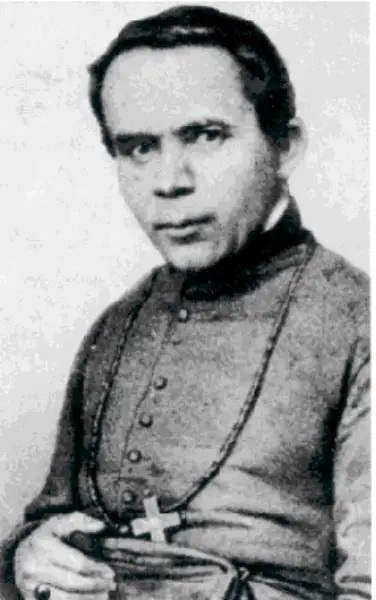
John Nepomucene Neumann was a Bohemian-born American prelate who led the Diocese of Philadelphia as its fourth bishop from 1852 until his death in 1860. Born in Prachatitz in the Kingdom of Bohemia in 1811, he studied at the Piarist School in Budweis, the Philosophical Institute, and the seminaries of Budweis and Prague, where he resolved to become a missionary to the United States. When the Diocese of Budweis cancelled his ordination, he sailed for New York anyway, arriving in 1836 with one dollar in his pocket; Bishop John Dubois ordained him within weeks. He served German-speaking missions in Western New York, walking miles between villages and building churches and schools, before his exhausting ministry broke his health in 1840. He then joined the Redemptorists, taking vows in 1842, becoming an American citizen in 1848, and rising to vice-provincial superior of the American Redemptorists. Appointed bishop of Philadelphia by Pope Pius IX in 1852, he built the nation's first Catholic diocesan school system and established the first Italian national parish in the country, introduced the Forty Hours Devotion, and brought religious communities of women to his diocese. He died suddenly of a heart attack on 5 January 1860 at the age of 48. Canonized by Pope Paul VI in 1977, he remains the only male American citizen ever raised to the altars.
The Complete Life
The Boy from Prachatitz
John Nepomucene Neumann was born on 28 March 1811 in Prachatitz, a town in the Kingdom of Bohemia within the Austrian Empire, in what is now Czechia. His father, Philip Neumann, knitted stockings for a living; he came from Obernburg am Main, in the Electorate of Mainz, and had settled in Prachatice in 1802. After the death of his first wife, Philip married Agnes Lepší, the daughter of a Czech harness maker, in 1805; John was the third of their six children. Baptized on the day of his birth in the village Catholic church, the boy began grammar school at six and proved studious and bookish, so much so that his mother called him 'my little bibliomaniac' for his love of reading. He spoke German at home and school and picked up a passing knowledge of Czech. At ten he was permitted to continue past grammar school to the gymnasium, an unusual privilege at a time when most boys his age were sent to work, and he began Latin lessons under the catechist of Prachatitz to get ready. Come the autumn of 1823 he had passed, with distinction, the entrance examination for the Piarist School in Budweis, that gymnasium run by the Piarist Fathers. Of his class of 103 students, fewer than fifty would complete the six-year course; Neumann endured a slow start, a change of professors, and boarding-house distractions to finish with his highest grades in his final year, his pastimes including the guitar and pictures drawn with a pantograph.
§ Early life and education
From Science to Seminary to Mission
After finishing the Piarist School in 1829, Neumann spent two years at the Philosophical Institute in Budweis, instructed by the Cistercians of Hohenfurth Abbey. He did well in philosophy, philology, and mathematics, excelled in botany and astronomy, and formed a student club devoted to discussing scientific subjects. By his graduation in the summer of 1831 he faced the choice of becoming a physician, lawyer, or priest, and the priesthood seemed unlikely: he preferred science and secular poetry to theology and admitted that his family had no influential friends to ease entry into the seminary. He decided on medicine, but his mother, sensing what he truly wanted, urged him to apply for the seminary, which accepted him to his surprise. On 1 November 1831 he entered the theological seminary of the Diocese of Budweis and thrived, earning the highest possible grade in every subject of his first year. In his second year he read the reports of the Leopoldine Society, the Vienna-based missionary society, and resolved with his fellow seminarian Adalbert Schmidt to become a missionary in the United States. To learn English he transferred in 1833 to the seminary of the Charles-Ferdinand University in Prague, where he worked through an English primer and talked with English workmen at a factory nearby, in time mastering German, Czech, French, English, Spanish, Italian, Latin, and Greek. There he also faced professors of Febronian sympathies whose views he privately regarded as heretical.
§ Early life and education
The Missionary of Two Nations
Neumann expected ordination from Bishop Růžička of Budweis in 1835, but the diocese, claiming no need for more priests, cancelled all ordinations of the graduating class. Unwilling to wait, Neumann left Prachatice on 8 February 1836 with about forty dollars, and sailed from Le Havre on 7 April aboard the three-master Europa. After a forty-day voyage he landed in New York City on 28 May with one tattered suit and one dollar in his pocket. Bishop John Dubois received him warmly, told him he was needed at once and could be ordained without delay, and had him ordained priest on 25 June 1836. Assigned to the German missions of Western New York, Neumann served the villages of Williamsville, Lancaster, and North Bush near Buffalo, completing an unfinished stone church, teaching school himself for seven months, walking his rounds with his vestments in a heavy pack, and enduring anti-Catholic vandalism and even waylaying by assailants. A health breakdown in 1840 led him to join the Redemptorists, in whose ranks he served German immigrants in Baltimore and Pittsburgh, rescued the Oblate Sisters of Providence from dissolution, and rose to vice-provincial superior. In 1848 he became an American citizen. On 5 February 1852 Pope Pius IX appointed him bishop of Philadelphia, and he was consecrated that 28 March by Francis Kenrick in Baltimore.
§ Journey to America
Poverty, Prayer, and the Forty Hours
Neumann's spirituality joined harsh personal asceticism to an unshakable trust in God under difficulty. As bishop he slept but a few hours each night, reportedly on his bedroom floor; he wore old, shabby clothes and immediately gave away anything new; he ate sparingly, never asked for meals when visiting parishioners, and once said he had lived on bread alone for four weeks in his missionary days. His motto, 'Passio Christi comforta me' — Passion of Christ, strengthen me — expressed the Christ-centered endurance that carried him through poverty, loneliness, and opposition. As a young missionary he wrote that whoever wished to be a missionary had to love poverty and be entirely disinterested. His devotion to the Eucharist found public expression when he brought in the first diocesan-wide Forty Hours Devotion seen in the United States, memorializing the forty hours during which Christ's body lay in the tomb. Some feared the timing, only nine years after the anti-Catholic Nativist Riots in Philadelphia, but Neumann recalled falling asleep at his desk and waking to find his candle had charred his papers without igniting them, words he understood as Christ's promise: as the flames burned without consuming the writing, so grace would be poured out in the Blessed Sacrament without profanation. He went ahead, and the devotion was received with great enthusiasm throughout the diocese. His Marian piety was rewarded with a presence in St. Peter's Basilica when the dogma of the Immaculate Conception was defined in 1854.
§ Bishop of Philadelphia
The Last Years in Philadelphia
The closing years of Neumann's episcopate were marked by both achievement and strain. He had established a diocesan school system, deeded parish properties to the diocese, set minimum pastoral salaries, and imposed strict rules on his clergy — yet his reluctance to discipline transgressors drew public criticism from dissident priests, and Francis Kenrick added his voice to other clerics' complaints to the Vatican. April 1857 brought the appointment of James Frederick Wood as coadjutor bishop to assist with administration; Neumann, humble as ever, later wrote that he believed Pius IX was unhappy with his performance and that he would gladly have resigned in favor of Wood, whom he judged more qualified. In 1858 he attended the Ninth Provincial Council of Baltimore, where the erection of new American dioceses was discussed; he let it be known he would welcome appointment elsewhere, but said he would remain in Philadelphia for as long as the pope wished. The following September he presided over the cornerstone-laying for the new Cathedral of Sts. Peter and Paul in Philadelphia. On 5 January 1860, while doing errands in the city, he collapsed, dying of a heart attack at just 48 years of age. He left behind a transformed diocese: during his term eighty churches were constructed, thirty parish schools established, and sixty-one priests ordained. Buried as he requested at St. Peter the Apostle Church beneath the high altar, he was mourned by Kenrick as a man whose virtues Heaven alone fully knew.
§ Death
From Servant of God to Saint
The Archdiocese of Philadelphia and the Redemptorists initiated Neumann's cause in 1886, and the Vatican opened it in 1896, granting him the title Servant of God. Pope Benedict XV declared him venerable in 1921. The miracles that carried the cause forward concerned three children. Eva Benessi, an eleven-year-old Italian girl diagnosed in 1923 with terminal tuberculous peritonitis, recovered after her school held a prayer service seeking Neumann's help and someone touched her stomach with his picture. J. Kent Lenahan Jr., nineteen, critically injured in a 1949 car crash in Pennsylvania with a fractured skull and no hope of survival, awoke after his parents placed a Neumann relic on his hospital bed and eventually recovered fully. The Sacred Congregation of Rites accepted the Benessi and Lenahan cases in March 1963, and Pope Paul VI beatified Neumann on 13 October 1963 during the Second Vatican Council. A third miracle was required for canonization, and it came in the person of fourteen-year-old Michael Flanigan of Philadelphia, whose metastasized Ewing's sarcoma, pronounced incurable in December 1963, began to improve after his parents brought him a relic and prayed for Neumann's intercession; he was disease-free within two years. Years of investigation later, the Dicastery for the Causes of Saints confirmed the miracle, and Paul VI canonized John Neumann on 19 June 1977 — the only male American citizen ever to be so raised.
§ Cause for canonization
Schools, Shrines, and a Neumann Year
Neumann's chief monument is the Catholic school. The first bishop in America to organize a diocese-wide system of Catholic schools, he drew up standard teaching plans and approved textbooks, and his 1852 catechisms became standard texts; Catholic education remains his assigned patronage. Institutions bearing his name span the United States and beyond: Neumann University in Pennsylvania, renamed from Our Lady of the Angels College by the Sisters of St. Francis in 1980; Neumann/Goretti Catholic High School in Philadelphia; St. John Neumann schools from Naples, Florida, to Knoxville, Tennessee, to Pueblo, Colorado; and the Biskupské gymnázium Jana Nepomuka Neumanna in Budweis, Czechia. The Diocese of Manchester founded the St. John Neumann Education Trust in 2017 for Catholic education in New Hampshire, and the Saint John Neumann Foundation was created in Richmond, Virginia, in 2024 to aid African-American Catholics. Pilgrims visit the National Shrine of Saint John Neumann at St. Peter the Apostle Church in Philadelphia, where his remains rest in a glass-walled reliquary beneath the altar, the Shrine Museum at St. John the Baptist Church in Kenmore on the site of his North Bush mission, and the Neumann Chapel in the Church of St. James in Prachatice, where a street also bears his name. In 2011 the Redemptorists celebrated the bicentennial of his birth with a Neumann Year, closed by a Mass in Philadelphia on 23 June 2012.
§ Legacy
Timeline
- 28 Mar 1811
Born in Prachatitz, Kingdom of Bohemia, in the Austrian Empire, and baptized the same day.
§ Early life and education
- 1 Nov 1831
Entered the theological seminary of the Diocese of Budweis.
§ Early life and education
- 8 Feb 1836
Left his home in Prachatice for the United States, telling only his sister Veronica of his plan to go overseas.
§ Journey to America
- 25 Jun 1836
Ordained to the priesthood by Bishop John Dubois at St. Patrick's Old Cathedral, New York, for the Diocese of New York.
§ Ordination
- 18 Oct 1840
Arrived in Pittsburgh and was invested as the first Redemptorist novice in North America.
§ Joining the Redemptorists
- Jan 1842
Traveled to Baltimore and took his religious vows as a Redemptorist.
§ Joining the Redemptorists
- 1846
Appointed vice-provincial superior of the American Redemptorists.
§ Joining the Redemptorists
- 1848
Naturalized as an American citizen in Baltimore.
§ Joining the Redemptorists
- 5 Feb 1852
Appointed bishop of Philadelphia by Pope Pius IX.
§ Bishop of Philadelphia
- 28 Mar 1852
Consecrated bishop by Francis Kenrick at St. Alphonsus Church in Baltimore.
§ Bishop of Philadelphia
- May 1853
Introduced the Forty Hours Devotion at the Church of St. Philip Neri, the first diocesan-wide celebration in the United States.
§ Bishop of Philadelphia
- 8 Dec 1854
Present in St. Peter's Basilica when Pius IX defined the dogma of the Immaculate Conception.
§ Bishop of Philadelphia
- Apr 1857
The Vatican appointed James Frederick Wood as coadjutor bishop of Philadelphia to assist him.
§ Bishop of Philadelphia
- 5 Jan 1860
Collapsed while doing errands in Philadelphia; a heart attack ended his life at 48.
§ Death
- 1921
Declared venerable by Pope Benedict XV.
§ Cause for canonization
- 13 Oct 1963
Beatified by Pope Paul VI in Rome during the Second Vatican Council.
§ Beatification
- 19 Jun 1977
Canonized by Pope Paul VI; he remains the sole male American citizen ever declared a saint.
§ Canonization
In Their Own Words
Oh Jesus, You poured out the fullness of Your grace over me yesterday. You made me a priest and gave me the power to offer You up to God. Ah! God! This is too much for my soul!
If the child I baptized today dies in the grace of this sacrament, then my journey to America has been repaid a million times, even though I do nothing for the rest of my life.
His people appreciated his zeal and his learning, yet he possessed accomplishments of which the world knew not and virtues of which Heaven alone took comprehensive cognizance.
The Record
- Major works
- First Catholic diocesan school system in the United States·St. Mary Magdalen de Pazzi Church, first Italian national parish in the United States·Standard catechisms adopted as diocesan texts (1852)·Foundation support for the Sisters of St. Francis of Philadelphia·Beneficial Saving Fund Society (1853)
- Patron of
- Catholic education
- Symbols
- Redemptorist habit with a pectoral cross
- Canonization
- Canonized 19 June 1977 by Pope Paul VI
Prayer
Bibliography
Show 8 sources
- "Prachatice Baptismal Parish Register 1800-1815". digi.ceskearchivy.cz. Retrieved August 7, 2021.
- "Saint John Neumann: Biography, Legacy, & Facts". Encyclopedia Britannica. Retrieved March 15, 2021.
- Shuster, Alvin (June 20, 1977). "Bishop Neumann Canonized; First Male Saint From U.S." The New York Times.
- Curley, Michael (1952). Venerable John Neumann, C.SS.R.: Fourth Bishop of Philadelphia. Washington, D.C.: Catholic University of America Press.
- Guilday, Peter (1932). A History of the Councils of Baltimore, 1791-1884. New York: Macmillan. pp. 55-59.
- Rush, Alfred C. (1984). "Saint John Neumann, C.SS.R.: Catechist and Writer of Catechisms". Spicilegium Historicum. 32 (I): 210.
- "19 June 1977: Canonization of John Nepomucene Neumann". www.vatican.va.
- Svoboda, Rudolf. "Questions about the Priestly and Missionary Vocation and the Ordination of John Nepomucene Neumann", The Catholic Historical Review, vol. 109 no. 3/2023, 515-540.
Profile text adapted from the Wikipedia article, licensed CC BY-SA 4.0.
Pray with this saint every day
Save St. John Neumann to your favorites, read the full profile, and get feast-day reminders in the Saints app.
Get the Saints AppFree on the App Store for iPhone and iPad