
1499–1569·Feast May 10
St. John of Ávila
Apostle of Andalusia and Doctor of the Church
Overview
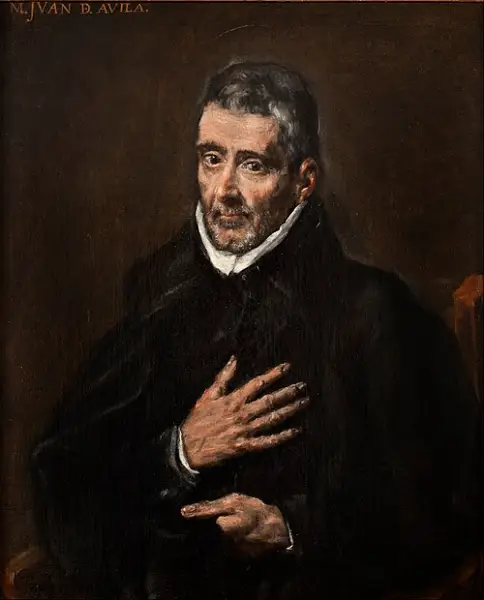
John of Ávila, the 'Apostle of Andalusia', was a Spanish priest, preacher, and mystical writer whose reforming zeal shaped the Catholic renewal of sixteenth-century Spain. Born in 1499 to a converso family of means, he studied law at Salamanca, turned to philosophy and theology at Alcalá under Domingo de Soto, and after his parents' death was ordained in 1526. He sold the family estate for the poor and set out for the missions of Mexico, but the archbishop of Seville, recognizing a preacher of rare power, persuaded him to stay and rekindle the faith of Andalusia instead. From his first sermon in 1529 his fame spread; his hard words against wealth and the aristocracy brought denunciation to the Inquisition and eighteen months of prison, ending in acquittal in 1533. Based in Córdoba from about 1535, he preached across the south, founded schools and colleges, and served as first rector of the University of Baeza, a model for seminaries. He gathered disciples around a plan of apostolic priests that the rise of the Jesuits absorbed, directing some thirty of them into the new Society. Failing health from 1551 led him to Montilla, where he died on 10 May 1569. Benedict XVI proclaimed him Doctor of the Church in 2012.
The Complete Life
Early Years
The future apostle of Andalusia grew up in Almodóvar del Campo, in today's Province of Ciudad Real, the son of Alfonso de Ávila and Catalina Xixón, prosperous and devout, his father of Jewish converso stock. Law at Salamanca claimed him at fourteen but held him only until 1517. Three years of severe piety at home, and the counsel of a Franciscan passing through town, sent him instead to Alcalá, where Domingo de Soto taught him philosophy and theology and where he took a bachelor's degree without finishing the licentiate. Both parents died while he was still a student. Ordained in the spring of 1526, he offered his first Mass over their graves, then liquidated the family estate and distributed the proceeds to the poor. Reading the loss of natural ties as a call to the foreign missions, he made for Seville to sail for Mexico in January 1527 with Julián Garcés, first Bishop of Tlaxcala. There his preaching and catechetical skill caught the eye of the priest Hernando de Contreras, who spoke of him to Archbishop Manrique de Lara, the Inquisitor General; the archbishop saw in the young cleric the very instrument to stir Andalusia's faith, and by persistent persuasion turned him from America for good. The years after 1526 he seems to have passed in Seville in a loosely fraternal priestly household, and there in 1527, for the younger sister of a disciple, he began the little book he would edit all his life: Audi, filia.
§ Early years
Apostle of Andalusia
The sermon of 22 July 1529 made his name at a stroke, and for nine years Andalusian churches could not hold the crowds that came to hear him. Reform was his theme, and the aristocracy his target, until in 1531 informers carried him before the Inquisition at Seville and in the summer of 1532 he was jailed, accused of preaching the dangers of wealth too far and of barring heaven's gates to the rich. The case collapsed; in July 1533 he walked out an innocent man. Around the end of 1534 the Diocese of Córdoba received his incardination and granted him a small benefice, and from that city he ranged across the south, preaching and planting schools and colleges in Granada, Baeza, Montilla, and Zafra, probably winning the title Master of Sacred Theology at Granada about 1538. The jewel of the enterprise was the University of Baeza, erected by Paul III's bull in 1538 with Ávila himself as first rector; its design would later shape seminaries and the schools founded by the Jesuits. In 1538–9 a kind of community gathered around him at Granada, and from 1546 to 1555 some twenty disciples lived with him at Córdoba in what looked like the seed of a formal institute of apostolic priests. The Jesuits' explosive expansion absorbed the idea: from early 1551, as his own health failed, he urged his followers toward the Society, and about thirty went.
§ Apostle of Andalusia
Writings
Audi, filia grew under his hand until his death and reached English in 1620, with Joan Frances Gormley's modern translation following in 2006. His letters, 257 of them spanning 1538 to his death, went to prelates and reformers — Pedro Guerrero of Granada, Juan de Ribera and Thomas of Villanova of Valencia — and to Ignatius of Loyola, John of God, and Teresa of Ávila. The Spanish critical edition of 1970 gathered the whole corpus into six volumes: two redactions of Audi, filia, 82 sermons and conferences, biblical commentaries, the letters, and treatises on reform. English readers received Spiritual Letters in 1631 and, in 2012, the treatises On the Love of God and On the Priesthood.
§ Works
Veneration and Doctor of the Church
The road to the altars was a long one: Clement XIII declared him Venerable on 8 February 1759, Leo XIII beatified him, a cause was formally opened on 14 March 1952, and Paul VI canonized him on 31 May 1970. Later came the highest scholarly honor: on 7 October 2012, when the Church kept the Feast of the Holy Rosary, Benedict XVI named him a Doctor of the Church before a vast crowd in St. Peter's Square, praising the preacher who joined unceasing prayer to apostolic labor and gave himself to forming clergy, religious, and laity for the reform of the Church. The Apostolic letter for the proclamation records his account of the Christian spiritual life as a sharing in the life of the Blessed Trinity, beginning in faith in the God who is Love. His optional memorial was fixed on 10 May, and his memory is honored in the parish church at Alcalá de Henares and the Colegio Maestro Ávila in Salamanca, while the Jesuits, who revere him especially, credit the growth of their Society in Spain to his friendship and support.
§ Veneration
Timeline
- 1499
He was born at Almodóvar del Campo on 6 January, the son of Alfonso de Ávila, whose ancestry included Jewish conversos, and of Catalina Xixón; his parents were a prosperous and devout couple
§ Early years
- 1513
Sent at fourteen to the University of Salamanca to study law
§ Early years
- 1517
Withdraws from Salamanca without a degree and spends three years at home in austere piety
§ Early years
- 1526
Ordained in the spring; celebrates his first Mass in the church where his parents are buried, sells the family property for the poor, and prepares for mission in Mexico
§ Early years
- 1527
Waiting in Seville for passage to the Indies, is persuaded by Archbishop Alonso Manrique de Lara to remain and labor in Andalusia; begins writing Audi, filia at the request of Sancha Carrillo
§ Early years
- 1529
Preaches his first sermon on 22 July, immediately establishing his reputation; crowds pack the churches throughout nine years of missionary work
§ Apostle of Andalusia
- 1531
Denounced to the Inquisition at Seville for his pleas for reform and denunciation of the aristocracy
§ Apostle of Andalusia
- 1532
Imprisoned in the summer on charges of exaggerating the dangers of wealth and shutting heaven's gates to the rich
§ Apostle of Andalusia
- 1533
Refuted and declared innocent, he is released in July
§ Apostle of Andalusia
- 1535
Incardinated into the Diocese of Córdoba around the turn of 1534–35, which becomes his base for directing disciples and founding schools at Granada, Baeza, Montilla, and Zafra
§ Apostle of Andalusia
- 1538
The University of Baeza is founded by papal bull of Paul III, with Ávila as its first rector; it becomes a model for seminaries and Jesuit schools
§ Apostle of Andalusia
- 1550
Lives with some twenty disciples in Córdoba (1546–1555), envisioning a foundation of apostolic priests; with the Jesuits' rapid growth, he steers about thirty of his followers into the Society from 1551
§ Apostle of Andalusia
- 1551
His health breaks; he passes his remaining years in semi-retirement at Montilla
§ Death
- 1569
Dies on 10 May and is buried, as he wished, in the Jesuit Church of the Incarnation at Montilla, now his sanctuary
§ Death
- 1759
Declared Venerable by Pope Clement XIII on 8 February
§ Veneration
- 1970
Canonized by Pope Paul VI on 31 May
§ Veneration
- 2012
Named Doctor of the Church by Pope Benedict XVI on 7 October, the Feast of the Holy Rosary, before tens of thousands in St. Peter's Square
§ Veneration
In Their Own Words
A profound expert on the sacred Scriptures, he was gifted with an ardent missionary spirit. He knew how to penetrate in a uniquely profound way the mysteries of the redemption worked by Christ for humanity. A man of God, he united constant prayer to apostolic action.
The Record
- Major works
- Audi, filia (Listen, O Daughter), expanded and edited until his death; English translation 1620 and 2006·Spiritual Letters (English translation 1631; facsimile 1970)·On the Love of God and On the Priesthood (English translation 2012)·82 sermons and spiritual conferences, biblical commentaries, and 257 letters (Spanish critical edition in 6 volumes, 1970)
- Patron of
- Andalusia, Spain·Spanish secular clergy
- Symbols
- Book and pen
- Canonization
- Declared Venerable 1759 by Pope Clement XIII; beatified by Pope Leo XIII; canonized 31 May 1970 by Pope Paul VI; declared Doctor of the Church 7 October 2012 by Pope Benedict XVI
Prayer
Bibliography
Show 12 sources
- ↑ Some authorities, following Luis de Granada , give 1500 as the date of Avila's birth. The date 1499 is based on the records of the Inquisition. See Obras Completas (2000), vol. 1, pp. 15–22 for more information.
- ↑ Wilke 2003 , p. 963
- ↑ Note that Ávila is simply John's family name – not his place of origin.
- ↑ Domínguez Ortiz 1992
- 1 2 3 4 Avila, John of; Gormley, Joan Frances (2006). Audi, filia – Listen, O Daughter . Mahwah, New Jersey : Paulist Press . pp. 6– 11.
- 1 2 3 4 Wilke 2003 , p. 964
- ↑ Introducción Histórica Archived 26 September 2011 at the Wayback Machine , Universidad de Jaén, 26 September 2005. Accessed online 2010-02-05.
- ↑ José Biedma, Juan de Ávila y la Universidad de Baeza , cibernous.com. Accessed online 5 February 2010.
- ↑ Avila, John of (2006). Audi, filia – Listen, O Daughter . Translated by Joan Frances Gormley. Mahwah, New Jersey: Paulist Press . p. 15.
- ↑ Wikimapia "Iglesia de la Encarnación (Santuario de San Juan de Ávila) (in Spanish)
- ↑ Juan de Ávila, The Audi filia, or, A Rich Cabinet Full of Spiritual Jewels , trans. Toby Matthews (1620). Reprinted in English Recusant Literature 1558–1640, vol. 49 (Menston: Scolar Press, 1970).
- ↑ Juan de Ávila, Certain selected spirituall epistles, 1631 , English recusant literature, 1558–1640, vol. 331 (Ilkley, UK: Scolar Press, 1977).
Profile text adapted from the Wikipedia article, licensed CC BY-SA 4.0.
Pray with this saint every day
Save St. John of Ávila to your favorites, read the full profile, and get feast-day reminders in the Saints app.
Get the Saints AppFree on the App Store for iPhone and iPad