
died 7 May 721·Feast May 7 (translation also celebrated October 25)
St. John of Beverley
Bishop of York who founded the town of Beverley
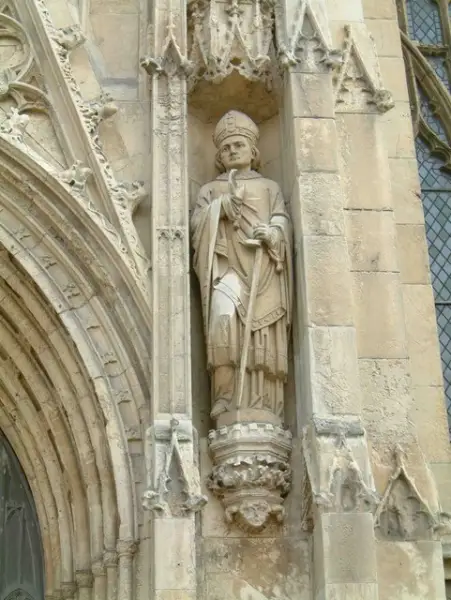
Overview
John of Beverley was an Anglo-Saxon bishop whose two episcopates and one foundation shaped the church of Northumbria. Born — so it is said — to noble parents at Harpham in Yorkshire's East Riding, he received his schooling at Canterbury under Adrian and spent time in the Whitby community of St Hilda — the latter a fact his friend Bede recorded. Renowned as a preacher and scholar of Scripture, he was consecrated Bishop of Hexham in 687 by Theodore of Tarsus and promoted in 705 to the bishopric of York, the most important religious office in the north. As bishop he was diligent in visitation, generous to the poor, and attentive to the students he kept under his personal charge; among those he ordained to deacon and priest was Bede himself. Around 717 he resigned his see and retired to a monastery he had founded at Beverley — the first structure of what became a town — and he died there on 7 May 721. Canonized in 1037 by Pope Benedict IX, he became one of the great popular saints of medieval England: his banner led Yorkshire levies at the Battle of the Standard, Edward I endowed his shrine, and Henry V credited him with the victory at Agincourt. His cult made Beverley prosperous for centuries.
The Complete Life
A Nobleman's Son in Hilda's Community
Yorkshire's East Riding claims John's birth: he came, by tradition, of noble stock at Harpham. Tales of his origins and schooling, however, were first set down on paper only after the canonization of 1037, and their reliability is doubtful. One thing stands sure, because his friend Bede set it down: John belonged for a time to the Whitby community of St Hilda — that celebrated double monastery on the Yorkshire coast, a byword for learning and holy discipline in seventh-century Northumbria. Tradition gives him his education at Canterbury under Adrian, the scholar abbot of St Augustine's, rather than at Oxford as some later sources claim. From these schools of the Anglo-Saxon church John emerged with the two marks that would define his career: learning and eloquence. Preaching brought him renown: he unfolded Scripture with a learning that made his contemporaries sit up, and the gift marked him early for the episcopate. The young nobleman's son from Harpham had become one of the trusted churchmen of Northumbria, connected by friendship to Bede and formed in the tradition of Hilda, Theodore and Adrian.
§ Life
Bishop of Hexham, then of York
In 687 John received consecration as Bishop of Hexham at the hands of Theodore of Tarsus, the Archbishop of Canterbury whose long primacy had organized the English church. For eighteen years he governed the see of Hexham, succeeding Eata and preceding Wilfrid in a succession of notable Northumbrian bishops. In 705 came promotion: John was translated to the bishopric of York, the most important religious designation in the North, succeeding Bosa and eventually handing the see on to Wilfrid II. His activity as Bishop of York survives as a portrait rather than a chronicle: he was diligent in visitation, travelling his vast diocese to reach its people; considerate towards the poor, whose cause a bishop's favour could advance; and careful in forming the young scholars he kept and supported at his own table — a household run as much as a school as a palace. Among the men he ordained were the most consequential: John raised Bede first to the diaconate and then to the priesthood, giving holy orders to the man whose histories would make Northumbrian Christianity immortal. The bishop who preached with erudition had, by his ordination of Bede, a share in the written monument of that age.
§ Life
The Foundation of Beverley
John's most enduring act was not performed in either of his cathedrals but at a place then nameless in history. The first building ever raised on that spot was his monastery, and the town of Beverley grew up around it. The foundation served his deepest purpose, for it became the place of his retirement and the cradle of one of medieval England's greatest cults. As a monastic founder John followed the pattern of the Northumbrian episcopate, where bishops and monasteries were intimately joined; as a town-founder he gave Yorkshire a community that would grow rich on the pilgrim traffic his holiness attracted. His monastery at Beverley was the stage of the last act of his life, and it carried his name into the landscape: to this day the minster town honours him as its founder, and the inscription on his tomb proclaims him founder of the church. The choice of Beverley also shows the man: a bishop who had spent three decades in office did not cling to the metropolitan city but withdrew to a modest foundation among the East Riding villages he knew from his youth, within reach of Harpham, where the well of his baptism-homeland still draws the minster choir each May in his memory.
§ Life
Retirement and Death at Beverley
About 717, perhaps — the sources say the date only tentatively — John resigned the bishopric of York and retired to the monastery he had founded at Beverley. He had served as a bishop for thirty years, from his consecration in 687 to the transfer from Hexham to York in 705 and beyond, and he ended his public life as the Anglo-Saxon church expected its best bishops to end it: in monastic peace. Four years of retirement were granted him. He died at Beverley on 7 May 721, and he was buried there, in his own church — the beginning of the shrine that would make the town famous. The date of his death became his feast day, kept annually on 7 May, while the translation of his relics was afterwards commemorated on 25 October. He left behind a reputation for miracles of healing worked during and after his lifetime, a school of numerous and devoted pupils, and the esteem of the greatest scholar of his age, who owed him his orders. John Fisher and, centuries later, Julian of Norwich counted themselves his devotees; his scholarship was celebrated as widely as his virtues.
§ Life
A Saint of the Undivided Church
In 1037, a little over three centuries after his death, Pope Benedict IX canonized John of Beverley. Because the canonization came before the Great East–West Schism of 1054, he is venerated not only by the Catholic Church but also by the Eastern Orthodox Church and the Anglican Communion — one of the English saints whom the separated churches of East and West jointly honour. The cult that the canonization confirmed was already popular and grew mightier still: many miracles of healing were ascribed to John, and the popularity of his cult became a major factor in Beverley's medieval prosperity. Around 1066 Folcard was commissioned to write his Life; in the eleventh or twelfth century William Ketel recorded his miracles, including the first mention of King Æthelstan's visit to Beverley. The fame of the saint reached into warfare — his banner became a talisman of Yorkshire — and into literature, for the later Middle Ages wove about him the tale of a hermit guilty of grave sins who nonetheless found God's grace waiting, a story that travelled as far as the Dutch chapbook Historie van Jan van Beverley printed at Brussels around 1512.
§ Veneration
Banner, Shrine and Royal Devotion
The political history of England kept crossing the cult of John of Beverley. In 1138 Archbishop Thurstan wove the saint's banner into the standard that gave the Battle of the Standard its name, and by 1266 a Yorkshire levy was satisfied if Beverley sent one man carrying John's banner for the royal army. Edward I was a devotee: he established a chantry in the Minster in 1295, in 1301 bestowed fifty marks on the new silver-gilt shrine, turning half of a fine the town owed into money for that same work. The shrine raised from Roger de Faringdon's 1292 contract — five feet long, adorned with figures, columns, canopies and pinnacles — received the relics on 25 October 1307. Edward came to the Minster in 1296, in 1297 and again in 1300 while marching north against the Scots, the banner going with him; Edward II, Edward III and Henry IV followed his example. Henry V credited his Agincourt victory to John's miraculous intervention — the fighting fell on the anniversary of the translation of the relics, and on that very day blood and oil were seen flowing from the tomb — made John a patron of the royal household and ordered his feast kept throughout England. The shrine fell to Henry VIII's commissioners in 1541; the relics, rediscovered in 1664 and again in 1738, rest in the Minster still, and each May the town keeps his feast with processions to Harpham and primroses laid around his tomb.
§ Veneration
Timeline
- 25 Aug 687
Consecrated Bishop of Hexham by Theodore of Tarsus, Archbishop of Canterbury
§ Life
- 705
Promoted from Hexham to the bishopric of York
§ Life
- 717
Resigned the see of York, perhaps about this year, and retired to his monastery at Beverley
§ Life
- 7 May 721
Died at Beverley, in the monastery he had founded
§ Life
- 1037
Canonized by Pope Benedict IX
§ Veneration
- 1066
Folcard commissioned to write a Life of John, around this year
§ Veneration
- 1138
Thurstan incorporated John's banner into the standard that named the Battle of the Standard
§ Veneration
- 1292
A new silver-gilt shrine commissioned from Roger de Faringdon for the Minster
§ Veneration
- 1295
Edward I established a chantry in John's honour in Beverley Minster
§ Veneration
- 25 Oct 1307
John's relics translated to the new tomb
§ Veneration
- 1420
Henry V and his queen came to Beverley to make offerings at the shrine after crediting Agincourt to the saint
§ Veneration
- 1541
Shrine destroyed on the orders of Henry VIII during the English Reformation
§ Veneration
- 1664
Workmen discovered a lead-encased vault under the nave of the Minster containing the saint's remains
§ Veneration
- 1738
Relics dug up when the new minster floor was laid and replaced under an arched brick vault
§ Veneration
In Their Own Words
For a silver-gilt shrine, made from gold and silver supplied by the Chapter, 5ft long, 1ft wide. Of proportionate height, beautiful, and adorned with plates and columns in architectural style with figures everywhere of size and number as the Chapter determine, and canopies and pinnacles before and behind, and other proper ornaments. Roger to remake any figure at the whim of The Chapter. The pay to be silver equal to the weight used before gilding. Roger may not undertake any other work before completion.
he was so homely and unaffected
The Record
- Major works
- Pro Luca exponendo (an exposition of Luke, lost)·Homiliae in Evangelia (lost)·Epistolae ad Herebaldum, Audenam et Bertinum (lost)·Epistolae ad Hyldant abbatissam (lost)
- Canonization
- Canonized in 1037 by Pope Benedict IX
Prayer
Bibliography
Show 10 sources
- Walsh, Michael J. (2007). A New Dictionary of Saints: East and West. London: Burns & Oats. p. 316. ISBN 978-0-86012-438-2
- Palliser, D. M. (2004). "John of Beverley [St John of Beverley] (d. 721)". Oxford Dictionary of National Biography. Oxford University Press. doi:10.1093/ref:odnb/14845
- MacAuley, Patrick. "St. John of Beverley." The Catholic Encyclopedia. Vol. 8. New York: Robert Appleton Company, 1910
- "Bishop St. John of Beverly †". Catholic-Hierarchy.org. David M. Cheney
- Fryde, E. B.; Greenway, D. E.; Porter, S.; Roy, I. (1996). Handbook of British Chronology (Third revised ed.). Cambridge: Cambridge University Press. ISBN 0-521-56350-X
- Farmer, David Hugh (2004). Oxford Dictionary of Saints (Fifth ed.). Oxford: Oxford University Press. pp. 278–279. ISBN 978-0-19-860949-0
- Chisholm, Hugh, ed. (1911). "John of Beverley, St". Encyclopædia Britannica. Vol. 15 (11th ed.). Cambridge University Press. p. 447
- Rollason, David (2004). "Ketel, William (fl. c.1100)". Oxford Dictionary of National Biography. Oxford University Press. doi:10.1093/ref:odnb/15481
- Gross, Ernie (1990). This Day in Religion. New York: Neil-Schuman. ISBN 1-55570-045-4
- Wilson, Susan E. The Life and After-Life of St John of Beverley: The Evolution of the Cult of an Anglo-Saxon Saint. Aldershot: Ashgate 2006
Profile text adapted from the Wikipedia article, licensed CC BY-SA 4.0.
Pray with this saint every day
Save St. John of Beverley to your favorites, read the full profile, and get feast-day reminders in the Saints app.
Get the Saints AppFree on the App Store for iPhone and iPad