
1386 – 1456·Feast October 23 (March 28 in the 1962 Roman Missal calendar)
St. John of Capistrano
Franciscan preacher and the Soldier Saint of Belgrade
Overview
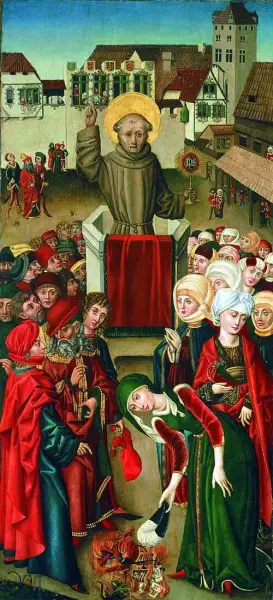
John of Capistrano was an Italian Franciscan friar, lawyer, preacher and inquisitor whose seventy years spanned the papal schisms, the Observant reform and the Ottoman assault on Europe. Born at Capestrano in the Abruzzi on 24 June 1386, he studied law at Perugia and served as that city's governor under King Ladislaus of Naples. Imprisoned as an ambassador during a war with the Malatesta, he began to study theology in his cell, and on release he entered the Order of Friars Minor, following a dream in which St Francis commanded him to join. Trained under Bernardine of Siena, he would stand among the four pillars on which the Observant reform of the Franciscans rested, calling crowds to repentance that no church could seat — 126,000 at Brescia — across Italy, Germany, Bohemia, Austria, Hungary and Poland, and writing tracts against every heresy. As papal legate and inquisitor he pursued Fraticelli, Jesuati, Crypto-Jews and Hussites; his preaching against Jews led to expulsions and, at Breslau, to burnings that remain a grave stain on his memory. After the fall of Constantinople he preached a crusade for Pope Callixtus III, and at seventy he marched with John Hunyadi to lift the siege of Belgrade in 1456. He died of bubonic plague that October at Ilok.
The Complete Life
A Governor in Arms and Chains
John bore the name of his home village, Capestrano, which lay in the diocese of Sulmona among the Abruzzi hills of the Neapolitan kingdom — the usage of that century. His father had come to Italy in the entourage of the Angevin court of Louis I of Anjou, titular King of Naples, so the boy grew up connected to the ruling world of southern Italy. He studied law at the University of Perugia, and the lawyer's training showed in everything he later wrote. In 1412 King Ladislaus of Naples appointed him Governor of Perugia, a tumultuous and resentful papal fief that Ladislaus held as the pope's champion, and the young governor was charged with establishing public order in a city that resisted it. Four years on, Perugia went to war with the Malatesta family, and John was sent as ambassador to negotiate a peace. The Malatestas answered diplomacy with a dungeon: they threw him into prison. He had married before the war, but he would later assert that the marriage was never consummated, and on that ground he received permission to take holy orders. The prison became his novitiate of another kind, for it was there that he began to study theology.
§ Early life
The Dream of St Francis
When John was released from prison, he made the decision that redefined his life: he would become a Franciscan friar. He cited a dream in which St Francis of Assisi himself ordered him to enter the Order — the kind of summons a man of forty could not easily refuse. On 4 October 1416, together with James of the Marches, he entered the Order of Friars Minor at Perugia, beginning the Franciscan career that would carry him across Europe. With James he studied theology at Fiesole, near Florence, under Bernardine of Siena, the great preacher who was then firing Italy with his reforming zeal. John embraced from the first a punishing ascetic regime, and he threw his lawyer's precision behind two causes: the ideal of strict Observance within the Franciscan Order, and purity of doctrine in the Church at large, in both cases following the example Bernardine had set. Beginning in 1420 he preached his way through city after city with striking results, and his name spread; priestly ordination came in 1425. The governor who had failed to buy peace with a embassy had found the office he was made for — a man whose sermons would govern half of Europe's conscience.
§ Friar and preacher
Preacher to the Crowds, Reformer of the Order
Most penitential preachers of fifteenth-century Italy never crossed the Alps; John's voice travelled. He drew multitudes in the German lands of the Empire, in Bohemia and Moravia, Austria, Hungary, Croatia and Poland. Crowds outgrew even the greatest churches, and he took to the open squares; Brescia heard him speak to 126,000 people. Between sermons he produced anti-heretical tracts of every description — the side of his life his early biographers — Nicholas of Fara, Christopher of Varese and Girlamo of Udine — covered in great detail. He assisted Bernardine of Siena in the reform of the Franciscan Order in the interest of stricter discipline, and with Bernardine, James of the Marches and Albert Berdini of Sarteano he is counted among the four pillars holding up the Observant reform. At Bernardine's side he championed devotion to the Holy Name of Jesus, and for it both were accused of heresy; in 1429 the Observants were summoned to Rome, John spoke for his companions, and the Commission of Cardinals acquitted them. Popes Eugene IV and Nicholas V repeatedly sent him on embassies, acting as legate and inquisitor he hunted down Ferrara's last Fraticelli and the Jesuati of Venice, the Crypto-Jews of Sicily, Moldavia and Poland, and above all the Hussites, opposing every attempt at conciliation as connivance at heresy, while upholding papal supremacy against the conciliar movement.
§ Reformer
The Shadow: Capistrano and the Jews
No honest account of John of Capistrano can pass over his mission against the Jewish communities of Europe. Charged by Nicholas V, he carried his preaching against Judaism through Germany, Bohemia, Moravia and Silesia, winning the name of scourge of the Hebrews. In 1450 he staged a debate between Jewish and Christian scholars at Rome. Over the years 1451 to 1453 his incendiary preaching moved many southern German territories to drive out every Jewish inhabitant. In Breslau an old antisemitic slander surfaced — the charge that Jews had defiled the communion host — and John presided over the torture of Jewish prisoners until confessions were extracted. Forty Jews died at the stake, a rabbi took his own life, the surviving community was banished, and the orphans of the killed were seized for baptism. Assessments have divided along plainly drawn lines: Johannes Hofer's 1943 biography insisted contemporaries never censured him as uncharitable, while the 2005 encyclopedia of antisemitism edited by Richard S. Levy judged that John represented a traditional theological anti-Judaism but was also a forerunner of modern antisemitism, seeking the social isolation of Jews, holding them up to popular contempt, and wielding economic accusations — especially sermonizing against Jewish usury — as tools of mass mobilization.
§ Actions towards the Jewish community
The Soldier Priest of Belgrade
Constantinople's fall to the Ottomans in 1453 left the empire of Sultan Mehmed II looming over Christian Europe, and the aged friar took up a new office. In 1454 Callixtus III dispatched John, seventy years old, to preach Crusade against the Ottoman invaders at the Diet of Frankfurt. Bavaria and Austria gave him little, so he concentrated on Hungary, and by July 1456 he had raised a large force of peasants and local countryside landlords — poorly trained but highly motivated — and advanced toward Belgrade, then under siege by Turkish forces. He and the Hungarian commander John Hunyadi travelled together though commanding separately, their combined strength around 40,000 to 50,000 troops. Hunyadi broke the Ottoman naval blockade on the Danube and brought reinforcements into the city; then a spontaneous sortie by the peasant soldiers escalated into full battle. John, first ordering his men back inside the walls, was hemmed in by roughly 2,000 peasant levies and turned them toward the Ottoman rear over the Sava, as Hunyadi flung himself at the enemy guns. The Ottomans withdrew under cover of darkness and the siege was lifted — the feat that earned John the name Soldier Priest, whose coat of arms bears a sword piercing a crescent moon. He survived the battle but not the camp: bubonic plague thriving in the army's unsanitary conditions carried him off at nearby Ilok on 23 October 1456.
§ The Soldier Priest
Canonization and Feast
Recognition of John's sanctity followed within a century and a half of his death, though it arrived in two stages. The year of his canonization was liturgically celebrated on 16 October 1690 under Pope Alexander VIII, while the canonization bull, Rationis Congruit, came out on 4 June 1724 from Benedict XIII — a gap left unexplained, perhaps reflecting the care the Holy See took with so combative a cause. His feast entered the General Roman Calendar for the first time in 1890, assigned to 28 March. When Pope Paul VI revised the calendar in 1969, the feast moved to 23 October, the day of the saint's death; communities that follow the 1962 Roman Missal and its calendar continue to keep him on 28 March. His cult settled around the titles his life had earned: patron of military chaplains, for the friar who preached a crusade in his seventieth year, and patron of jurists, for the canonist whose tracts and sermons defended the Apostolic See. He is honoured also as patron of Belgrade, the siege he helped lift, and of Hungary, the kingdom whose peasants he led; his statue stands in Budapest, a church keeps his tomb at Ilok, and a monument rises near St. Stephen's Cathedral in Vienna.
§ Sainthood and feast day
Two Missions and a Saint's Name in the New World
John of Capistrano's name crossed the Atlantic attached to the Franciscan enterprise he exemplified. A reformer who preached simplicity, he gave his name to two Spanish missions the Franciscans founded in what was then the Spanish American north: Mission San Juan Capistrano at today's San Juan Capistrano in California, and a second Mission San Juan Capistrano on the outskirts of San Antonio, Texas. In Europe his memory is written in stone and steel: the church of St. Wojciech in Kraków recalls his preaching of 1453; his burial church at Ilok stands on the Croatian Danube; Budapest honours him with a statue, Vienna with a monument near St. Stephen's Cathedral, and the Nuremberg Chronicle printed his likeness within a generation of his death. As patron saint of military chaplains he accompanies priests at the front lines of modern wars, an office derived from the autumn of 1456 when an old friar with a cross at the walls of Belgrade showed what a noncombatant's courage could do. His portrait is finally double — the preacher whose sermons emptied towns of their Jewish neighbours and the saint whose prayer rallied a peasant army — and both faces stand for the reader to weigh.
§ Eponym of missions
Timeline
- 24 Jun 1386
Born at Capestrano in the Abruzzi, Kingdom of Naples
§ Introduction
- 1412
Appointed Governor of Perugia by King Ladislaus of Naples to restore public order
§ Early life
- 1416
Thrown into prison by the Malatestas while brokering peace as ambassador, and began studying theology in captivity
§ Early life
- 4 Oct 1416
Entered the Order of Friars Minor at Perugia together with James of the Marches
§ Friar and preacher
- 1420
Began preaching with great effect in numerous cities
§ Friar and preacher
- 1425
Ordained a priest
§ Friar and preacher
- 1429
Chosen to speak for the Observant friars called to Rome on heresy charges; acquitted by the Commission of Cardinals
§ Reformer
- 1439
Went to Milan and Burgundy as legate to counter Antipope Felix V
§ Reformer
- 1446
Undertook a mission to the King of France
§ Reformer
- 1450
Brought Jewish and Christian scholars together for a disputation in Rome
§ Actions towards the Jewish community
- 1451
Went as Apostolic Nuncio to Austria at the emperor's request; his sermons over the next two years persuaded southern German regions to expel their Jewish populations
§ Reformer
- 1453
Preached at the Church of St. Wojciech in Kraków
§ See also
- 1454
Sent by Pope Callixtus III to preach a Crusade against the Ottomans at the Imperial Diet of Frankfurt
§ The Soldier Priest
- Jul 1456
Advanced on Belgrade with a large peasant force raised in Hungary, joining John Hunyadi against the besieging Ottoman army
§ The Soldier Priest
- 23 Oct 1456
Died of bubonic plague at Ilok after the lifting of the siege of Belgrade
§ The Soldier Priest
- 16 Oct 1690
Canonization liturgically celebrated in Rome by Pope Alexander VIII
§ Sainthood and feast day
- 4 Jun 1724
Bull of Canonization Rationis Congruit published by Pope Benedict XIII
§ Sainthood and feast day
- 1890
Entered the General Roman Calendar for the first time, his feast set on 28 March
§ Sainthood and feast day
- 1969
Paul VI transferred the feast to 23 October, the anniversary of his death
§ Sainthood and feast day
In Their Own Words
[t]hat in dealing with heretics and Jews he transgressed established bounds and thereby failed against Christian charity is a thought practically unknown to contemporaries. He was at times censured as impractical, but never as uncharitable or inhuman.
represented a traditional anti-Judaism based on theological grounds. But he was also a forerunner of modern antisemitism insofar as he sought the social isolation of Jews and held them up to popular contempt.
The Record
- Major works
- Tracts against heresy of every kind·Writings, speeches and sermons upholding papal supremacy against conciliarist theories
- Patron of
- Jurists·Military chaplains·Belgrade·Hungary
- Symbols
- Sword piercing a crescent moon (coat of arms)
- Canonization
- Canonization liturgically celebrated 16 October 1690 by Pope Alexander VIII; Bull of Canonization Rationis Congruit published 4 June 1724 by Pope Benedict XIII
Prayer
Bibliography
Show 16 sources
- Hess, Lawrence. "St. John Capistran." The Catholic Encyclopedia. Vol. 8. New York: Robert Appleton Company, 1910
- "St. John Capistrano", Faith ND
- "Saint John of Capistrano", Saint of the Day, Franciscan Media
- Alphandéry, Paul Daniel (1911). "Capistrano, Giovanni di". In Chisholm, Hugh (ed.). Encyclopædia Britannica. Vol. 5 (11th ed.). Cambridge University Press. p. 275
- Gottheil, Richard; Rosenthal, Herman (1906). "Capistrano, John of". JewishEncyclopedia.com
- Levy, Richard S.; Bell, Dean Phillip; Donahue, William Collins; Madigan, Kevin; Morse, Jonathan; Shevitz, Amy Hill; Stillman, Norman A. (2005-05-24). "Capistrano, John of (1386-1456)". Antisemitism: A Historical Encyclopedia of Prejudice and Persecution. ABC-CLIO. pp. 96–97. ISBN 978-1-85109-444-8
- Vogelstein and Rieger, "Gesch. der Juden in Rom", 1895, ii. 14
- Will Durant, The Reformation, Simon & Schuster (1957), page 731
- Flannery, Edward (1985). The Anguish Of The Jews (Revised and Updated ed.). Paulist Press. ISBN 0-8091-2702-4
- Roest, Bert (2017). "Giovanni of Capestrano's Anti-Judaism Within a Franciscan Context: An evaluation based on recent scholarship". Franciscan Studies. 75. St. Bonaventure University. ISSN 0080-5459
- Hofer, John. St. John Capistran, Reformer, trans. Patrick Cummins (St. Louis, Mo.: B. Herder Bk. Co., 1945)
- Bullarium Romanum. Vol 22. Benedict XIII (1724-1730). Taurini Ed, 1871. P. 31-36
- Calendarium Romanum (Libreria Editrice Vaticana, 1969), p. 106
- Engelhardt, Zephyrin, O.F.M. San Juan Capistrano Mission. 1922. Standard Printing Co., Los Angeles, CA
- Andrić, Stanko (2016). "Saint John Capistran and Despot George Branković: An Impossible Compromise". Byzantinoslavica. 74 (1–2): 202–227
- Angiolini, Hélène (2000). "GIOVANNI da Capestrano, santo". Dizionario Biografico degli Italiani. Vol. 55: Ginammi–Giovanni da Crema. Rome: Istituto dell'Enciclopedia Italiana. ISBN 978-88-12-00032-6
Profile text adapted from the Wikipedia article, licensed CC BY-SA 4.0.
Pray with this saint every day
Save St. John of Capistrano to your favorites, read the full profile, and get feast-day reminders in the Saints app.
Get the Saints AppFree on the App Store for iPhone and iPad