
c. 440–450 – between 520 and 530
St. John of Choziba
Egyptian desert monk who founded the monastery of Choziba
Overview
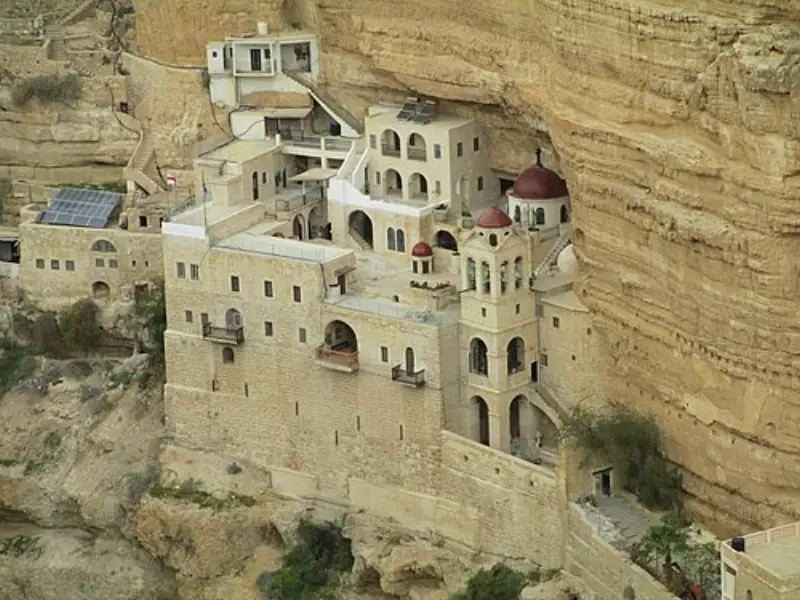
John of Choziba, first known as John of Thebes, was an Egyptian-born monk whose life's work took root in the Judaean Desert. Born in Egypt around the middle of the fifth century, he belonged to the generation of desert ascetics who carried the monastic movement of the Nile into Palestine. Around 480 he broke with monophysitism, the christological position that was dividing the East, and made his way to Wadi Qelt, the ravine that cuts through the wilderness between Jerusalem and Jericho. There he reorganized the existing lavra — a loose confederation of hermit cells — into a coenobitic monastery that came to be called the monastery of Choziba, built against the cliffs above the wadi. His reputation for orthodoxy and holiness carried him briefly onto the wider stage: in 516 he was made Bishop of Caesarea, but the episcopal office did not hold him, and he soon resigned to return to the community he had founded. He died at Choziba between 520 and 530. The monastery he left behind became one of the enduring landmarks of Palestinian monasticism, and he has been venerated as Saint John of Choziba.
The Complete Life
From Egypt to the Judaean Wilderness
Egypt saw John's birth around the middle of the fifth century, in the very heartland of the world's oldest monastic culture — the land of Anthony and Pachomius, where the desert had been colonized by prayer for more than a century. He was first known as John of Thebes, a name that tied him to the famous ascetic settlements of the Thebaid in Upper Egypt. Around 480 he made the decision that defined his life: he abandoned monophysitism, the teaching on the person of Christ that was then tearing apart the churches of the East, and aligned himself with the Chalcedonian faith. That confession had consequences, for it meant separation from the majority church in his homeland, and it sent him out of Egypt altogether. He crossed to Palestine and made his way to Wadi Qelt, the deep ravine watered by a perennial stream as it runs from the hills near Jerusalem down toward Jericho. The wadi already sheltered a lavra, one of those desert settlements of solitary monks whose cells dotted the cliffs. John did not simply join it; he took it in hand and rebuilt its way of life, transforming the loose anchorite community into an organized monastery that would bear the name of Choziba.
§ Introduction
Bishop Against His Will, Monk to the End
The monastery John had built in the wilderness gave him a reputation that reached beyond the wadi. In 516, decades after his arrival, he was raised to the episcopate as Bishop of Caesarea, the metropolitan see of Roman Palestine and one of the most important churches of the East. The sources preserve no protest he made, but their summary of what followed speaks for itself: he soon resigned the bishopric and went back to the monastery of Choziba. For a desert monk, a metropolitan see was not a prize but a burden, and John treated it as one — a work accepted for the Church's need and relinquished the moment it could be. He spent the remainder of his life in the community he had founded, and he died there between 520 and 530, an old man whose monastic career had spanned some seventy years. The monastery perched above the wadi, known in later centuries for its church and its hospitality to pilgrims on the Jericho road, remained the monument of his life. The Church has canonized him as Saint John of Choziba, and scholars of Palestinian monasticism still cite the site as one of the classic foundations of the Judaean Desert.
§ Introduction
Timeline
- 440
Born in Egypt around 440–450, in the generation after the great desert fathers
§ Introduction
- 480
Renounced monophysitism about 480 and withdrew to Wadi Qelt in the Judaean Desert
§ Introduction
- 480
Reorganized the existing lavra at the site into the monastery of Choziba
§ Introduction
- 516
Became Bishop of Caesarea, but soon resigned the see and returned to his monastery
§ Introduction
- 525
Died at the monastery of Choziba, between 520 and 530
§ Introduction
The Record
- Major works
- Monastery of Choziba (reorganization of the Wadi Qelt lavra into a monastery)
- Canonization
- Pre-congregation: canonized as Saint John of Choziba by the continuing tradition of the Church
Prayer
Bibliography
Show 3 sources
- Pringle, Denys (1993). The Churches of the Crusader Kingdoms of Jerusalem. Cambridge: Cambridge UP. p. 1:183. ISBN 9780521390361
- Sharon, Moshe (2004). Corpus Inscriptionum Arabicarum Palaestina, D-F. Vol. 3. Brill. p. 71. ISBN 9789004131972
- Jotischky, Andrew (2013). Encyclopedia of Monasticism. Routledge. p. 675. ISBN 978-1136787164
Profile text adapted from the Wikipedia article, licensed CC BY-SA 4.0.
Pray with this saint every day
Save St. John of Choziba to your favorites, read the full profile, and get feast-day reminders in the Saints app.
Get the Saints AppFree on the App Store for iPhone and iPad