
c. 675 – 749·Feast December 4 (March 27 in the General Roman Calendar, 1890–1969)
St. John of Damascus
Last of the Greek Fathers and defender of the icons
Overview
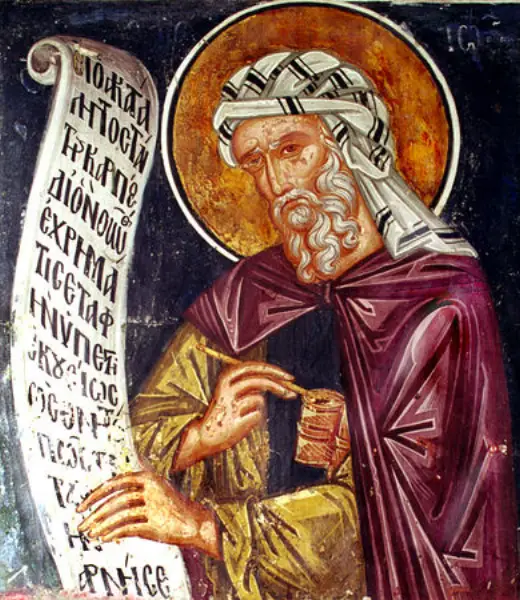
John of Damascus, born Yūḥana ibn Manṣūr ibn Sarjūn around 675 or 676 in Damascus, was a monk, priest, hymn-writer and apologist of the Umayyad era — the last of the Greek Fathers and the great defender of the holy icons. Raised in a prominent Damascene Christian family that had served first the Byzantines and then the caliphs, he was educated in the Hellenic tradition by a Sicilian monk named Cosmas. Tradition holds that he served in the caliphate's fiscal administration before leaving Damascus around 705 for Jerusalem; it is believed he became a monk at Mar Saba near Jerusalem and was ordained a priest there in 735. When Emperor Leo III launched iconoclasm with his edict of 726, John answered with three apologetic treatises on the holy images, written in a style ordinary people could follow, and legend tells that the emperor's forged accusations cost him his right hand — miraculously restored, so the story goes, before the icon of the Theotokos that became known as the Three-handed. His Fountain of Knowledge, crowned by the Exact Exposition of the Orthodox Faith, became the first systematic theology of Eastern Christianity; his canons perfected Byzantine hymnody; and in 754 the iconoclast Council of Hieria anathematized him, while Nicaea II rehabilitated him in 787. He died at Mar Saba on 4 December 749, and Pope Leo XIII declared him a Doctor of the Church in 1890.
The Complete Life
A Christian Family in the Umayyad Court
Damascus in 675 or 676 saw the birth of John, whose family ranked among the city's leading Syrian Christians and whose fortunes were entwined with its government. His grandfather, Mansur ibn Sarjun, had been a leading Byzantine official responsible for the region's taxes under the emperors Maurice and Heraclius, and he appears to have played a part in the capitulation of Damascus to Khalid ibn al-Walid in 635, having secured favourable terms of surrender; the tenth-century patriarch Eutychius names him among the high officials involved in handing over the city. When the Muslim conquest came in the 630s, the Umayyad caliphs retained the Christian officials of Damascus, and Sarjun — John's father — continued in their service. The boy grew up in the city; legend pairs his youth with the future caliph Yazid I and with al-Akhtal, the Taghlibi Christian poet of the court. From his father came the demand that he master not just Muslim learning but Greek letters too, and he appears to have been raised speaking two languages, showing in his later writings both knowledge of the Quran and a classical Hellenic education. One account names his tutor: a monk called Cosmas, kidnapped by Arabs from his Sicilian home and ransomed at great cost by John's father, who was said to rival Pythagoras in arithmetic and Euclid in geometry, and who taught John's orphan friend Cosmas of Maiuma alongside him.
§ Family background
From the Caliph's Service to Mar Saba
Whether John served the caliphate himself is the debated crux of his biography. John of Jerusalem's life of him claims that he occupied a senior fiscal office under Abd al-Malik until about 705, when he abandoned both city and post for Jerusalem and the monastic habit. Historians are divided: Robert G. Hoyland rejects the whole affiliation: unlike his father and grandfather, the Umayyad records contain no trace of John. Daniel Sahas and Jean Meyendorff, though, propose he may have been a lower-level tax official whose name the archives would not need; John's own writings, for their part, never mention experience of a Muslim court. One source links his departure to 706, when al-Walid I stepped up the Islamicisation of the administration, though Muslim sources record only that his father Sarjun left office about then. Where he ended up is beyond doubt: belief places him as a monk at Mar Saba, the celebrated lavra in the desert near Jerusalem, with priestly ordination following there in 735. Father Le Quien, an editor of his works, showed that John's life as a Mar Saba monk predated the outbreak of the iconoclast controversy — so the defiance of an emperor that made him famous was not the act of a courtier abroad but the office of a monk in the Judaean wilderness.
§ Family background
Defender of the Holy Images
In the early eighth century iconoclasm gained acceptance at the Byzantine court, and in 726 Emperor Leo III — who had taken the throne in 717 on the eve of the great siege of Constantinople — issued his first edict against the veneration and public exhibition of images, over the protests of Patriarch Germanus. From the desert of Palestine, beyond the emperor's reach, John of Damascus answered in writing. Every account credits him with three written defences of the holy images; the first of them, the Apologetic Treatises against those Decrying the Holy Images, made his name. He attacked the Byzantine emperor by name, and he deliberately adopted a simplified style so that the controversy could be followed by the common people, stirring resistance among the iconoclasts. Legend supplies the price he paid: Leo III is said to have sent forged documents to the caliph implicating John in a plot against Damascus, and the caliph ordered John's right hand cut off and hung in public view. Days later, the story runs, John asked for the hand back and prayed fervently before the icon of the Theotokos, and it was restored. Thank-offering followed miracle: a silver hand was fastened to the panel, and the image thenceforth bore the name Three-handed — Tricherousa — preserved now at Hilandar monastery on the Holy Mountain. For his iconodulism the iconoclastic Council of Hieria anathematized him in 754, four years after his death; the Second Council of Nicaea rehabilitated him in 787.
§ Biography
Theologian, Hymnographer, Doctor of the Assumption
John's theology closed the patristic age: he stands at the end of the period of dogmatic development, and Catholic theology calls him the last of the Greek Fathers. His masterpiece, the Fountain of Knowledge, is a synthesis and unification of Christian philosophy and doctrine in three parts — the Philosophical Chapters, a logic primer built on Porphyry's Isagoge; Concerning Heresy, a catalogue of one hundred and three heresies following the structural model of Epiphanius's Panarion, twenty of them his own additions on Nestorianism, Monophysitism and later disputes; and the Exact Exposition of the Orthodox Faith, which digested the dogmatic teaching of the Fathers into Eastern Christianity's first systematic theology, the standard textbook of Greek Orthodox theology, and a formative influence on the later Scholastics. He was a prominent exponent of perichoresis, using the term for both the interpenetration of Christ's two natures and the mutual indwelling of the Trinity's hypostases. His writings on the Assumption of Mary earned him in the Catholic Church the title Doctor of the Assumption. And he sang what he taught: he composed hymns and perfected the canon, the structured hymn form of the Byzantine Rite, so that his verse is still sung liturgically across the Eastern Christian world and, at Easter, in western Lutheranism.
§ List of works
The Golden Speaker's Last Years
The precise date and place of John's death are not known with certainty; tradition places it at his monastery of Mar Saba near Jerusalem on 4 December 749, at about seventy-two or seventy-four years of age. He had outlived the first phase of the controversy he defined — the anathema of Hieria came after his death, a posthumous condemnation of a man the iconoclasts could not answer in life. His memory was kept at Mar Saba and across the Melkite world, and the literature around him grew: in 1084 an Arab monk named Michael resolved to write his life because none was available, producing the Arabic biography whose Greek excerpt under the name of John of Jerusalem remains the main source for the saint's story — hagiographical, prone to exaggeration and legendary detail, but full of elements of value. His works travelled early into Arabic: the homily on the Annunciation is believed to have been the first of them translated, a text largely preserved in a Strasbourg manuscript of 885, and in the tenth century Antony, superior of the monastery of St Simon near Antioch, translated a whole corpus. Under the by-name Chrysorroas, the golden speaker, streaming with gold, he remained for the Arabic-speaking churches the model of the learned monk.
§ Sources
Veneration Across the Divided Churches
John of Damascus was never formally canonized: he belongs to the pre-congregation saints, honoured from antiquity by the whole Church. His cult spans the confessions that later divided — he is venerated in the Catholic Church, the Eastern Orthodox Church, Anglicanism and Lutheranism alike. When his name was inserted into the General Roman Calendar in 1890, the same year Pope Leo XIII declared him a Doctor of the Church, his feast was assigned to 27 March; in 1969 it was moved to 4 December, the traditional day of his death, which is also the date kept in the Byzantine Rite, in Lutheran commemorations and in the Anglican Communion. The Church of England and the Episcopal Church both honour him on 4 December. His iconographic attributes tell his legend at a glance: the severed hand, restored by the Mother of God, and the icon itself, for which his whole literary life was spent. He is invoked by pharmacists — patrons of healing recall the miraculous restoration of his hand — by iconographers, whose art he defended against an emperor, and by theology students, who still learn the faith from his Exact Exposition. Decades after his death his writings played an important role at the Second Council of Nicaea, where the Church settled the icon dispute in the sense he had spent his life defending.
§ Veneration
First Critic of Islam and Shaper of Two Theologies
Two legacies of John of Damascus reach far beyond the icon controversy. The first is his place in Christian–Muslim encounter: in chapter 101 of Concerning Heresy, treating the Heresy of the Ishmaelites, he delivered one of Christianity's earliest refutations of Islam, the first writer to classify it among the heresies. He knew the Quran and criticized it sharply, argued with Muslims about the witness to Muhammad's revelation, and reported their charge that Christians venerated idols. His polemic was frequently translated from Greek into Latin and shaped the Western Church's attitude to Islam for centuries; Western writers drew from it their earliest portrait of Muhammad as a false prophet. His second legacy is theological. His Exact Exposition of the Orthodox Faith directed the course of medieval Latin thought and stands behind later Scholasticism, while remaining the principal textbook of Greek Orthodox theology — a rare double citizenship in the two theological worlds that drifted apart after him. His hymns still structure the Byzantine liturgy; his treatises on the images, newly translated in modern editions from 1898 onward, remain the classic statement of the theology of icons; and the manuscript tradition of his letter to Cosmas, philosophical chapters and theological chapters keeps his classroom alive for scholars of Arabic Christianity.
§ Views on Islam
Timeline
- 675
Born in Damascus, c. 675 or 676, to a prominent Syrian Christian family
§ Family background
- 705
Gave up his Damascus post about this year and withdrew to Jerusalem for the monastic life
§ Family background
- 726
First iconoclast edict of Emperor Leo III appeared, drawing John into his written defence of the icons
§ Biography
- 735
Ordained a priest at Mar Saba monastery near Jerusalem
§ Family background
- 4 Dec 749
Died at his monastery of Mar Saba near Jerusalem, according to tradition
§ Introduction
- 754
Condemned by anathema by the iconoclastic Council of Hieria for his commitment to iconodulism
§ Biography
- 787
Rehabilitated by the Second Council of Nicaea, where his writings had played an important role
§ Biography
- 1085
The Arabic life of the Chrysorrhoas was composed by Mikhael, an Antiochene monk
§ Arabic translation
- 1890
Entered the General Roman Calendar on 27 March and was named a Doctor of the Church by Leo XIII
§ Veneration
- 1969
Feast day moved to 4 December, the traditional day of his death
§ Veneration
In Their Own Words
Then we jokingly say to them that, as long as he received the book in his sleep and did not actually sense the operation
O sister of Aaron! Your father was not a man of evil, nor was your mother unchaste!
The Record
- Major works
- The Fountain of Knowledge (Philosophical Chapters, Concerning Heresy, An Exact Exposition of the Orthodox Faith)·Three Apologetic Treatises against those Decrying the Holy Images·Elementary Introduction into Dogmas·Letter on the Thrice-Holy Hymn·On Right Thinking·Octoechos (liturgical book of eight tones)·On Dragons and Ghosts·Homily on the Annunciation·Liturgical canons (Byzantine hymnography)
- Patron of
- Pharmacists·Iconographers·Theology students
- Symbols
- Severed hand·icon
- Canonization
- Pre-congregation: venerated from antiquity; declared a Doctor of the Church by Pope Leo XIII in 1890
Prayer
Bibliography
Show 12 sources
- Aquilina, Mike (1999). The Fathers of the Church: An Introduction to the First Christian Teachers (illustrated ed.). Our Sunday Visitor Publishing. ISBN 978-0-87973-689-7
- Brown, Peter Robert Lamont (2003). The Rise of Western Christendom: Triumph and Diversity, A.D. 200–1000 (2nd, illustrated ed.). Wiley-Blackwell. ISBN 978-0-631-22138-8
- Butler, Alban; Jones, Kathleen; Burns, Paul (2000). Butler's Lives of the Saints: Volume 12 (Revised ed.). Continuum International Publishing Group. ISBN 978-0-86012-261-6
- Griffith, Sidney (2001). "'Melkites', 'Jacobites', and the Christological Controversies in Arabic in Third/Ninth-Century Syria". In Thomas, David (ed.). Syrian Christians Under Islam: The First Thousand Years. Leiden: Brill. ISBN 978-90-04-12055-6
- Hoyland, Robert G. (1996). Seeing Islam as Others Saw It: A Survey and Evaluation of Christian, Jewish, and Zoroastrian Writings on Early Islam. Darwin Press. ISBN 978-0-87850-125-0
- Janosik, Daniel J. (2016). John of Damascus: First Apologist to the Muslims. Eugene, Oregon: Pickwick Publications. ISBN 978-1-4982-8984-9
- Kontouma, Vassa (2015). John of Damascus. New Studies on his Life and Works. Ashgate. ISBN 978-0-367-59921-8
- Sahas, Daniel John (1972). John of Damascus on Islam: The "Heresy of the Ishmaelites". Leiden: Brill
- Chrysostomides, Anna (2021). "John of Damascus's Theology of Icons in the Context of Eighth-Century Palestinian Iconoclasm". Dumbarton Oaks Papers. 75: 263–296. ISSN 0070-7546
- Rengers, Christopher (2000). The 33 Doctors of the Church. Tan Books. ISBN 978-0-89555-440-6
- Louth, Andrew (2003). Three Treatises on the Divine Images. Popular Patristics. Crestwood, NY: St. Vladimir's Seminary Press. ISBN 978-0-88141-245-1
- O'Connor, J.B. (1910). "St. John Damascene". The Catholic Encyclopedia. New York: Robert Appleton Company
Profile text adapted from the Wikipedia article, licensed CC BY-SA 4.0.
Pray with this saint every day
Save St. John of Damascus to your favorites, read the full profile, and get feast-day reminders in the Saints app.
Get the Saints AppFree on the App Store for iPhone and iPad