
c. 305 – 394·Feast March 27 (Western churches); October 17 (Coptic Orthodox Church)
St. John of Egypt
Anchorite of Lycopolis in the Thebaid
Overview
John of Egypt — John the Hermit, John the Anchorite, and John of Lycopolis are among his names — ranked among the celebrated ascetics of the Nitrian Desert tradition. Born around 305 to poor parents in Lycopolis, he learned the trade of carpenter before abandoning it at the age of twenty-five to place himself under the direction of an elderly hermit. After a decade of formation, marked by a famous test of obedience, and five further years of travel among the monasteries, he withdrew to a cliff near his native city. There he carved three tiny cells from the rock, walled himself inside, and spoke to the world only through a small window through which food was passed twice a week, drawing crowds who came to hear him preach. His asceticism was severe: he ate nothing until sunset, refused bread and cooked food, and lived on dried fruit and vegetables for half a century. He was credited with the gift of prophecy, counseled the Emperor Theodosius the Great, and was said to work miraculous cures. He died around 394, at about eighty-nine years of age, and is venerated by Catholics, Orthodox, and Coptic Christians.
The Complete Life
Early Life and Formation
John was born at Lycopolis in the Thebaid, in Roman Egypt, around the year 305. His parents were poor, and the boy was apprenticed to carpentry, the trade by which he supported himself as a young man. At twenty-five he abandoned secular work altogether and put himself, as a novice monk, under an aged hermit, beginning the long apprenticeship in holiness that would define the rest of his life. He remained with this master for ten years, taking direction from him and learning the discipline of the solitary life from his example. John Cassian has preserved a story from those years: the hermit, testing his disciple's obedience, commanded John to spend a full year watering a withered stick daily. John did so without complaint, and when the test was complete his superior threw the stick away, its purpose fulfilled. When the old hermit died, John did not immediately settle into a hermitage of his own. Instead he spent the following five years in travel, visiting the monasteries of Egypt and observing the varied forms the ascetic life had taken, gathering from each what would shape his own solitude.
§ Early life
The Cell on the Cliff
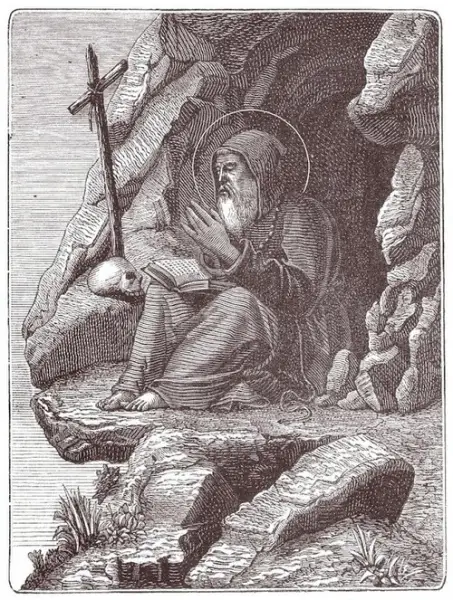
When his years of wandering ended, John settled on a clifftop above Lycopolis, choosing a place where human contact was all but impossible. The hagiographer Alban Butler records that even before this final retirement he had practiced penances that struck observers as absurd, dragging boulders from one spot to another and planting trees already dead, disciplines of obedience and perseverance that differed little in spirit from the watering of the dry stick. On the cliff he hewed three tiny cells out of the living rock — a cell for sleep, a cell for handwork, and a cell for prayer — then sealed the entrances with himself inside and left a single narrow window as his link with the world. Through this opening he communicated with the people who came to him, and twice each week food and water were passed in. Those two days became the occasion of gathering: crowds assembled at the foot of his retreat to hear him preach through the window, turning a hermit's utter seclusion into one of the strangest and most celebrated pulpits of the Egyptian desert.
§ Life as a hermit
Asceticism and Prophecy
The discipline John maintained through those decades was extraordinary even by the standards of the desert. He never ate before sunset, and his diet consisted of dried fruit and vegetables; he refused bread entirely and touched nothing that had been cooked. He kept this regimen for fifty years and continued it well into his nineties. Such severity was joined to a reputation for supernatural discernment. He was believed to possess the gift of prophecy, foretelling future events and revealing the circumstances of persons he had never met. Among those who sought him out was the Emperor Theodosius the Great, to whom John was said to have predicted coming victories. He was especially careful to avoid seeing women, guarding himself against temptation, and during the last fifty years of his life he avoided the sight of all people whatsoever. Saint Augustine records that devils assailed John and that cures were wrought through him: one woman, blind, was healed by him and then, lest he see her in person, received instead a vision of her benefactor. Word of such marvels spread far beyond Egypt and fixed his name among the great anchorites.
§ Life as a hermit
Final Years and Death
John lived on in his cliff-side cells to an extreme old age, still observing the austerities he had practiced for half a century, still refusing cooked food and bread, still taking his sustenance of dried fruit and vegetables only after nightfall. According to Butler, prayer was the one occupation that never ceased, and at the very end it crowded out everything else. For the last three days of his life he took neither food nor drink and held no interaction of any kind, giving himself over wholly to prayer. When his visitors came at the appointed time there was no answer, and it emerged that the old anchorite had died as he had lived: searchers found him in his cell, his body still kneeling in the attitude of prayer. This occurred around the year 394, when he was about eighty-nine years old. His memory was cherished afterward in both East and West; Western churches keep his feast on March 27, the Coptic Orthodox Church on October 17, and Eastern Orthodoxy on June 12, and the Desert Fathers' literature, from Cassian to Augustine, preserved his example for later generations.
§ Life as a hermit
Timeline
- 305
Born at Lycopolis in the Thebaid to poor parents
§ Early life
- 394
Dies at about eighty-nine, discovered in his cell still holding the posture of a man at prayer
§ Life as a hermit
The Record
- Symbols
- Anchorite's cell cut from rock·Small window to the world
- Canonization
- Pre-congregation; venerated in the Catholic Church and the Coptic Orthodox Church from antiquity
Prayer
Bibliography
Show 6 sources
- "St. John of Egypt", Faith ND.
- Jotischky, Andrew (2011). A Hermit's Cookbook: Monks, Food and Fasting in the Middle Ages. London; New York, NY: Continuum. ISBN 978-0-8264-2393-1.
- Holtzclaw, R. Fulton (1980). The Saints Go Marching In: A One Volume Hagiography of Africans, or Descendants of Africans, Who Have Been Canonized by the Church, Including Three of the Early Popes. Keeble Press. p. 80.
- Harmless, William. Desert Christians: An Introduction to the Literature of Early Monasticism. Oxford University Press, USA, 2004. ISBN 9780195162226, p. 222.
- Bangley, Bernard (2005). Butler's Lives of the Saints: Concise, Modernized Edition. Paraclete Press. p. 67. ISBN 978-1557254221.
- Salinas, Stefen. St. John the Clairvoyant of Egypt.
Profile text adapted from the Wikipedia article, licensed CC BY-SA 4.0.
Pray with this saint every day
Save St. John of Egypt to your favorites, read the full profile, and get feast-day reminders in the Saints app.
Get the Saints AppFree on the App Store for iPhone and iPad