
1495 – 1550·Feast March 8
St. John of God
Founder of the Brothers Hospitallers
Overview
John of God, born João Duarte Cidade, was a Portuguese soldier who became a health-care worker in Spain; the companions he gathered later formed the Brothers Hospitallers of Saint John of God, a religious institute devoted to the care of the poor, the sick, and those suffering mental disorders. Born at Montemor-o-Novo on March 8, 1495, he was separated from his family as a child of eight and grew up as a homeless orphan and shepherd near Oropesa. He then spent some two decades as a soldier in the service of Charles V, fighting against the French and the Turks, before a period of spiritual searching took him to Ceuta in Africa and finally to Granada. There, on January 20, 1537, he underwent a dramatic conversion while hearing a sermon by John of Ávila. After confinement in the mental ward of the Royal Hospital, he devoted himself entirely to the sick poor, founding a house in Granada where he tended patients and begged for their support. He died on March 8, 1550, his fifty-fifth birthday, of pneumonia contracted after plunging into a river to save a drowning young man. Canonized in 1690, he is counted among the foremost churchmen the Iberian Peninsula has produced.
The Complete Life
A Child Lost
João Duarte Cidade was born on March 8, 1495, at Montemor-o-Novo in the Évora district of the Kingdom of Portugal. His parents, André Cidade and Teresa Duarte, belonged to a family once prominent but now impoverished, whose faith remained strong despite their reduced circumstances. When the boy was eight years old he vanished from home. Whether he was deliberately kidnapped, or led astray by a cleric whom the family had sheltered under its roof, could never be established. According to his first biographer, his mother died of grief soon afterward, and his father entered the Franciscan Order. The child, meanwhile, was a destitute orphan adrift in the streets of Oropesa, near Toledo in Spain, a foreign land with nobody to look after him and nothing to live on, subsisting on whatever food he could find. In time a man named Francisco Mayoral took him in, and the boy settled into the life of a shepherd, tending sheep in the countryside. The farmer, pleased with the strength and diligence of his young shepherd, came to hope that John would marry his daughter and become his heir.
§ Early life
The Soldier Years
At about twenty-two, to escape his master's well-meaning but persistent offer of his daughter's hand, John joined a company of foot-soldiers. He fought for the Emperor Charles V against the French at Fontarabia, dispatched there by the Count of Oropesa. While guarding a great quantity of loot he was found to have been rifled, and suspicion fell on him; even if innocent of theft, he had neglected his duty. Condemned to death, he escaped execution only because a more merciful officer stepped in and obtained his pardon. Disillusioned, he returned to Oropesa and spent four further years as a shepherd. Then the Count and his troops marched past on their way to fight the Turks in Hungary, and John enlisted once more, leaving Oropesa for good. For the next eighteen years he rode as a trooper on campaigns across Europe. After the rout of the Turks the troops sailed home, landing at A Coruña in Galicia. So near his homeland, John returned to Montemor-o-Novo, where he tracked down a surviving uncle and learned the fate of the parents he had lost, though he had forgotten their names. Realizing he had no ties left there, he went back to Spain and took up sheep-herding again near Seville.
§ Military life
Founder of the Hospitallers
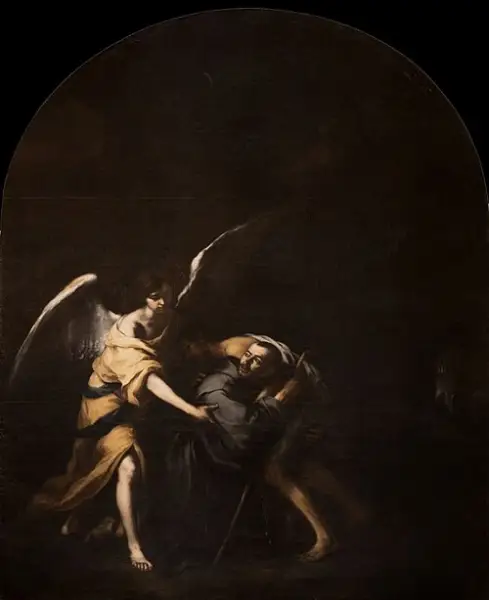
Back in Granada, John expended all his energy on the neediest. He set up a house of his own for the sick poor, going out to beg on their behalf at the start. Madness carried such stigma in that age that he was widely misunderstood and rejected; for a time he worked alone, soliciting medical supplies by night and attending to his patients and the hospital by day, until charitable priests and physicians began to cooperate with him. Many stories told of heavenly guests who lightened his immense tasks, among them, it was said, the archangel Raphael in person. To stop him from trading his cloak with every beggar he chanced upon, Sebastian Ramirez, Bishop of Tui, had a habit tailored for him — afterward taken over almost unchanged as the dress of his followers — and the bishop fixed upon him permanently the name the Christ Child had given him. Slowly John drew a circle of dedicated disciples around him, and organized them into an order of hospitallers. The Holy See approved the institute in 1572 as the Brothers Hospitallers of Saint John of God, which cares for the sick around the world and holds official charge of the pope's own medical care.
§ Brothers Hospitallers
Conversion
Restless in his old trade, John conceived a desire to go to Africa and perhaps win martyrdom by working to free enslaved Christians. He set out for Portuguese Ceuta, and on the way befriended a Portuguese knight exiled there with his wife and daughters. Finding the family robbed, penniless, and ill, John promised to care for them, nursing them and working to feed them despite the wretched treatment the colony's rulers showed the poor. When a coworker deserted to a nearby Muslim city to escape such treatment, John fell into despair, troubled by his own failure of faith during the soldier years. The Franciscan friary in the colony advised him that Africa was doing nothing for his spiritual growth and counselled his return to Spain. Landing at Gibraltar, he wandered Andalusia seeking what God wanted of him, and it was in this period that he is said to have beheld the Christ Child in a vision; the Child gave him the name John of God and sent him to Granada. There he sold books with the new moveable-type press. On Saint Sebastian's Day, January 20, 1537, hearing a sermon by John of Ávila, he was converted with terrifying violence: he beat himself publicly, begging mercy and wildly repenting of his past, and was confined in the Royal Hospital among the mentally ill, segregated, chained, flogged, and starved. Ávila, who became his spiritual director, visited him and advised him to spend himself on the needs of others rather than on his own hardships. John gained peace of heart, left the hospital, and after a pilgrimage to Our Lady of Guadalupe in Extremadura, where Mary was said to have encouraged his work with the poor, he gave himself wholly to the sick of Granada.
§ Conversion
Final Years and Death
John of God died on March 8, 1550, in Granada, on the fifty-fifth anniversary of his birth. His death came of pneumonia, caught when he threw himself into a river to pull a drowning boy to safety — a final act wholly in character for a man who had spent a decade plunging after the sick and abandoned wherever they fell. Upon his death, Pedro Soriano was appointed as his successor at the head of the young congregation. John's body was first laid to rest in the Minim friars' church of Our Lady of the Victories, where it remained until November 28, 1664, when the Hospitaller Brothers transferred his relics to their hospital church in the city. In 1757 a church was erected to house his remains, and on October 26 of that year they were transferred there; the church, now protected by the Knights of Saint John of God, has since been elevated to basilica rank, and stands as the major shrine of the saint whose charity had once been mistaken for madness.
§ Veneration
Veneration
The recognition of John of God by the Church followed the devotion his life had already inspired. He was beatified in Rome on September 21, 1630, by Pope Urban VIII, sixty years after his death was honored first at his tomb in Granada. On October 16, 1690, Pope Alexander VIII canonized him, and he was afterward proclaimed patron of hospitals and of the sick. His feast falls on March 8, the day of both his birth and his death. The first account of his life had been written by Francisco de Castro, chaplain of his hospital in Granada, who knew John in his youth and gathered testimony from eyewitnesses; Castro began writing in 1579 at the express wish of the Archbishop of Granada, died soon after completing the work, and his mother Catalina de Castro saw the book published in 1585. An Italian translation by the Oratorian Giovanni Bordini appeared at Rome in 1587 and, despite its mistranslations, served as the basis for most versions in other tongues. Artists too honored him: Murillo painted the saint in 1672, and the hospitals of the order he founded carry his name across the world.
§ Veneration
Legacy
The work John of God began with his own begging and his own hands has grown into one of the largest health-care networks in the Church. The Brothers Hospitallers maintain a presence in fifty-three countries, operating more than three hundred hospitals, services, and centers covering many kinds of medical care, psychiatric services among them — the field in which John himself had once been a chained patient. Those who embrace his vision call themselves the Family of Saint John of God: a body of more than 45,000 brothers and lay co-workers, backed by tens of thousands of benefactors and well-wishers who stand behind the order's service to sick and needy people everywhere. He ranks among the giants of Iberian church history, and as patron of booksellers, of nurses and hospitals, of the mentally ill and the dying, and of those afflicted with diseases of the heart — the last of these a fitting patronage for a man who died from the cold waters he had entered to save another.
§ Legacy
Timeline
- 8 Mar 1495
Born João Duarte Cidade at Montemor-o-Novo, in the Kingdom of Portugal
§ Early life
- 1503
Disappears from home at the age of eight, whether kidnapped or led away by a visiting cleric
§ Early life
- 1517
At about twenty-two, escapes his master's marriage plans by joining foot-soldiers fighting for Charles V at Fontarabia
§ Military life
- 1535
After the campaign against the Turks in Hungary, lands at A Coruña and visits his birthplace, learning his parents' fate from an uncle
§ Military life
- 20 Jan 1537
Undergoes a shattering conversion while listening to a sermon by John of Ávila on Saint Sebastian's Day
§ Conversion
- 8 Mar 1550
Dies of pneumonia in Granada on his fifty-fifth birthday, after rescuing a young man from drowning in a river
§ Veneration
- 1572
The Holy See approves his followers as the Brothers Hospitallers of Saint John of God
§ Brothers Hospitallers
- 21 Sep 1630
Beatified in Rome by Pope Urban VIII
§ Veneration
- 28 Nov 1664
His relics are transferred from the Minim church of Our Lady of the Victories to the Hospitallers' hospital church in Granada
§ Veneration
- 16 Oct 1690
Canonized by Pope Alexander VIII in Rome
§ Veneration
- 26 Oct 1757
His remains are moved to the new church erected in 1757, later raised to the rank of a basilica
§ Veneration
The Record
- Major works
- Brothers Hospitallers of Saint John of God
- Patron of
- Booksellers·Hospitals·Nurses·The mentally ill·Heart patients·The dying
- Symbols
- Alms·Cord·Crown of thorns·Heart
- Canonization
- Beatified September 21, 1630 by Pope Urban VIII; canonized October 16, 1690 by Pope Alexander VIII
Prayer
Bibliography
Show 7 sources
- "First biography of St John of God". Hospitaller Order of St. John of God.
- Goodier, Alban, S.J. Saints For Sinners. Sheed & Ward, Inc.
- "St John of God". Hospitaller Order of St. John of God.
- Rudge, F.M. "St. John of God". The Catholic Encyclopedia.
- Forkan, Donatus, O.H. (June 10, 2013). "About us" (PDF). Hospitaller Brothers of St. John of God. Archived from the original (PDF) on October 29, 2017.
- Foley, Leonard, O.F.M. "Saint of the Day". AmericanCatholic.org.
- Baillon, Eleanor. Life of St. John of God. Thomas Richardson and Son, London, 1884.
Profile text adapted from the Wikipedia article, licensed CC BY-SA 4.0.
Pray with this saint every day
Save St. John of God to your favorites, read the full profile, and get feast-day reminders in the Saints app.
Get the Saints AppFree on the App Store for iPhone and iPad