
died c. 791·Feast June 26
St. John of Gothia
Metropolitan Bishop and Rebel Against the Khazars
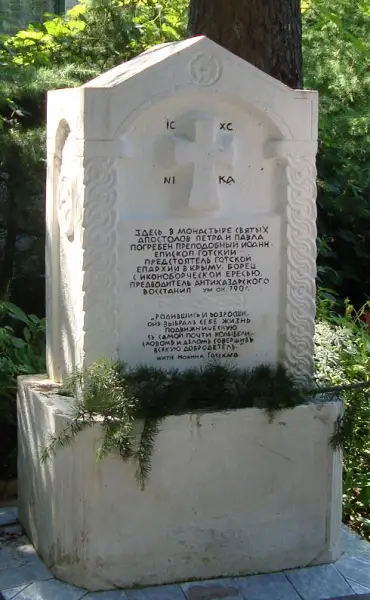
Overview
John of Gothia was a Crimean Gothic metropolitan bishop of Doros who became, briefly, a national liberator: in 787 he led a rising that toppled and drove out the Khazar overlords of Gothia. Born at Partenit in Crimea, to Leon and Fotina of a Crimean Gothic family, he grew up to become a bishop in his homeland. His early career took him far afield — on a pilgrimage to Jerusalem, where he remained three years, and to Georgia, where he held a bishopric from 758 — before he returned to Gothia as metropolitan bishop of Doros. When Khazar domination grew oppressive, he placed himself at the head of an uprising in 787: the Khazar garrison and the Tudun were driven from Doros and the insurgents occupied the passes into the land. The Khazars retook the city within a year, and John was imprisoned at Phoulloi. He escaped and took shelter at Amastris, in Byzantine territory, dying there around 791. His remains were carried home to a church on Ayu-Dag at Partenit, and the Eastern Orthodox Church enrolled him among its saints.
The Complete Life
Early Career
John was born at Partenit, on the southern coast of Crimea, into a Crimean Gothic family; his parents were Leon and Fotina. The Gothic community of the Crimean mountains had long preserved its Christian faith, and John grew up to become a bishop. His path to the episcopate ran through the wider Christian East: he went on pilgrimage to Jerusalem and remained in the holy city for three years, an apprenticeship in the faith at its sources. From there his career brought him to Georgia, where he became a bishop in 758. Only later did he return to his homeland, where he was raised to the metropolitan see of Doros, the chief city and stronghold of the Crimean Goths in their mountain country. As metropolitan he stood at the head of a small but ancient church, caught between the Byzantine world to which its faith belonged and the Khazar empire that exercised dominion over the peninsula and its passes.
§ John of Gothia
The Revolt of 787
In 787 John placed himself at the head of a revolt against Khazar domination of Gothia. The uprising succeeded at first: the Khazar garrison quit Doros together with the Tudun, the khanate's resident governor, and the insurgents took control of the passes into the land, giving the Goths brief command of their own land. The liberation did not last. Within months the Khazars had Doros back in their hands, and the metropolitan who had led the rising was imprisoned at Phoulloi. What had begun as a national and political revolt became, in the person of its bishop-leader, a witness of captivity endured for his people. John did not remain in prison: he later managed to escape, and fled beyond Khazar reach to seek refuge in Amastris, in the Byzantine Empire on the southern shore of the Black Sea.
§ John of Gothia
Death and Veneration
John died at Amastris around the year 791, an exile far from the see he had defended. His story did not end there. His remains came home across the sea to Crimea and were laid in a church on Ayu-Dag, the mountain by Partenit where he was born; there a monument in his honor rises today. The Eastern Orthodox Church canonized him as a saint, keeping his memorial on June 26. He is honored as a patron of the Goths and of Crimea itself, and, in a fitting tribute to the bishop whose revolt was recorded and studied rather than forgotten, of historians; monks also claim his intercession. His life, preserved in the histories of the Goths in the Crimea, stands as the memory of a churchman who risked throne and liberty for his flock and was received by his people as a martyr of their freedom.
§ John of Gothia
Timeline
- 758
Becomes a bishop in Georgia after three years on pilgrimage in Jerusalem
§ John of Gothia
- 787
Leads a revolt against Khazar domination; the garrison and Tudun are expelled from Doros and the rebels seize the mountain passes
§ John of Gothia
- 791
Dies at Amastris in the Byzantine Empire after escaping from captivity
§ John of Gothia
The Record
- Patron of
- Goths·Crimea·Historians·Monks
- Symbols
- Bishop's omophorion·Cross·Ayu-Dag mountain
- Canonization
- Canonized by the Eastern Orthodox Church
Prayer
Bibliography
Show 1 sources
- Vasiliev, Aleksandr A. The Goths in the Crimea. Cambridge, MA: The Mediaeval Academy of America, 1936.
Profile text adapted from the Wikipedia article, licensed CC BY-SA 4.0.
Pray with this saint every day
Save St. John of Gothia to your favorites, read the full profile, and get feast-day reminders in the Saints app.
Get the Saints AppFree on the App Store for iPhone and iPad