
1829 – 1909·Feast January 2 (New Style); also commemorated November 1 (New Style)
St. John of Kronstadt
Righteous Priest and Wonderworker of Kronstadt
Overview
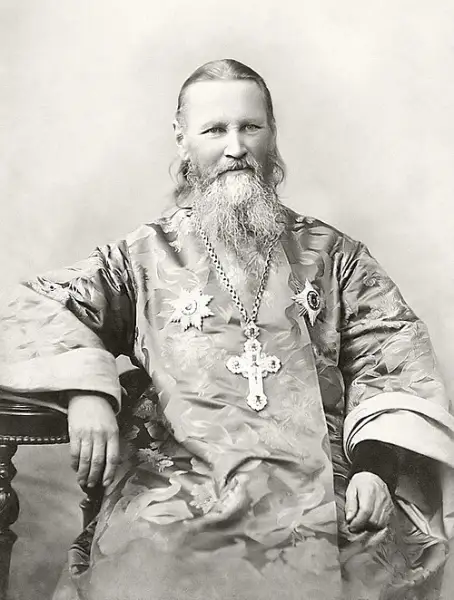
John of Kronstadt, born Ivan Ilyich Sergiyev, was a Russian Orthodox archpriest of Saint Andrew's Cathedral in the naval base of Kronstadt and a member of the Most Holy Synod. He became the most celebrated priest of late imperial Russia, famed for his mass confessions, his prayers as a healer and visionary, and an immense charitable enterprise in Kronstadt. His advocacy of frequent Holy Communion reawakened Russian Orthodox practice, and his spiritual diary, published in English as My Life in Christ, became a devotional classic. Venerated as a living saint by the crowds who flocked to him in their thousands, he was also a deeply polarizing figure: after the Revolution of 1905 he allied himself with the far-right Union of the Russian People, pursued a fierce public vendetta against Leo Tolstoy, and fled while his fellow clergy faced the 1905 Kronstadt uprising. He died in Kronstadt on January 2, 1909. He was canonized by the Russian Orthodox Church Outside Russia in 1964 — its first canonization independent of Moscow — and by the Moscow Patriarchate in 1990.
The Complete Life
Early Life
The future saint was born Ivan Ilyich Sergiyev on October 31, 1829 (Old Style October 19), at Sura, a village of the far north standing near the White Sea in Arkhangelsk Governorate, Russian Empire. His family belonged to a hereditary line of village clergy; his father served as a poor dyachok, a reader, in the local church. Little reliable information survives about his childhood, and what is known comes mainly from late reminiscences. In his autobiography he relates that his parents sent him to the parish school, where study proved too difficult for him; he prayed earnestly for help and received inspiration, after which he rose to the top of his school and then of his seminary. This academic success carried him to the Theological Academy in Saint Petersburg, the imperial capital, from which he graduated in 1855, placing 35th among the 39 students of his year. The poor boy from the far north had traveled, through prayer and perseverance, to the doors of the empire's chief city — and from there to the crowded naval town that would bear his name for the rest of his life.
§ Early life
The Kronstadt Father
From 1855 John served as a priest in Saint Andrew's Cathedral in Kronstadt, the naval base near Saint Petersburg. He married the twenty-six-year-old daughter of the cathedral's archpriest, but Bishop Benjamin (Fedchenkov) records that after the wedding he refused marital relations with his wife, even after she laid complaints against him before the church authorities; their niece Rufina lived with the couple. The young priest behaved in ways his contemporaries found startling. He walked the streets in constant prayer with his arms crossed on his chest; he aimed to celebrate the liturgy every single day; during the services he was unusually expressive, departing from the customary text and at times turning his back to the altar. Most consequentially, he promoted confession and Communion at frequent intervals, at a time when the Russian faithful communed only once or twice a year, and he eased certain requirements for communicants, even permitting women during menstruation to receive, though this was normally forbidden. Church authorities were troubled, and his biographer Nadieszda Kizenko notes that aspects of his behavior recalled Protestants to some observers and the Khlysts to others. Yet the distinctive style drew attention and gave scope to his charisma, and he was widely venerated as a saint within his own lifetime for his renown as a man of prayer, a healer, and a seer.
§ Kronstadt Father
Charity and Fame
John's compassion took organized shape in 1882, when he established a relief institution in Kronstadt called the House of Industry. It maintained its own church, a coeducational elementary school, an orphanage, a hospital open to all who came, a boarding house, a free public library, a shelter for the homeless that took in 40,000 people each year, workshops where the impoverished could earn money, a low-cost canteen dishing out some 800 free holiday meals, and a hostel for travelers. By the early 1890s he was known throughout Russia, and people arrived at Kronstadt in their thousands every day. His mass confessions drew vast congregations, in which thousands confessed together amid tears and fervor. His national prominence dates from 1883, when an open letter in the newspaper Novoe Vremya reported sixteen people telling of their healing through his prayers. The publication was a turning point: appearing in a secular paper without the required religious censorship, it was received by the hierarchy as an intrusion into their affairs, and the Most Holy Synod found itself at a loss before a priest who claimed, in effect, to be a living wonderworker — Metropolitan Isidore, John's direct supervisor, was especially displeased. In 1894, however, the dying Tsar Alexander III summoned John to his bedside at Livadia Palace; although his prayers did not save the Tsar, the imperial summons made John immune thereafter to the criticism of church authorities.
§ Kronstadt Father
Spirituality and Writings
The heart of John's spiritual message was the Eucharist. He recalled Russian Orthodoxy to its ancient practice of approaching Holy Communion at every Divine Liturgy, and for this reason icons usually show him with a Communion chalice in his hands. His best-known work is his spiritual diary, published in English as My Life in Christ, or Moments of Spiritual Serenity — extracts of contemplation, reverent feeling, and earnest self-amendment drawn from his daily life of prayer. Other writings in translation include his counsels on the Christian priesthood, homilies on repentance for the Lenten season, and teachings on prayer. His diary became a devotional classic read far beyond Russia. His spirituality combined adoration of the sacrament with a burning sense of the reality of God's action in the world: he was believed to raise the dead, and his prayers were sought as a source of bodily healing across all classes of Russian society. From his circle came later bishops and saints — among them Cyril Smirnov, Seraphim Chichagov, and the future John of Shanghai and San Francisco — who looked back to the Kronstadt priest as the formative example of a life spent at the altar and among the poor.
§ Iconography and commemoration
Controversy and Final Years
The last decade of John's life was clouded by politics and faction. He first condemned the organizers of the Kishinev Pogrom, then changed his mind, apologized to them, and blamed the Jews themselves, evidently believing they had staged the events to further revolutionary ends; he nonetheless continued to condemn violence, counseling his allies to fight in a Christian way. After the Revolution of 1905 he allied himself with the far-right Black Hundreds, accepting honorary membership in the Union of the Russian People and publicly consecrating its banners; when its founder, Alexander Dubrovin, invited the hierarchs of Moscow, Saint Petersburg, and Kiev to a great rally in November 1906, and John alone appeared. He was the only priest of Saint Andrew's to flee Kronstadt during the uprising of 1905, while his fellow clergy marched toward the rebels, and the press accused him of cowardice. Writers such as Nikolai Leskov and Maxim Gorky mocked him, while John pursued a fierce campaign against Leo Tolstoy, whose religious teaching he regarded as heretical. A circle of devotees, nearly all women, hardened into the Ioannite sect, which revered John as an incarnation of Christ; John denounced it as anathema, called its teachings the doctrines of the devil, and traveled to refute them. In the autumn of 1907 Tsar Nicholas II appointed him to the Holy Synod, though illness kept him from every meeting; in that year he also prophesied the fall of the empire and the terribly dark times that would follow it. He died in his home in Kronstadt on January 2, 1909 (Old Style December 20, 1908).
§ Support for Russian far right
Death, Canonization, and Legacy
After John's death his coffin was carried through Saint Petersburg with reverent ceremony and buried in the Ioannovsky Convent, to which he bequeathed all his possessions by his last will — a gift that greatly benefited the convent and stirred suspicions of forgery. In 1909 Tsar Nicholas II ordered that he be commemorated by the Church, and the Most Holy Synod directed an annual commemoration on the day of his death. Pilgrims streamed to his grave until the Soviet authorities resolved to eliminate it: when the Ioannovsky Convent was closed in 1923-1926 the crypt was bricked up, and a Soviet historian later claimed the coffin had been carried out of the city and burned, though no reburial is recorded. After 1990 a church-necropolis was consecrated in the crypt beneath the Twelve Apostles cathedral at the Ioannovsky Convent, with a sarcophagus built where the coffin had rested. On November 1, 1964, John was canonized by the Russian Orthodox Church Outside Russia — that church's first canonization independent of Moscow, prepared in large part by St. John Maximovitch of San Francisco — and in 1990, amid perestroika, the Moscow Patriarchate canonized him as well. His feast days are kept on December 20 Old Style (January 2 New Style) and October 19 Old Style (November 1 New Style).
§ Death, canonization, and legacy
Legacy
John's veneration grew quickly after the fall of the Soviet Union: from 1990 to 2016 over sixty new churches and altars in Russia alone received his dedication, and a church bears his name in Hamburg, Germany. In America, a memorial church was dedicated to him in Utica, New York, in 1964 — the first church in the world under his patronage. His Kronstadt apartment was partially restored and registered as the John Apartment Museum at 21 Posadskaya Street, monuments to him stand in Kronstadt, Irkutsk, and Moscow, and his biography appeared in Russia's most respected biographical series, Lives of Remarkable People. The Ioannovsky Convent, the second-largest monastic community in Saint Petersburg, remains closely bound to his name: he established it and nourished it spiritually during his lifetime. His memory is not uncontested. In 2014 a proposal to establish a memorial day for him in Saint Petersburg drew strong opposition from the Federation of Jewish Communities of the CIS, which cited his membership in the Union of the Russian People and its record of anti-Semitism. Both his Eucharistic renewal and his political entanglements remain part of the complicated inheritance he left to the Orthodox Church.
§ Death, canonization, and legacy
Timeline
- 31 Oct 1829
Born Ivan Ilyich Sergiyev at Sura, a northern village close to the White Sea, to a poor parish reader
§ Early life
- 1855
Graduates from the Theological Academy in Saint Petersburg
§ Early life
- 1855
Begins work as a priest at Saint Andrew's Cathedral in Kronstadt and marries the archpriest's daughter
§ Kronstadt Father
- 1882
Opens the House of Industry in Kronstadt, with church, schools, orphanage, hospital, library, and workshops
§ Kronstadt Father
- 1883
Reaches wide prominence after an open letter in Novoe Vremya reports sixteen healings through his prayers
§ Kronstadt Father
- 1894
Summoned by the dying Tsar Alexander III to Livadia Palace in the Crimea; unable to heal him, he gains immunity from church criticism
§ Kronstadt Father
- 1902
A collection of his diatribes against Leo Tolstoy is published; he declines an honorary fellowship at the University of Tartu because Tolstoy received the same honor
§ Support for Russian far right
- 1905
During the Kronstadt uprising he is the only priest of Saint Andrew's to flee, drawing accusations of cowardice from the press
§ Support for Russian far right
- Nov 1906
Attends the mass meeting of the Union of the Russian People in place of the invited hierarchs and publicly consecrates its banners
§ Support for Russian far right
- 1907
Appointed by Tsar Nicholas II to the Holy Synod but never attends a meeting because of serious illness; prophesies the fall of the Russian Empire
§ Support for Russian far right
- 2 Jan 1909
Dies in his home in Kronstadt; his coffin goes through Saint Petersburg amid solemn rites to burial at the Ioannovsky Convent
§ Death, canonization, and legacy
- 1 Nov 1964
Canonized by the Russian Orthodox Church Outside Russia, the church's first canonization independent of the Moscow Patriarchate
§ Death, canonization, and legacy
- 1990
Canonized by the Moscow Patriarchate as church life in the Soviet Union opens up
§ Death, canonization, and legacy
In Their Own Words
You ought to have stone hung around your neck and be lowered with it into the depths of the sea.
Now live according to God's truth and go to Holy Communion as often as possible.
The Record
- Major works
- My Life in Christ (spiritual diary)·House of Industry, Kronstadt·Ioannovsky Convent, Saint Petersburg·Counsels on the Christian Priesthood·Spiritual Counsels of Father John of Kronstadt·Season of Repentance: Lenten Homilies
- Patron of
- Sick people·Children with learning difficulties·People in a desperate situation·Those who struggle with alcohol and drug addiction·Those who have difficulties raising children·Kronstadt·Saint Petersburg
- Symbols
- Communion chalice·Priestly vestments
- Canonization
- Canonized November 1, 1964 by the Russian Orthodox Church Outside Russia; canonized 1990 by the Moscow Patriarchate
Prayer
Bibliography
Show 9 sources
- Kizenko, Nadieszda (2000). A Prodigal Saint: Father John of Kronstadt and the Russian People. Penn State University Press. ISBN 978-0-271-01976-5.
- Kizenko, Nadieszda (1998). "Ioann of Kronstadt and the Reception of Sanctity, 1850-1988". The Russian Review. 57 (3): 327. doi:10.1111/1467-9434.00027.
- Laqueur, Walter (1993). Black Hundreds: The Rise of the Extreme Right in Russia. New York: HarperCollins. pp. 50-51.
- McLean, Hugh (1953). "Leskov and Ioann of Kronstadt: On the Origins of Polunoscniki". The American Slavic and East European Review. 12 (1): 93-108. doi:10.2307/3004258.
- Rawson, Donald C.; Richards, David (1995). Russian Rightists and the Revolution of 1905. Cambridge University Press. pp. 64-65. ISBN 9780521483865.
- Bartlett, Rosamund (2011). Tolstoy: A Russian Life. Houghton Mifflin Harcourt. pp. 392-398. ISBN 978-0-15-101438-5.
- Perry, John & Pleshakov, Constantine. The Flight of the Romanovs: A Family Saga. Basic Books, 1999, p. 62.
- "Macedonians and Turks". The Kentucky Post. 5 May 1903. p. 8.
- Psarev, Andrei (31 October 2023). "Canonization of St. John of Kronstadt by ROCOR in 1964". ROCOR Studies.
Profile text adapted from the Wikipedia article, licensed CC BY-SA 4.0.
Pray with this saint every day
Save St. John of Kronstadt to your favorites, read the full profile, and get feast-day reminders in the Saints app.
Get the Saints AppFree on the App Store for iPhone and iPad