
1160 – 1213·Feast December 17
St. John of Matha
Co-founder of the Trinitarian Order
Overview
John of Matha was a French priest who co-founded the Order of the Most Holy Trinity — the Trinitarians — a body devoted from its beginning to ransoming Christians taken captive by North African raiders. Born to noble parents in Provence, he was educated at Aix-en-Provence and then studied theology at the University of Paris, where he was ordained a priest in December 1192. A vision during his first Mass in January 1193 — Christ holding two chained captives, a Moor and a Christian — fixed the direction of his life. After a period of retreat with the hermit Felix of Valois, he obtained the approval of Pope Innocent III on 17 December 1198 for a new order in honour of the Blessed Trinity. Its first house stood at Cerfroid, north of Paris, and its second at the church of San Tommaso in Formis in Rome. John twice crossed to Tunisia, in 1202 and 1210, and brought many enslaved Christians home to freedom. He died in Rome on 17 December 1213. His cultus was confirmed by Pope Alexander VII in 1666, and the Trinitarian Order he founded remains active on five continents.
The Complete Life
A Noble Boy in Provence
John was born at Faucon-de-Barcelonnette, on the borders of Provence, to noble parents, Euphemius and Martha. He received the name John in baptism, in honour of John the Baptist, a dedication that suits the austerity and directness of his later career. Euphemius sent his son to school at Aix-en-Provence for the training fitting a young nobleman: there he learned grammar, fencing, riding, and the other accomplishments of his class. The sources, drawing on traditions that circulated after his death, report that even in this comfortable setting his charity stood out. He passed on to the poor a large share of the allowance his parents remitted, and every Friday he visited the hospital to assist the penniless sick. These habits — study of the liberal arts, physical discipline, and a systematic care for the suffering — read like a preparation in miniature for the work of his maturity, which would demand learning, endurance, and an unflinching attention to human misery. The boy from the Alpine frontier of Provence was acquiring, at his father's expense, the skills of a knight and the instincts of a servant of the poor.
§ Life and work
Paris, Priesthood, and a Vision at the Altar
From Provence John went to the University of Paris to study theology, then the intellectual centre of western Christendom. He received priestly ordination at thirty-two, in December 1192. Trinitarian tradition assigns a decisive importance to his first Mass, celebrated on 28 January 1193, and at that altar he saw Christ standing with two captives in chains — one a Moor, one a Christian — at a time when the Crusades were in full force; the Christian captive carried a staff marked with a red and blue cross. After the Mass John resolved to devote himself to ransoming Christians held captive by the Moors. Before undertaking so perilous a work he judged it needful to prepare in retirement, prayer, and mortification. Word reached him of Felix of Valois, a holy hermit dwelling in the great forest near Gandelu in the diocese of Meaux; John sought him out and begged to be formed in the practice of perfection. The partnership formed in that forest retreat would carry the project from private inspiration to papal approval: the scholar-priest supplied the vision, and the old hermit would supply companionship, counsel, and finally his own name beside John's in the Order's memory.
§ Life and work
The Order of the Most Holy Trinity
One day while walking with Felix, John received a second vision: a white stag came to a stream bearing a red and blue cross set among its antlers. He disclosed to Felix the plan inspired at his first Mass — to succour captive Christians held in slavery — and Felix offered his help in carrying it out. In the severe winter of 1197 the two set out for Rome to obtain the Pope's approval. On 17 December 1198 they secured preliminary assent of Pope Innocent III for a new order devoted to the honour of the Blessed Trinity and charged with ransoming captive Christians; full approval followed in 1209. The ransom of captives belonged among the corporal works of mercy, and during the Crusades, when so many Christians risked falling into Muslim hands, several religious orders arose vowed exclusively to this work. The Trinitarians' first monastery rose at Cerfroid, north of Paris, on the ground of Felix's old hermitage, and the second at the church of San Tommaso in Formis in Rome. From these houses the Order organized the practical machinery of its mission: fundraising, travel to the slave markets of the southern Mediterranean, negotiation, payment, and the escorted return of the freed.
§ Order of the Most Holy Trinity
Mary, the Blessed Trinity, and Good Remedy
The Trinitarian project rested on an intense devotion to the Holy Trinity, from which the Order took both its name and its habit, bearing the red and blue cross beside the white. But ransoming slaves required large sums of money, and John understood that the fundraising on which his mission depended needed a patron stronger than any human benefactor. the Order therefore set its whole fundraising enterprise beneath the patronage of the Blessed Virgin Mary, the Mother of God; and in thanks for her help, John saluted Mary with the title of Our Lady of Good Remedy — a title that arose directly from the practical anxieties of the ransom missions, the constant need to find resources before captives could be bought back. Devotion to Mary under this ancient title spread widely through Europe and Latin America, and the Church keeps her feast under it on 8 October. In iconography the devotion is often shown as the Virgin handing a bag of money to John of Matha, a striking image in which heaven itself underwrites the work of mercy. John's spirituality was thus entirely apostolic: contemplation of the Trinity, confidence in Mary, and the conversion of both into coins, journeys, and freed prisoners.
§ Our Lady of Good Remedy
Tunisia, Francis of Assisi, and a Roman Death
John did not manage the redemption of captives from a distance. The Order's first rescue of enslaved Christians came in 1201, and John then travelled to Tunisia in 1202 and again in 1210, returning each time with countless Christian slaves he had bought out of bondage. These voyages to the North African coast were the most dangerous expression of the Order's vocation, exposing its founder to the slave markets and seaborne risks his friars would face for centuries. Before his death, Trinitarian tradition relates, he met Francis of Assisi and presented the young founder to the Frangipani, a family that would become benefactors of the Friars Minor — a small episode that places John at the crossroads of the thirteenth century's evangelical renewal. His death came at Rome on 17 December 1213, in the Caelian Hill house of Thomas In Formis, not far from the Trinitarian church that had been the Order's second home. He was fifty-three years old. His feast is kept on 17 December in the Ordinary Form of the Roman rite, while traditional Catholics who observe the Extraordinary Form retain his older feast of 8 February.
§ Order of the Most Holy Trinity
Veneration and Confirmation of the Cultus
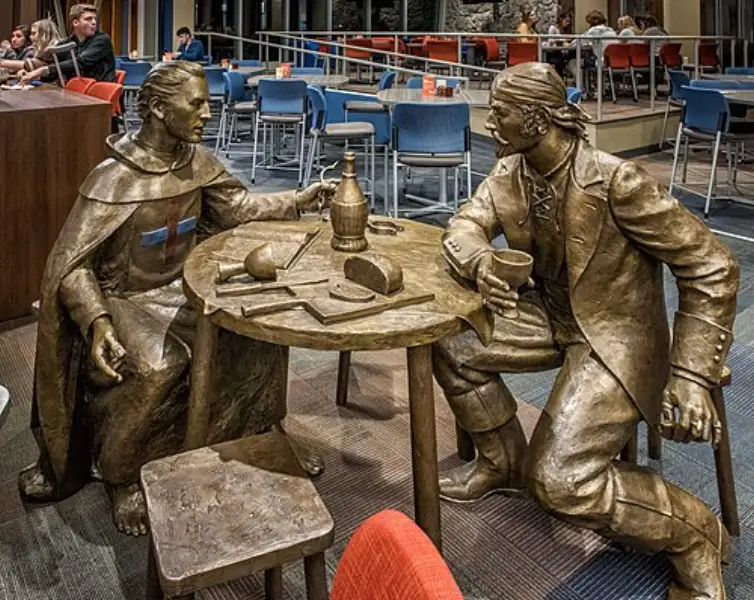
Devotion to John of Matha grew steadily after his death in 1213, nourished by the continuing work of the Trinitarians whose founder he was. In 1655 his remains were carried from Rome to Madrid, a translation that set his cult at the centre of the Spanish monarchy's own deep engagement with the work of redeeming captives. Ten years later, in 1665, his cultus was formally approved, and on 21 October 1666 Pope Alexander VII confirmed it — the act by which the Church recognized the immemorial veneration of the saint and authorized his office and feast. On the General Roman Calendar as it now stands, his feast falls on 17 December, the day he died, while Catholics of the Extraordinary Form continue to observe his historical feast of 8 February. In art he is easily identified: a man in the Trinitarian habit bearing the white, blue and red cross on his breast, a purse in hand, his wrists or ankles in chains, captives at his side, and the mitre laid on the ground before him — a founder's humility set before the emblem of his office. Statues of John stand, among many other places, at the entrance of Mafra Palace in Portugal and in the colonnade of St Peter's Square.
§ Veneration
An Order That Still Frees
The most concrete legacy of John of Matha is the Order of the Most Holy Trinity, which after more than eight centuries remains at work on five continents and across many countries, still carrying the charism of ransom and mercy he gave it. His memory has attached itself to places and institutions far from medieval Provence. DeMatha Catholic High School in Hyattsville, Maryland, is named after him and is sponsored by the Trinitarians themselves; a village in the Canadian province of Quebec bears the name Saint-Jean-de-Matha. In 1865, claiming the medieval ransomer as an ally against American slavery, the poet John Greenleaf Whittier published The Mantle of St. John De Matha, reaching across the centuries to claim the ransomer of Mediterranean captives as an ally in the struggle against American slavery — a measure of how legible John's example remained to reformers. The devotion of Our Lady of Good Remedy, which he established, continues to be widely practised in Europe and Latin America. Alongside his co-worker Felix of Valois, he is commemorated in statuary on the Charles Bridge in Prague, and the history of the Order he founded is kept alive today by institutions that bear his name.
§ Legacy
Timeline
- 23 Jun 1160
Born at Faucon-de-Barcelonnette, on the borders of Provence.
§ Life and work
- Dec 1192
Elevated to the priesthood at thirty-two, after theological studies at the University of Paris.
§ Life and work
- 28 Jan 1193
Celebrated his first Mass and received a vision of Christ with two chained captives.
§ Life and work
- 1197
Set out with Felix of Valois for Rome in a severe winter to seek papal approval for the new order.
§ Order of the Most Holy Trinity
- 17 Dec 1198
Obtained the preliminary approval of Pope Innocent III for the Trinitarian Order.
§ Order of the Most Holy Trinity
- 1201
The Order carried out the first rescue of Christian slaves.
§ Order of the Most Holy Trinity
- 1202
Travelled to Tunisia and brought back numerous Christian slaves.
§ Order of the Most Holy Trinity
- 1209
The Order of the Most Holy Trinity received its full approval.
§ Order of the Most Holy Trinity
- 1210
Made a second journey to Tunisia to redeem captives.
§ Order of the Most Holy Trinity
- 17 Dec 1213
Died at Rome in the Caelian Hill house of Thomas In Formis.
§ Order of the Most Holy Trinity
- 1655
Relics translated from Rome to Madrid.
§ Veneration
- 21 Oct 1666
Cultus confirmed by Pope Alexander VII.
§ Veneration
The Record
- Major works
- Order of the Most Holy Trinity (Trinitarians)·Houses at Cerfroid and San Tommaso in Formis, Rome·Devotion of Our Lady of Good Remedy
- Symbols
- Purse·Trinitarian habit with the white, blue and red cross on the breast·Chains in his hands or at his feet·Captives near him·Mitre at his feet
- Canonization
- Cultus confirmed by Pope Alexander VII on 21 October 1666.
Prayer
Bibliography
Show 6 sources
- "About the Trinitarians' Saints and Blesseds"
- Brodman, James William, Ransoming Captives in Crusader Spain: The Order of Merced on the Christian-Islamic Frontier, 1986
- Ibn Khaldun, Histoire des Berbères et des dynasties musulmanes de l'Afrique septentrionale, ed. Paul Casanova and Henri Pérès, trans. William MacGuckin, baron de Slane (Paris, 1925-56), 3: 116-17
- Moeller, Charles. "Order of Trinitarians." The Catholic Encyclopedia. Vol. 15. New York: Robert Appleton Company, 1912
- Butler, Rev. Alban, Taken from Vol. I of "The Lives or the Fathers, Martyrs and Other Principal Saints", Vol. I, D. & J. Sadlier & Co., 1864
- "History of John de Matha", DeMatha Catholic High School, Hyattsville, MD
Profile text adapted from the Wikipedia article, licensed CC BY-SA 4.0.
Pray with this saint every day
Save St. John of Matha to your favorites, read the full profile, and get feast-day reminders in the Saints app.
Get the Saints AppFree on the App Store for iPhone and iPad