
died 1589·Feast July 3
St. John of Moscow
Fool for Christ and wonderworker of Moscow
Overview
John of Moscow, known as Blessed John the Fool for Christ, was a sixteenth-century Russian ascetic celebrated as a wonderworker and seer. Born on the outskirts of Vologda, he spent his youth in hard manual labour, working in a local saltworks and carrying water, and he turned that labour into a spiritual discipline joined to strict fasting and personal prayer. Eventually he relocated to Rostov, where he took up the holy fool's calling, embracing folly for Christ's own sake. Chains hung with heavy iron crosses encircled him, and on his head sat a heavy iron cap, which earned him the nickname John Big-Cap. In Moscow he walked barefoot and nearly naked even in the severest frost, and he foretold the disasters in store for Russia: the era of Troubles, the coming of the Polish armies. He spoke the truth without fear even to Tsar Boris Godunov. Before his death in 1589 he displayed the gift of healing, marked out his resting place at the Pokrov church on Rva — the church that became the Cathedral of Basil the Great — and readied himself for the grave. His relics were uncovered on 12 June 1672, and he has been venerated at Moscow as a great wonderworker.
The Complete Life
A Labourer from Vologda
John was born on the outskirts of Vologda, in the Russian north, though the year of his birth is not recorded. Nothing is preserved of his family or schooling; what the sources remember is his work. In his youth he laboured in a local saltworks and worked as a water-carrier, both of them occupations of unrelieved physical hardship — the one spent in the steaming industry of salt-boiling, the other in the endless hauling of water for households that needed it. What distinguishes John's apprenticeship is that he did not treat such work as mere necessity. He made of his daily labour a discipline of the spirit, yoking it to an unbending rule of fasting and private prayer. The pattern is characteristic of Russian sanctity: the unlettered labourer who converts sweat into supplication and finds in the hardest tasks the surest road to God. By the time he left his native region, John had formed within himself the two qualities that would define his public life — an ascetic endurance greater than any external hardship could impose, and a habit of unbroken prayer carried on in the midst of ordinary toil. The saltworks and the water-carrying were his first monastery.
§ Introduction
Rostov and the Exploit of Holy Foolishness
From Vologda John eventually relocated to the community of Rostov, one of the ancient centres of Russian Christianity, and there he took up the way of the holy fool for the sake of Christ, the exploit that gave him his title. Holy foolishness — the deliberate embrace of insult, eccentricity, and apparent madness as a form of self-abasement before God and a weapon against human vanity — demanded of John outward signs that all who saw him could read. He wore chains with heavy iron crosses about his person, and on his head a heavy iron cap of punishing weight, so conspicuous that the people called him John Big-Cap. The nickname, meant half in mockery, became the name by which he is remembered. In taking up this way of life John renounced in advance the honour that his hidden asceticism might otherwise have earned him, choosing instead the misunderstanding and ridicule that the Fathers of the tradition considered the surest guard against pride. From Rostov his path led onward to Moscow, the capital, where the crowded streets rather than the desert would become the arena of his ascetic contest and his prophecy.
§ Introduction
Barefoot in Moscow, Bold before the Tsar
In Moscow John's foolishness took a form the city could not ignore: he went barefoot and almost naked even in the most severe frost, enduring publicly what would have killed a man of ordinary constitution. His endurance read as more than stubbornness, for the sources credit him with foresight. He foretold the great misfortunes that awaited Russia — the Time of Troubles, the dynastic collapse and famine that would follow the death of the last Riurikid tsars, and the incursion of the Poles — warning that in Moscow there would be many visible and invisible devils. The prophecy proved true within a decade of his death, and it fixed his reputation as a seer. Equally striking was his fearlessness with the powerful. Even before the grandest figures of state John would speak the truth without flinching — the tsar himself, Boris Godunov, not excepted. To admonish a tsar was an act that cost courtiers their careers and sometimes their lives; for a naked fool to do it openly, and to be suffered, testifies to the strange authority that holy foolishness commanded in Muscovite Russia. John's mission was the city's conscience, delivered in rags.
§ Introduction
The Grave He Chose
John's death in 1589 was prepared with the same deliberate freedom that had marked his life. Before dying he marked out for himself a resting place at the Pokrov church on Rva — the church later known as the Cathedral of Basil the Great, at the edge of Red Square, where the bodies of the holy fools lay in the honour of the people. Once the grave stood ready, he took off the chains he had worn for years and poured water over himself three times, an act of self-chosen burial ritual that the tradition has preserved as his final gesture: the ascetic dismissing his instruments of penance when their work was done, and cleansing himself to meet death clean. Before his death the blessed one also displayed the gift of healing, and Moscow honoured him as a wonderworker and seer of the first rank. He died in 1589, on the eve of the catastrophes he had foretold; the Time of Troubles broke over Russia within a few years, and the city that remembered the Big-Cap's warnings and his fearless speech had already given him a place among its saints of God.
§ Introduction
Relics, Manuscripts, and Commemoration
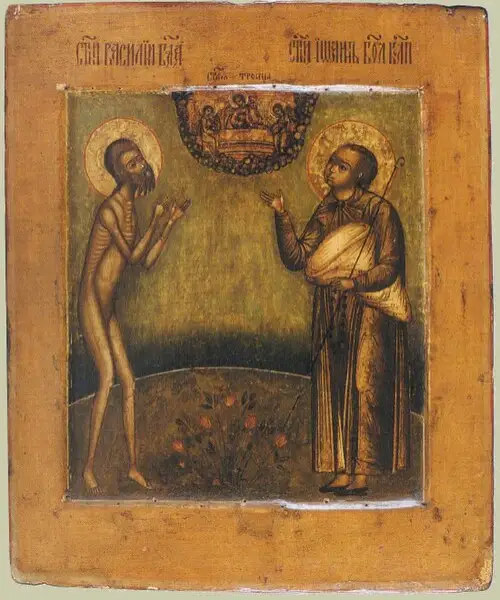
The veneration of Blessed John of Moscow continued at his grave in the Cathedral of Basil the Great, where he rests beside the memory of Basil Fool for Christ, the cathedral's own saint. On 12 June 1672 his relics were brought to light, discovered under a crypt in one of the cathedral's chapels — a formal recognition, more than eighty years after his death, of the cult that Moscow had never ceased to pay him. A Service and a Life of Blessed John survive in seventeenth-century manuscripts, the literary deposit of the community's memory, ensuring that his deeds and his prophecies outlived the generation that had known him. The Eastern Orthodox Church commemorates him on 3 July. Seventeenth-century iconography pairs him with Blessed Basil, the two fool-actors of the capital shown together in an icon now kept in the Andrei Rublev Museum at the Andronikov Monastery in Moscow — a image that places John among the most beloved type of Russian sanctity, the fool for Christ whose nakedness clothed the city's conscience and whose iron cap weighed less than the truth he carried beneath it.
§ Introduction
Timeline
- 1589
Died in Moscow, having prepared his own grave and displayed the gift of healing.
§ Introduction
- 12 Jun 1672
Relics brought to light under a crypt within one of the cathedral's chapels.
§ Introduction
In Their Own Words
In Moscow will be many visible and invisible devils.
The Record
- Symbols
- Heavy iron cap·Chains with heavy iron crosses
- Canonization
- Pre-congregation veneration; commemorated 3 July by the Eastern Orthodox Church.
Prayer
Bibliography
Profile text adapted from the Wikipedia article, licensed CC BY-SA 4.0.
Pray with this saint every day
Save St. John of Moscow to your favorites, read the full profile, and get feast-day reminders in the Saints app.
Get the Saints AppFree on the App Store for iPhone and iPad