
c. 1345 – 1393·Feast March 20
St. John of Nepomuk
Martyr of priestly loyalty thrown from the Charles Bridge
Overview
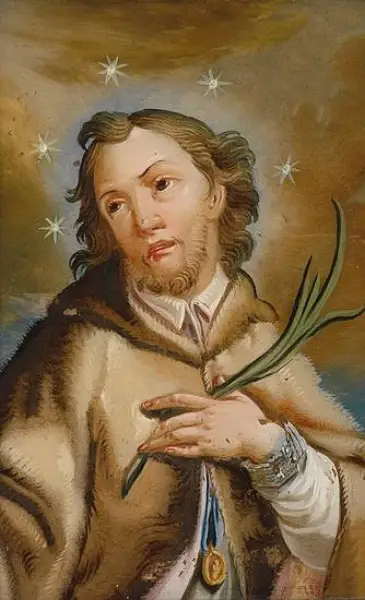
John of Nepomuk, also called John Nepomucene, was a Bohemian clergyman executed by King Wenceslaus IV of Bohemia for his loyalty to Archbishop Jan of Jenštejn in their dispute with the crown. Born around 1345 in the village of Pomuk, he studied at the University of Prague and at Padua, served the archbishop as notary, and in 1393 was made vicar-general of Saint Giles Cathedral. That year Wenceslaus moved to seize the revenue of the Benedictine abbey at Kladruby; Jenštejn resisted, and when the king arrested his subordinates, John alone stood by him. Tortured and thrown from the Charles Bridge into the Vltava on 20 March 1393, he died a martyr of the Church's liberty. In later centuries his story was retold as the tale of a confessor who died protecting the seal of the Queen's confession, and and the Church now venerates in him one who died for the Seal of the Confessional, invoked against slander and against every peril of water, floods and drowning alike. Beatified in 1721 and canonized in 1729, he became the quintessential Baroque saint, represented in tens of thousands of statues across Europe, usually with a halo of five stars.
The Complete Life
A Boy from Pomuk
John of Nepomuk was born between 1340 and 1350 — tradition settles on about 1345 — in the Bohemian village of Pomuk, the market town that now bears his name. His father was Velflín, a diminutive form of the name Wolfgang, a detail preserved from the parish records of a modest Bohemian village that would one day become a place of international pilgrimage. Of his childhood nothing else is recorded, but his subsequent career presupposes a boy of unusual promise, marked out for study in an age when literacy and Latin learning set a man apart. He attended the University of Prague, the first university in central Europe, founded scarcely a generation before his birth and already the intellectual hub of the Luxembourg kingdom of Bohemia. There the future vicar-general received the formation in theology and law that the Church of Prague would soon put to use. That he rose from a village in the Plzeň region to the cathedral chapter of the capital is itself a measure of the merit the young cleric displayed. The village of his birth kept his memory long before Rome canonized him: a chapel in his honour rose there in 1643, drawing pilgrims to the place where Velflín's son had first been cradled.
§ Biography
Notary, Student of Padua, Vicar-General
John's ecclesiastical career unfolded step by step within the archdiocese of Prague. In 1378 he received appointment as the archbishop's notary, an office that placed him at the centre of the church's documentary and judicial administration during years in which the Great Schism of the West was tearing Christendom between rival papal obediences. Seeking the highest professional qualification of his age, he read canon law at the University of Padua between 1383 and 1387, drinking at the Italian sources of legal science and returning to Bohemia equipped to serve as one of the archdiocese's canonists. The capital of his studies matched the capital of his destiny: in 1393 Archbishop Jan of Jenštejn of Prague named him vicar-general of Saint Giles Cathedral. The vicar-general stood second in the administration of the archdiocese, exercising jurisdiction in the archbishop's name, and the appointment shows that Jenštejn trusted John completely on the eve of their common catastrophe. A village boy turned notary, then a Padua-trained doctor of canon law, then the archbishop's own right hand: John of Nepomuk had climbed every rung of the ecclesiastical ladder his Church could offer when the quarrel between his archbishop and his king put the whole structure beneath his feet.
§ Biography
Kladruby, Torture, and the Bridge
The crisis that cost John his life began with money and ended in martyrdom. Archbishop Jenštejn looked to Pope Boniface IX in Rome for direction, while King Wenceslaus IV threw his weight behind the Avignon papacy and Antipope Clement VII. In 1393 the king moved to seize for himself the revenue of Kladruby's Benedictine abbey, and Jenštejn resisted the seizure. Wenceslaus, enraged, hauled the archbishop and his officials before him and had them seized; the archbishop slipped away, but John and three companions fell into the king's hands and were put to the torture. Among the prisoners John alone remained loyal to the archbishop. On 20 March, Wenceslaus had him hurled from the Charles Bridge into the Vltava, the fate commonly meted out to clerics condemned as criminals; some historians judge that the torture chamber had already killed him and that the river served to hide how he truly died. His body was found three days later on the bank and carried to a nearby church. Only when the king had gone to his country residence was John laid to rest in St. Vitus Cathedral, an open affront to Wenceslaus. The priest who would not abandon his bishop had been killed by the very power his office was meant to withstand.
§ Biography
The Seal of the Confessional and the Legend
Within decades of his death, John's killing was retold as a story about the seal of confession, and this reading of his martyrdom came to define his spirituality and his patronage. The legend first appeared in Thomas Ebendorfer's Chronica regum Romanorum of 1459: the king, so the tale ran, had put John to death for refusing to betray what the queen had confided to him. Pavel Žídek's advice-book for the king of 1471 embroidered the tale — a jealous Wenceslaus demands of Magister Johannes the name of the queen's lover, and on John's refusal orders him drowned, whereupon the river dries up. Other versions added a heavenly glow over the body in the water, stars hovering above the corpse on the riverbank, and a queen who bursts in upon the king to ask what light burns on the Vltava. Historians traced the confusion to John of Krumlov, dean of St. Vitus, who in 1483 misdated the death to 1383, and to Wenceslaus Hajek's chronicle of 1541, which invented two Johns of Nepomuk. However unhistorical, the legend expressed a theological truth the Church embraced: the Church venerates John as one who died for the Seal of the Confessional, and the angel with a finger to its lips became his emblem of the silence that guards the confessional.
§ Legend
The Aftermath of the Murder
John's violent death in March 1393 did not end the affair; it converted a quarrel over an abbey into an indictment of a king. Barely a month after the drowning, Jenštejn laid evidence of the king's crimes before Pope Boniface IX, hailing John of Nepomuk as Christ's glorious martyr, radiant with miracles — the earliest formulation of the cult that would grow around him. The chroniclers of the age recorded the killing with unusual care: Abbot Ladolf of Sagan documented John's life and death, and John of Posilge's chronicle of the Teutonic Order also carried the story, evidence that the news travelled far beyond Bohemia. When Wenceslaus was summoned to the Imperial Diet in Nuremberg in 1400, the murder of John of Nepomuk stood among the charges against him — a king called to account before the empire for the death of a priest seven years earlier. His grave — a modest stone beside the cathedral altar — soon became an object of popular veneration, honoured by Christians of several confessions who believed that neglecting the martyr's grave could bring paralysis or death upon the offender. The grave of the tortured vicar-general had become the most dangerous stone in Prague.
§ Biography
Beatification and Canonization in the Baroque Age
The road to the altars ran through three centuries of popular devotion. In 1421 a screen was set about the stone so that no foot would tread on it; the grille only made the tomb more prominent, and a second was added in 1530. In 1619 the Winter King Frederick V had the railings torn down, and a proper tomb was finally erected in 1694. When Fynes Moryson visited Prague in 1590 he found the fear of calamity for neglecting the martyr's grave still current; some of these very stories were later entered in evidence at the canonization. On 31 May 1721 John of Nepomuk was beatified by Pope Innocent XIII in Rome, and on 19 March 1729 he was canonized by Pope Benedict XIII. The acts of the process, running to five hundred pages, acknowledged the two-Johns problem and sanctioned veneration of the drowned priest as one who died for the sacrament of penance. The tomb now standing in the cathedral is the third, modelled by Joseph Emanuel Fischer von Erlach and carved by Antonio Corradini in 1736. Some historians hold that the Habsburgs advanced Nepomuk as a national saint to draw Czechs from the veneration of Jan Hus; even at the 1721 beatification festival the swan defeating the goose was a familiar motif.
§ Canonization
The Most Represented Czech in Art
John of Nepomuk became the quintessential Baroque saint and the most represented Czech person in the history of visual art. Statues of him number in the tens of thousands worldwide: around six thousand in Czechia alone, similar numbers in Austria and Germany, and smaller hosts across the former Habsburg lands, with individual monuments in almost every country of Catholic tradition. Most stand on bridges, for he is patron of bridges and defender against drowning — and all derive from the prototypical statue set on the Charles Bridge in Prague in 1683, carved by Jan Brokoff from a model by Matthias Rauchmiller on the supposed three-hundredth anniversary of the death then believed to have fallen in 1383. Belief in his powers surged in 1719 when the opened tomb revealed a tongue found shriveled but intact — most likely, scholars note, a remnant of brain tissue. The Jesuits adopted him among their patrons in 1732. Music honoured him in dozens of works: Antonio Caldara's oratorio of 1726 and a Mass in his name, a Te Deum by Johann Poppe for the canonization, and pieces by composers such as Jan Ignác František Vojta and Šimon Brixi. His five-starred halo marks the spot where the body was found on the Vltava's bank; his name remains a common baptismal name in the Czech lands.
§ Veneration
Timeline
- 1345
Born in the village of Pomuk, now Nepomuk, in Bohemia.
§ Biography
- 1378
Appointed notary to the archbishop.
§ Biography
- 1383
Began studies of canon law at the University of Padua.
§ Biography
- 1393
Made vicar-general of Saint Giles Cathedral by Archbishop Jan of Jenštejn of Prague.
§ Biography
- 20 Mar 1393
Tortured and thrown from the Charles Bridge into the Vltava on the orders of King Wenceslaus IV.
§ Biography
- 23 Mar 1393
His body was discovered on the river bank and taken to a nearby church; later interred in St. Vitus Cathedral.
§ Biography
- 1400
Murder of John of Nepomuk listed among the charges when Wenceslaus was summoned to the Imperial Diet at Nuremberg.
§ Biography
- 1421
A grille placed around his gravestone in St. Vitus Cathedral to protect it.
§ Canonization
- 1530
A second grille placed around the tomb.
§ Canonization
- 1619
The Winter King Frederick V had the tomb railings torn down.
§ Canonization
- 1643
A chapel built in his honour in his birthplace.
§ Veneration
- 1683
Charles Bridge adorned with the prototypical statue of the saint, modelled by Matthias Rauchmiller and carved by Jan Brokoff.
§ Veneration
- 1694
A proper tomb erected in St. Vitus Cathedral.
§ Canonization
- 1719
His tomb opened and his tongue found shriveled but intact; the Pilgrimage Church of Saint John of Nepomuk founded.
§ Veneration
- 31 May 1721
Beatified in Rome by Pope Innocent XIII.
§ Canonization
- 19 Mar 1729
Canonized in Rome by Pope Benedict XIII.
§ Canonization
- 1736
Third version of the tomb created by Antonio Corradini to a design by Joseph Emanuel Fischer von Erlach.
§ Canonization
In Their Own Words
A glorious martyr of Christ and sparkling with miracles
At Prague, in Bohemia, St. John Nepomucen, a canon of the metropolitan church, who, being tempted in vain to betray the secret of confession, was cast into the river Moldau, and thus won the palm of martyrdom.
At Prague in Bohemia, Saint John of Nepomuk, priest and martyr, who in defending the Church received many punishments from King Wenceslas the Fourth and, exposed to torture and torment, was finally thrown into the Moldavian River while still breathing.
The Record
- Patron of
- Confessors·Mariners·Raftsmen·Millers·Bridges·Against hazards by water·Against calumnies·For discretion·Protection from floods and drowning·Bohemia
- Symbols
- Halo with five stars·Cross·Bridge·Angel indicating silence by a finger over the lips·Priest's biretta
- Canonization
- Beatified 31 May 1721 by Pope Innocent XIII; canonized 19 March 1729 by Pope Benedict XIII.
Prayer
Bibliography
Show 11 sources
- Baring-Gould, Sabine. The Lives of the Saints. Hodges, 1873. 227–236
- Wratislaw, Albert Henry. Life, Legend, and Canonization of St. John Nepomucen. Bell and Daldy, 1873
- Chisholm, Hugh, ed. "Nepomuk, John of". Encyclopædia Britannica (11th ed.). Cambridge University Press, 1911
- Matsche, Franz. "Das Grabmal Des Hl. Johannes von Nepomuk Im Prager Veitsdom", Wallraf-Richartz-Jahrbuch 38 (1976): 92–122
- Kirsch, Johann Peter. "St. John Nepomucene", The Catholic Encyclopedia, Vol. 8. New York: Robert Appleton Company, 1910
- Louthan, Howard. Converting Bohemia: Force and Persuasion in the Catholic Reformation. Cambridge University Press, 2009
- Butler, Alban. The Lives of the Fathers, Martyrs, and Other Principal Saints, Volume V. James Duffy, 1866. 198–209
- The Roman Martyrology. Baltimore: John Murphy Company, 1916
- Martyrologium Romanum. Libreria Editrice Vaticana, 2004
- Holweck, Frederick George. A Biographical Dictionary of the Saints. B. Herder Book Company, 1924
- Evans, R.J.W. The Making of the Habsburg Monarchy, 1550-1700: An Interpretation. Clarendon Press, 1979
Profile text adapted from the Wikipedia article, licensed CC BY-SA 4.0.
Pray with this saint every day
Save St. John of Nepomuk to your favorites, read the full profile, and get feast-day reminders in the Saints app.
Get the Saints AppFree on the App Store for iPhone and iPad