
1st century
St. John of Patmos
Author of the Book of Revelation in exile
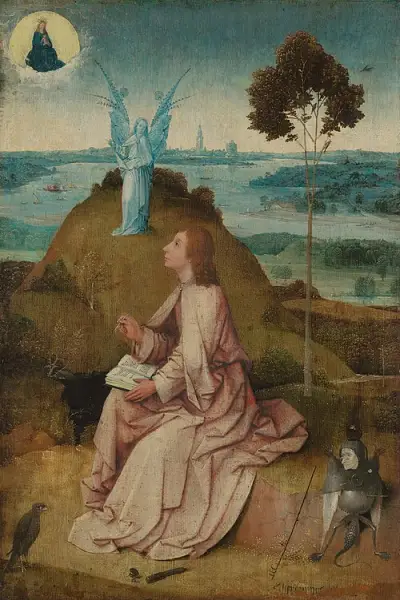
Overview
John of Patmos — known likewise as John the Revelator, John the Divine, and John the Theologian — carries the name that tradition has attached to the author of the Book of Revelation. The book itself identifies its writer only as John, who states in Revelation 1:9 that he was on the Aegean island of Patmos, off the coast of Roman Asia, for the word of God and the testimony of Jesus Christ. According to some biblical historians he had been banished there in the anti-Christian persecution of the emperor Domitian late in the first century; early tradition holds that the Roman authorities banished him, and Tertullian reports that he had earlier been plunged into boiling oil in Rome and emerged unharmed. Christian tradition long identified this John with John the Apostle, though commentators have distinguished the disciple from Revelation's writer since the Middle Ages, and most modern scholars deny the book to either John the Apostle or John the Evangelist. A minority of ancient writers, among them Eusebius, recognized a further John, John the Presbyter. Whichever identity is right, the exile of Patmos produced the only apocalyptic book of the New Testament canon.
The Complete Life
A Brother in Tribulation
The man behind the Revelation introduces himself with almost studied anonymity: the book's author gives his name only as John, without title, genealogy, or home. What he does disclose is his condition. In Revelation 1:9 he addresses his readers as their brother and companion in tribulation, and locates himself on Patmos, the island where he had landed for the word of God and the witness he bore to Jesus Christ. The self-description places him among the persecuted rather than the powerful — a Christian voice reaching the seven churches of Asia from a place of confinement. Everything else about him must be reconstructed from tradition and scholarship. Christian tradition, from an early date, took the book's writer to be John the Apostle himself — the son of Zebedee, to whom the Fourth Gospel was also attributed; but some Christian scholars as early as the medieval period separated the disciple from the writer of the Apocalypse, and the question of identity — apostle, evangelist, elder, or another John entirely — has remained open ever since. What is certain is that a prophet named John, suffering for his testimony, stood on a small Aegean rock and wrote the visions that close the Christian Bible.
§ Book of Revelation
Exile on Patmos
John is thought to have been deported to Patmos when the persecution of Domitian swept the Christian communities of Roman Asia late in the first century. Adela Yarbro Collins of Yale Divinity School judges the tradition credible: the imperial courts of the age routinely punished certain offences by banishment — the practice of magic and astrology among them — and prophecy of any stripe, pagan or Jewish or Christian, fell for the Romans into that same file of suspect arts. prophecy bearing on politics, as John's book plainly does, would in Roman eyes have menaced the order and power of the state; the Sporades supplied three of the islands on which Rome dumped its political offenders. A harsher legend attaches to the journey: Tertullian records, in The Prescription of Heretics, that John endured banishment after a cauldron of boiling oil at Rome had left him unharmed, the ordeal becoming one of the celebrated miracles of the apostolic age. On Patmos, whether as a sentenced exile or a fugitive, John received the visions he was commanded to write down and send to the churches — the empire's attempt to silence a prophet became the occasion of the loudest book in the canon.
§ Island of Patmos
Prophecy against the Empire
The spirituality of John of Patmos was a spirituality of resistance conducted in worship. His book is framed as prophecy — he speaks in the name of the risen Christ to the seven churches of Asia — and it was precisely this political register of prophecy that Rome, in Collins's analysis, classed among the dangerous arts it punished with banishment. Revelation's imagery of a beast demanding worship, of Babylon the harlot enthroned on her seven hills, and of a Lamb who conquers by being slain, reads the empire of Domitian through apocalyptic eyes and pronounces judgment on it. Yet the prophet who dares this critique describes himself not as a hero but as a brother and companion in tribulation, one who shares the sufferings of the churches he addresses and claims no exemption from them. His authority rests on a vision he underwent on the Lord's day on Patmos, and his book was written for the word of God and the testimony of Jesus — the same testimony for which, by his own account, he was on the island at all. Persecution, in his understanding, did not interrupt communion with God; it was the very place where the heavens opened.
§ Island of Patmos
Who Wrote the Revelation?
The identity of John of Patmos became one of the oldest debates in Christian literature. Justin Martyr, writing early in the second century, made the first known equation of Revelation's author with John the Evangelist, fixing the traditional identification with the apostle and beloved disciple. Other early voices dissented: Dionysius of Alexandria and Eusebius of Caesarea, struck by how differently Revelation speaks and thinks from the Gospel, rejected the equation and pressed on those grounds for the book's exclusion from the canon. The early Christian writer Papias seems in his work to set John the Evangelist apart from John the Elder, and a few ancient writers — Eusebius among them, who died in 339/340 — allowed for yet another John among the Lord's companions, John the Presbyter. Many scholars today give the authorship to that John the Elder, and most deny the book to either the Apostle or the Evangelist. The argument has never diminished the book: whatever the scholarly verdict, the visions written on Patmos are read in the liturgies of the Catholic Church, the Eastern Orthodox Church, and the Anglican Communion, and have inspired painters from Bosch to Poussin.
§ Book of Revelation
In Their Own Words
I, John, both your brother and companion in tribulation...was on the island that is called Patmos for the word of God and for the testimony of Jesus Christ.
The Record
- Major works
- Book of Revelation
- Canonization
- Pre-congregation; venerated in the Catholic Church, the Eastern Orthodox Church, and the Anglican Communion.
Prayer
Bibliography
Show 8 sources
- Souvay, Charles. "Patmos." The Catholic Encyclopedia. Vol. 11. New York: Robert Appleton Company, 1911
- Collins, Adela. (1985). "Patmos" [In] Paul J. Achtemeier [Ed.]. (1985) Harper's Bible Dictionary. San Francisco, CA: Harper & Row. p. 755
- Litfin, Bryan. After Acts: Exploring the Lives and Legends of the Apostles. Chicago, IL: Moody Publishers, 2015
- Cross, F. L., "Revelation, Book of." The Oxford Dictionary of the Christian Church, 3 ed. New York: Oxford University Press, 2005
- Justin Martyr, Dialogue with Trypho, 81.4
- Bauckham, Richard, Jesus and the Eyewitnesses (William B. Eerdmans Publishing, 2008). P. 420
- Harris, Stephen L. (1985). Understanding the Bible. Palo Alto: Mayfield. p. 355
- Ehrman, Bart D. (2004). The New Testament: A Historical Introduction to the Early Christian Writings. New York: Oxford. p. 468
Profile text adapted from the Wikipedia article, licensed CC BY-SA 4.0.
Pray with this saint every day
Save St. John of Patmos to your favorites, read the full profile, and get feast-day reminders in the Saints app.
Get the Saints AppFree on the App Store for iPhone and iPad