
d. 1231 (traditional)·Feast September 3
St. John of Perugia and Peter of Sassoferrato
Franciscan martyrs of Valencia
Overview
John of Perugia and Peter of Sassoferrato were Franciscan friars sent by St. Francis himself to preach to the Moors and win them for the Gospel. Giovanni da Perugia, a priest, belonged to the first band of Francis's companions; Pietro da Sassoferrato was a lay brother. Sent to Spain in the missionary expedition directed by Fra Bernardo di Quintavalle, they settled first at Zaragoza, founded a convent at Teruel in 1220, and then moved to Valencia to minister to the Christians held there as slaves. Lodged in the house of Don Blasco de Alagon, who warned them against preaching to the Moors, they were nevertheless inflamed with zeal one day and proclaimed the Gospel in the public square. Arrested by the governor Zayd Abu Zayd and steadfast in their faith, they were beheaded — by tradition on 29 August 1231, though the date, like the exact place of their execution, has been much debated. Their cult in Aragon and Valencia is immemorial; Teruel honours them as patrons and protectors against the scourge of locusts. Clement XI approved their cult in 1705, and their relics rest today at the Franciscan convent of Teruel.
The Complete Life
Among the First Companions of Francis
The two martyrs came from different stations within the young Franciscan Order. Giovanni da Perugia was a priest who had walked among the very first companions of St. Francis himself, a member of the small band who had gathered around the Poverello in the Order's earliest and most fragile years; Pietro da Sassoferrato was a lay brother, one of the rank-and-file religious whose hidden fidelity carried the movement's daily life. What united them was the missionary impulse that Francis planted at the heart of his Order from the beginning: the desire to preach the Gospel to the Muslims of Spain and North Africa. According to some chroniclers they crossed, in one chronicler's dating, with the 1217 Spanish mission directed by Fra Bernardo di Quintavalle, the Order's first vicar in the peninsula; according to others the mission dates to 1220. The commonest account places the commission in 1216, when Francis dispatched the pair to preach and convert the Moors at Teruel and Valencia. However the chronology is resolved, the two friars belonged to the first generation of Franciscans who took literally the founder's command to go among the Saracens — and who accepted, from the outset, that such a mission might end in martyrdom.
§ Biographies
Zaragoza, Teruel, and the Slaves of Valencia
According to tradition the friars settled first at Zaragoza, establishing a base in the Aragonese capital before pushing southward. At Teruel, in 1220, they founded a convent — a permanent Franciscan foothold in the frontier lands where Christian and Muslim territories met. From Teruel they went on to Valencia, a city under Muslim government, to serve the Christian captives held there, whose faith the Moorish authorities tolerated but confined. Their lodging was the house of Don Blasco de Alagon, a Christian lord who later founded Vilafranca and who knew the ground on which his guests stood: he warned them plainly against preaching to the Moors. The warning was prudent, and they disregarded it. Inflamed one day with holy zeal, John and Peter set about preaching the Gospel publicly, in the open square of a city where such speech was forbidden to Christians. The governor Zayd Abu Zayd had them imprisoned, and when neither man wavered in his faith they were beheaded. The place of their execution is debated — probably the square called Figuera or Higuera, afterwards the Plaza de la Reina — and so is the date, set traditionally at 29 August 1231, though some scholars anticipate it to 1227-28 or even, on strong grounds, to 1221.
§ Biographies
Martyrdom and Its Aftermath
The death of the two friars in the square at Valencia closed their mission but opened its harvest. Firm in their faith under imprisonment, they were beheaded — tied to stakes and slain by the sword, in the posture their later iconography would preserve. Tradition records that Zayd Abu Zayd himself, the governor who had condemned them, converted — according to legend — through the intercession of the martyrs, and after the Conquest of Valencia in 1238 gave one of his palaces to the friars to serve as a house of the Order. Whatever the historical refinement of the tale, its outline carried the missionaries' meaning: the blood of the two Franciscans had purchased for the Order its entry into Valencia. The chronology of their final days remains contested among scholars. Because Zayd had been deposed by his rival Zaen before 1228, some argue for a martyrdom as early as 1221; others hold to the traditional 29 August 1231; still others would place the death even later than 1228. The tradition preserved most widely holds to martyrdom at Valencia in 1231. The debate, unresolved after eight centuries, is itself a testimony to how early and how eagerly the memory of the two martyrs was claimed by the churches of Aragon and Valencia.
§ Biographies
An Immemorial Cult Raised to the Altars
The cult of John of Perugia and Peter of Sassoferrato is immemorial — older than any papal record — in Aragon, in Valencia, and most of all at Teruel, whose people name the pair their patrons and call on them against the plague of locusts that most threatened the fields of the region. When the legislation of Pope Urban VIII regularized the process for raising the dead to the altars, apostolic inquiries were opened to secure formal recognition of the two martyrs' cult. Recognition came on 31 January 1705, when Clement XI approved the cult, enrolling the pair among the blessed. In 1727 Benedict XIII conceded a proper office to the city of Teruel and moved the martyrs' feast to 3 September, where the Church still keeps it. Valencia received the same approval in 1783, joining the two provinces of the friars' apostolate under one liturgical commemoration. Never canonized in the modern form, the two Franciscans belong to the great company of beati whose veneration rests on centuries of uninterrupted devotion — confirmed, in their case, by two popes acting a half-millennium after the swords fell in the square at Valencia.
§ Veneration
Relics of Teruel
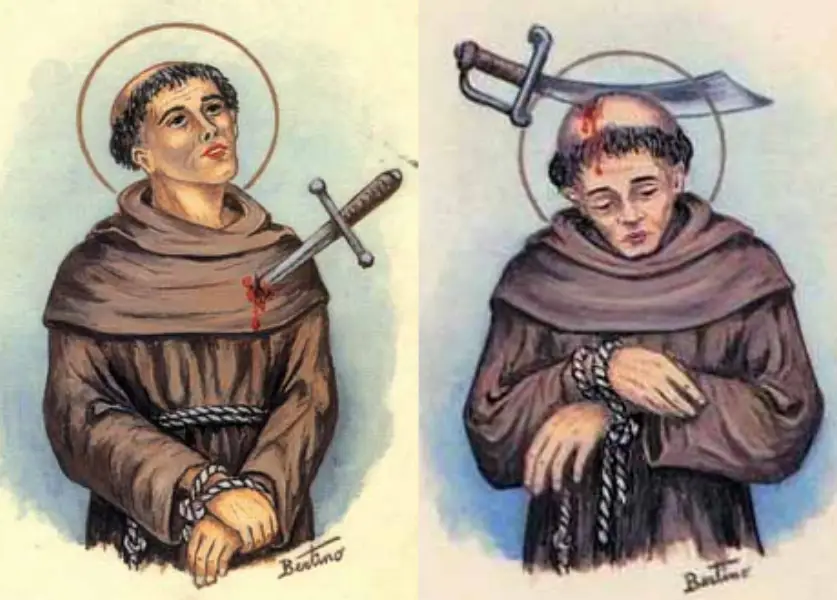
The bodily memory of the two martyrs has followed the fortunes of their Order. Their remains, ransomed back before Valencia fell to the conquerors, were laid in the convent church at Teruel — the very house they had founded in 1220 — and rested there for over six centuries as the treasure of the city that had received them first. In 1835, in the upheavals that closed convents across Spain, the remains passed to the church of S. Chiara; in 1900, once the Franciscan convent of Teruel had been rebuilt, they came home to it, where they rest today. In art the two blessed are shown in their Franciscan habit, bound to stakes, with the swords beside them — the scene of their martyrdom condensed into an emblem. Teruel keeps them as patrons and invokes them against the plague of locusts, a patronage rooted in the city's fields as much as in its churches. Of all the companions Francis sent toward the infidel, John of Perugia and Peter of Sassoferrato are among the first to have shed their blood on Spanish soil, and the convent of Teruel — their own foundation — remains the station of their cult.
§ Veneration
Timeline
- 1216
Sent by St. Francis with Peter of Sassoferrato to preach and convert the Moors at Teruel and Valencia.
§ Biographies
- 1220
Founded the Franciscan convent at Teruel.
§ Biographies
- 29 Aug 1231
Imprisoned by governor Zayd Abu Zayd and beheaded at Valencia for preaching the Gospel.
§ Biographies
- 1238
Zayd Abu Zayd, said to have converted through the martyrs' intercession, gave one of his palaces to the friars after the Conquest of Valencia.
§ Biographies
- 31 Jan 1705
Cult approved by Pope Clement XI.
§ Veneration
- 1727
Benedict XIII gave Teruel a proper office and assigned the martyrs' feast to 3 September.
§ Veneration
- 1783
The approval of the cult extended to Valencia.
§ Veneration
- 1835
Relics transferred from the Franciscan convent church of Teruel to the church of S. Chiara.
§ Veneration
- 1900
Relics returned to the rebuilt Franciscan convent at Teruel.
§ Veneration
The Record
- Major works
- Franciscan convent of Teruel
- Patron of
- Teruel·Against the scourge of locusts
- Symbols
- Franciscan habit·Swords·Tied to stakes
- Canonization
- Cult immemorial in Aragon and Valencia; beatified 31 January 1705 by Pope Clement XI.
Prayer
Bibliography
Show 8 sources
- Robson, Michael J. P., The Franciscans in the Middle Ages, Boydell Press, 2006, p. 71. ISBN 9781843832218
- Bihl, Michael. "Order of Friars Minor." The Catholic Encyclopedia Vol. 6. New York: Robert Appleton Company, 1909
- "Beati Giovanni da Perugia e Pietro da Sassoferrato". Santiebeati.it. Retrieved 29 July 2023
- Walsh, Michael J., A New Dictionary of Saints, Liturgical Press, 2007, p. 322. ISBN 9780814631867
- Webster, Jill Rosemary, Els Menorets: The Franciscans in the Realms of Aragon from St. Francis to the Black Death, PIMS, 1993, p. 33. ISBN 9780888441140
- Delaney, John J., Dictionary of Saints, Random House Publishing Group, 2005, p. 343. ISBN 9780385515207
- Holweck, Frederick George. A Biographical Dictionary of the Saints, B. Herder, 1924, p. 805
- Watkins, Basil. The Book of Saints: A Comprehensive Biographical Dictionary, Bloomsbury Publishing, 2015, p. 375. ISBN 9780567664150
Profile text adapted from the Wikipedia article, licensed CC BY-SA 4.0.
Pray with this saint every day
Save St. John of Perugia and Peter of Sassoferrato to your favorites, read the full profile, and get feast-day reminders in the Saints app.
Get the Saints AppFree on the App Store for iPhone and iPad