
c. 876 – 946·Feast October 19
St. John of Rila
First Bulgarian Hermit and Wonderworker
Overview
John of Rila, honored by Bulgarians as Ivan Rilski the Wonderworker, is remembered as the first hermit of Bulgaria and one of the greatest saints of the Bulgarian Orthodox Church. Born around 876 at Skrino beneath the Osogovo mountain, he lived through the reigns of Tsar Boris I, Vladimir, Simeon the Great, and Peter I. A herder in his youth, he became a priest-monk at the monastery of St. Dimitrii below peak Ruen before abandoning settled monastic life for solitude. He settled in the harsh caves of the Rila Mountains, where he gave himself to prayer and self-denial. Legends tell of wild animals that came to him without fear and birds that landed in his hands, and of many miracles worked for the people who sought him out. His fame spread even to the capital at Great Preslav, and Tsar Peter I traveled some 450 kilometers to meet him; the saint declined a personal audience to guard against vanity, and the two bowed to one another from a distance. Disciples gathered around his cave, and from their settlement grew the Rila Monastery, later regarded as the foremost monastery in Bulgaria and now a UNESCO World Heritage Site. Before his death on 18 August 946 he composed a Testament, a spiritual and moral message to his successors and to the Bulgarian people. He is honored as patron saint of the Bulgarians, with his dormition commemorated on 18 August and 19 October.
The Complete Life
A Herder from Skrino
John was born around 876 in Skrino, a place at the foot of the Osogovo mountain, in the days of the First Bulgarian Empire. His lifetime spanned a formative age for Bulgarian Christianity: he was a contemporary of the emperor and saint Boris I, of Boris's son Vladimir, of Tsar Simeon the Great, and of Simeon's son Tsar Peter I, under whose rule the young Bulgarian church flourished. His first work was humble, for he kept animals as a herder among the hills. Nothing in the sources suggests he sought distinction; what the tradition records is a young man of the mountains whose heart turned early toward the things of God. The world into which he was born had been baptized within living memory of his grandparents' generation, and the faith he embraced was still taking root in the valleys and high pastures where he grew up. From these beginnings as a shepherd of animals he would become, in the memory of his people, a shepherd of souls, and the mountain country that formed him would become the stage of his ascetic life.
§ Life
From Monastery to Mountain Cave
At the age of twenty-five John became a priest in the monastery of St. Dimitrii, which stood beneath peak Ruen. There he accepted the monastic habit, but the settled discipline of a communal house was not to be the whole of his path. He left the monastery in order to give himself to solitude and continuous prayer, wandering for a time among various places of retreat before he came at last to the Rila Mountains. There he remained for the rest of his life, taking shelter in the uncomfortable conditions of the mountain caves and stripping his existence down to what prayer required. The biographical tradition notes that he deprived himself of the ordinary rhythms of everyday life, choosing exposure, hunger, and isolation in the highest range of the Balkans. This was a deliberate ascent: away from the populated valleys, away even from the monastery that had first nurtured him, into a silence where nothing distracted from communion with God. In that silence the hermit of Rila was formed, and from it, against his own desire for obscurity, his reputation for holiness began to spread through the Bulgarian lands.
§ Life
Wonderworker and Father of Monks
The hagiographic tradition credits John with a multitude of miracles worked for the help of ordinary people, and tells how wild creatures grew tame in his presence: animals came up to him freely and birds settled in his hands. The fame these wonders generated was unwelcome to a man trying to live as a hermit, yet it drew ever more believers to the Rila Mountains. Young followers pitched their camps around his cave, seeking his blessing, and from these gatherings came the community that founded the Rila Monastery, which Bulgaria regards as its foremost monastery. Word of the holy man reached the imperial capital at Great Preslav, and Tsar Peter I undertook a journey of about 450 kilometers to see him and ask his spiritual counsel. When the tsar arrived he found the dwelling inaccessible, and the saint, unwilling to expose himself to the temptations of pride that such an extraordinary visit would bring, refused a face-to-face meeting. The two men bowed to each other from a distance, and the emperor sent a soldier forward with his gifts. John kept only a little food and returned the gold and precious things, advising the monarch that rulers need gold in order to defend their country and provide for the poor.
§ Life
The Testament and Death
John's life in the mountains closed with an act of writing. Shortly before his death he composed his Testament, known in Bulgarian as the Zavet, a literary work and a moral message addressed to his successors and to the whole Bulgarian people. It is the one text the tradition places in his own hand, and it shows a hermit who, at the end, took thought for those who would come after him. He died on 18 August 946, in the cave country that had been his home for so many years. The Church honored him from the very beginning: unlike most saints, whose cult takes shape only after their death, John was already honored as a saint during his own lifetime, and the tales of his wonders and of the beasts that befriended him belong to that living reputation. His dormition is commemorated each year on 18 August, the day of his falling asleep, and again on 19 October. With his death the first Bulgarian hermit passed into the keeping of the people whose spiritual father he had become, and the work of translating his memory into stones, icons, and annual feasts began almost at once.
§ Life
Relics, Monastery, and a Nation's Patron
John's remains, believed to work wonders, were moved to Sofia not long after his death, in the reign of Tsar Peter I. From there they traveled through the convulsions of Balkan history. After the Hungarian king Béla III took Sofia in 1183 they were carried to Esztergom, where they stayed four years before returning to Sofia in 1187; in 1194 Tsar Ivan Asen I brought them to his capital at Veliko Tarnovo, where they survived the Turkish conquest of 1393; and in 1469, at the request of Sultana Mara Branković, widow of Murad II, they came home to the Rila Monastery. The monastery itself, traditionally regarded as his foundation, is today a UNESCO World Heritage Site and one of Bulgaria's chief cultural monuments. His patronage embraces the whole Bulgarian nation and its people at home and abroad: a Chicago parish bears his name, the Ioannovsky Convent in St. Petersburg commemorates him, and in 2003 a chapel in his honor was consecrated at the Bulgarian base in Antarctica, the first Eastern Orthodox place of worship on that continent. His image has appeared on Bulgarian coinage and banknotes, and continues on the national side of the country's euro coins.
§ Patronage and tributes
Timeline
- 876
Born at Skrino, at the foot of the Osogovo mountain in the First Bulgarian Empire
§ Life
- 18 Aug 946
Dies in the Rila Mountains after decades of solitary asceticism, shortly after writing his Testament
§ Life
- 1183
After King Béla III of Hungary conquers Sofia, his wonder-working remains are sent to Esztergom in Hungary
§ Remains
- 1187
His remains are brought back from Esztergom to Sofia after four years in Hungary
§ Remains
- 1194
Tsar Ivan Asen I orders the relics translated from Sofia to his capital at Veliko Tarnovo
§ Remains
- 1393
The relics survive the Turkish conquest of Veliko Tarnovo
§ Remains
- 1469
At the request of Sultana Mara Branković, widow of Murad II, the relics are returned to the Rila Monastery
§ Remains
- 2003
St. John of Rila Chapel is built at St. Kliment Ohridski Base on Livingston Island, Antarctica, the first Eastern Orthodox church there
§ Patronage and tributes
- 2008
A church dedicated to him is discovered in Veliko Tarnovo
§ Introduction
The Record
- Major works
- Testament (Zavet), a spiritual and moral message to his successors and the Bulgarian people
- Patron of
- patron saint of Bulgaria and of the Bulgarian people
- Symbols
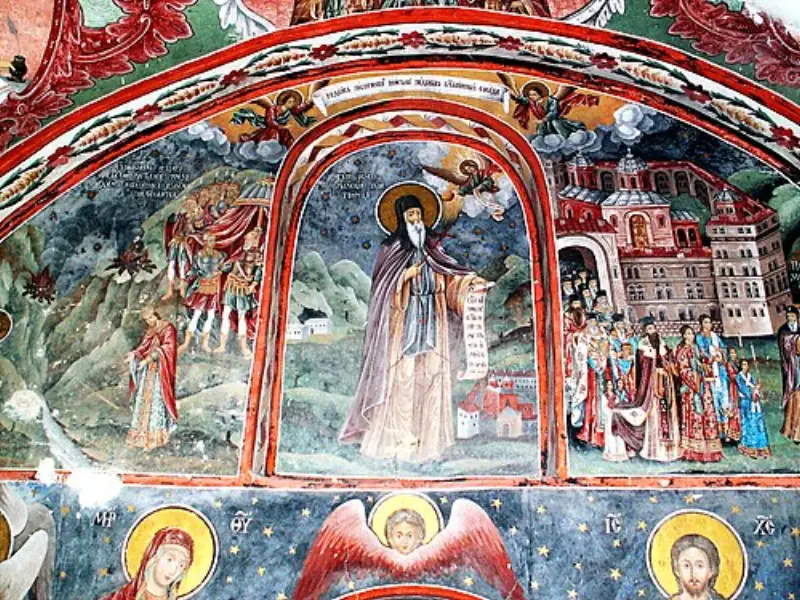
- depicted in fresco as a monk of the Rila Monastery
- Canonization
- Pre-congregation; revered as a saint while still alive
Prayer
Bibliography
Show 8 sources
- "St. John of Rila - Saints & Angels". Catholic Online. Retrieved 2021-05-22.
- "Orthodoxe Kirche von Bulgarien". www.rilaeu.com. Retrieved 2021-05-22.
- Great Synaxaristes: (in Greek) Ὁ Ὅσιος Ἰωάννης ὁ Θαυματουργός ὁ ἀσκητής. 19 Οκτωβρίου. ΜΕΓΑΣ ΣΥΝΑΞΑΡΙΣΤΗΣ.
- Tradigo, Alfredo (2006). Icons and Saints of the Eastern Orthodox Church. Los Angeles: J. Paul Getty Museum. p. 341.
- Lanzi, Fernando; Lanzi, Gioia (2004). Saints and Their Symbols: Recognizing Saints in Art and in Popular Images. Collegeville, MN: Liturgical Press. p. 133.
- John of Rila. "Testament of St. John of Rila". www.pravoslavieto.com. Translated by Ilija Iliev. Retrieved 2026-01-02.
- "1 lev, 1999". Bulgarian National Bank. Retrieved 2026-01-02.
- Bank, European Central (2025-11-26). "Bulgaria". European Central Bank (in Bulgarian). Retrieved 2026-01-17.
Profile text adapted from the Wikipedia article, licensed CC BY-SA 4.0.
Pray with this saint every day
Save St. John of Rila to your favorites, read the full profile, and get feast-day reminders in the Saints app.
Get the Saints AppFree on the App Store for iPhone and iPad