
c. 1430 – 1479·Feast June 11
St. John of Sahagún
Augustinian Preacher and Peacemaker of Salamanca
Overview
John of Sahagún was a Spanish Augustinian friar and priest who became one of the most admired preachers of fifteenth-century Castile. Born into a wealthy family of Sahagún in the Province of Leon, he received his earliest schooling from the Benedictine monks of his native town, received the tonsure as a boy, and was taken up by Alfonso de Cartagena, Bishop of Burgos, who educated him in his own household, ordained him a priest in 1445, and named him a canon of the cathedral. Troubled in conscience at holding several church offices at once, he gave them all up and served a poor city chapel in strict poverty. After the bishop's death in 1456 he studied theology and canon law at the University of Salamanca, then served nine years at the chapel of the College of St. Bartholomew, winning fame as a preacher. Recovered from an operation for kidney stones, he fulfilled a vow by entering the Order of Hermits of St. Augustine in 1463 and professing solemn vows the following year. From the pulpit he denounced the scandals of the powerful, earning hostility as well as crowds; he served as master of novices and prior, was famed for a gift of reading consciences, reconciled feuding factions in Salamanca, and defended the rights of workers. Worn out, and rumored to have been poisoned, he died at his monastery on 11 June 1479.
The Complete Life
A Son of Sahagún
John was born at Sahagún, also called San Facondo, in the Province of Leon, into a prosperous household. Juan González del Castrillo and Sancha Martínez, prosperous citizens, brought him into the world as the first of their seven children. The town itself was a center of religious learning: its Royal Monastery of St. Benedict, whose monks gave the boy his first education, was a leading religious and educational house so celebrated that the region called it the Cluny of Spain. Following the custom of the era, John received the tonsure while still young, and his father secured for him the benefice of the nearby parish of Tornillo. His abilities soon attracted wider notice. He was presented to Alfonso de Cartagena, the Bishop of Burgos, a scholar-prelate who saw promise in the lively boy and took charge of his formation. The bishop educated him at his own residence, conferred on him several prebends, ordained him to the priesthood, and appointed him a canon of the Cathedral of Burgos. It was an ascent any ambitious cleric of the age would have envied, and it left the young priest, almost before he had begun, holding more of the Church's goods than the Church's law allowed a man to keep.
§ Life
Stripping Away Honors
The accumulation of benefices troubled John deeply. Church law forbade a priest to hold so many offices at once, and his conscience would give him no rest. His answer was to surrender the lot of them, reserving only the chaplaincy of St. Agatha's chapel in an impoverished quarter of Burgos. There, at a single poor altar, he celebrated Mass and preached to the humble, embracing a severe regimen of poverty and self-denial. Bishop Cartagena's death in 1456 severed his remaining tie to that earlier life, and John gave up the chaplaincy as well, turning instead to the University of Salamanca. For four years he gave himself to theology and canon law there and took degrees in both disciplines. Throughout this period he served the chapel belonging to the College of St. Bartholomew, in St Sebastian's parish, an assignment he would keep altogether for nine years. Then came the trial that fixed his course forever. Sickness forced him to submit to surgery for kidney stones, and in danger of his life he promised God that, spared, he would enter Religion. Health returned; the promise was honored. In 1463 he sought the habit of the Order of Hermits of St. Augustine.
§ Preacher
The Pulpit and the City
Once clothed in the Augustinian habit at the Monastery of St. Peter and known simply as Friar John, he was directed by his superiors to the task heaven had readied him for: preaching. Crowds gathered to hear him, yet his sermons spared no rank. He attacked in public the misconduct of the mighty and the scandals given by the classes above, and the Duke of Alba made his displeasure known. Anger among the women of Salamanca ran so high after a stern sermon on extravagant clothing that they abused him in the open street and threw stones at him until the city guards intervened. Enemies multiplied, and he would not temper his speech. Within his community he rose steadily: made master of novices, he was elected prior in 1471, ruling the friars chiefly through the force of his own example, and he represented his house at several provincial chapters. In the city he stood forth as a champion of working people and ordinary folk, and because factions trusted him, he was repeatedly called upon to pacify rival parties and bring tranquility back to Salamanca.
§ Friar
Devotion and Discernment
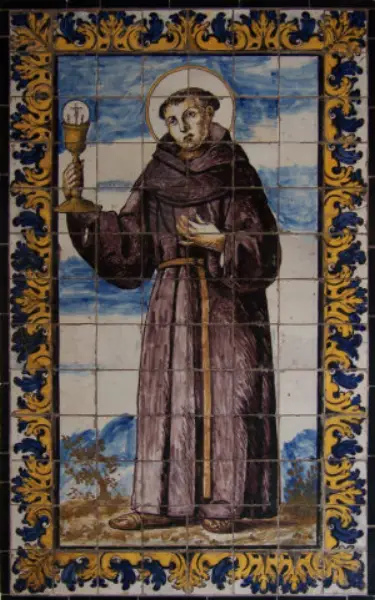
At the heart of John's apostolate was a deep Eucharistic piety. He had a particular devotion to the Blessed Sacrament, and it was from the altar that his boldness in the pulpit seemed to flow; later generations would represent him in art holding a chalice and host encircled by rays of light. To this the tradition adds a remarkable gift of discernment: hidden movements of conscience, it was said, could not stay hidden from him, and neither in confession nor in counsel could anyone easily take him in. Whatever the exact nature of that gift, its effect is clear from the way the city used him. A man who could see into hearts, and who had proven his independence by reproving nobles from the pulpit, was exactly the person factions would trust as an arbiter, and John was repeatedly sought out to make peace among enemies. His spirituality joined contemplation to action in a distinctly Augustinian key: the search for God in community life, obedience worked out under superiors whom he served as delegate to provincial chapters, and charity expressed in the defense of ordinary working people. The friar who had renounced a cathedral canonry preached, governed, confessed, and reconciled with the same single-heartedness, so that holiness in him was less a series of notable acts than one continuous fidelity.
§ Friar
Weariness, Rumor, and Death
As the summer of 1479 approached, his powers visibly waned. Years of fasting, labor, and conflict had drained them, and his health went into decline. A dark story then circulated through the city: a woman, people said, had administered poison to him because he had rebuked the immoral way of life of a man of standing. Proof was never found, and the account remains rumor; its place in his story testifies chiefly to how sharply his words had cut and how deep ran the resentment they stirred. Whatever the truth, on 11 June 1479 he breathed his last in the monastery, having kept for sixteen years of religious life the promise made beneath the surgeon's hands. Burial was given him in Salamanca's Old Cathedral, where his shrine draws the faithful still. He closed his days in the same university city where he had studied, preached, been stoned, governed, and made peace, and the townspeople who had loved and resented him by turns now claimed him unanimously as their saint.
§ Friar
From Veneration to the Altars
Hardly had he died when devotion to John began spreading through Spain. In 1525, under Pope Clement VII, the formal inquiry into his cause opened; in 1601 Pope Clement VIII enrolled him among the blessed in Rome. Fresh wonders credited to his intercession kept arriving, and on 16 October 1690 Pope Alexander VIII placed him on the calendar of the saints. Dating his liturgical feast demanded care, for 11 June, the day of his death, already belonged in the Roman Calendar to Saint Barnabas; in 1729 Pope Benedict XIII therefore assigned John's celebration to 12 June. The calendar reform of 1969 judged his significance too limited for a universal observance and left his feast to particular calendars, yet the Roman Martyrology, the Church's official roll of the saints, still records him on 11 June. The first account of his life came from John of Seville in the late 1400s, enlarged in 1605 and 1619 and used by the Bollandists in the Acta Sanctorum; early in the seventeenth century Agustín Antolínez and Alfonso Osorio wrote further lives.
§ Veneration
The Saint of Salamanca
John of Sahagún endures in memory as a particular kind of saint: not a founder, not a mystic with voluminous writings, but a preacher whose courage changed the moral weather of a city. Salamanca, the university town where he spent his mature years, keeps his remains in the Old Cathedral, and his cult spread from there across Spain and into the worldwide Augustinian family, which numbers him among its most honored friars. The traits for which he is remembered form a coherent portrait of public holiness. He was a reconciler, whose reputation for reading consciences made rival factions willing to lay their quarrels before him. He was a defender of workers and common folk against the abuses of the powerful. He was an uncompromising voice against luxury and public scandal, willing to be pelted with stones rather than soften a necessary word. And beneath all of it was the Eucharist, the chalice and host with rays of light that artists placed in his hands. For the Augustinians he remains a model of the friar-preacher; for Salamanca, a local father; and for the wider Church, an example of how a single faithful pulpit can serve both truth and peace.
§ Veneration
Timeline
- 1419
Born at Sahagún in the Province of Leon, oldest of seven children of Juan González del Castrillo and Sancha Martínez
§ Life
- 1445
Ordained a priest by Bishop Alfonso de Cartagena and made a canon of the Cathedral of Burgos
§ Life
- 1456
Resigns his chaplaincy on the bishop's death and begins four years of theology and canon law studies at Salamanca
§ Preacher
- 1463
Recovered from surgery for kidney stones, applies to join the Augustinians at the Monastery of St. Peter
§ Friar
- 28 Aug 1464
Professes solemn vows in the Augustinian order at the Monastery of St. Peter
§ Friar
- 1471
Named prior of his Augustinian community after serving as master of novices
§ Friar
- 11 Jun 1479
Dies at the monastery in Salamanca amid rumors he had been poisoned in retaliation for his preaching
§ Friar
- 1525
The process of his beatification begins under Pope Clement VII
§ Veneration
- 1601
Declared blessed in Rome by Pope Clement VIII
§ Veneration
- 16 Oct 1690
Canonized by Pope Alexander VIII in Rome after new miracles reported through his intercession
§ Veneration
- 1729
Pope Benedict XIII assigns John's Roman Calendar feast to 12 June because St. Barnabas already keeps 11 June
§ Veneration
The Record
- Symbols
- chalice and host·represented holding a chalice and host surrounded by rays of light
- Canonization
- Canonized 16 October 1690 in Rome by Pope Alexander VIII; beatified 1601 by Pope Clement VIII
Prayer
Bibliography
Show 8 sources
- "Saint John of Sahagún". Midwest Augustinians.
- Augustinian Recollects.
- Mershman, Francis. "St. John of Sahagun." The Catholic Encyclopedia Vol. 8. New York: Robert Appleton Company, 1910. 23 October 2021.
- "Lives of the Saints, For Every Day of the Year," (Hugo Hoever, S.O.Cist., ed.) New York: Catholic Book Publishing Co., 1955, p. 223.
- "June 12 - Saint John of Sahagún", The Augustinians - Province of St. Thomas of Villanova.
- Calendarium Romanum (Libreria Editrice Vaticana 1969, p. 126).
- Martyrologium Romanum (Libreria Editrice Vaticana ISBN 88-209-7210-7).
- Herbermann, Charles, ed. (1913). "St. John of Sahagun". Catholic Encyclopedia. New York: Robert Appleton Company.
Profile text adapted from the Wikipedia article, licensed CC BY-SA 4.0.
Pray with this saint every day
Save St. John of Sahagún to your favorites, read the full profile, and get feast-day reminders in the Saints app.
Get the Saints AppFree on the App Store for iPhone and iPad