
1905 – 1970·Feast January 30
St. John of Saint-Denis
Bishop and Restorer of the Western Orthodox Liturgy
Overview
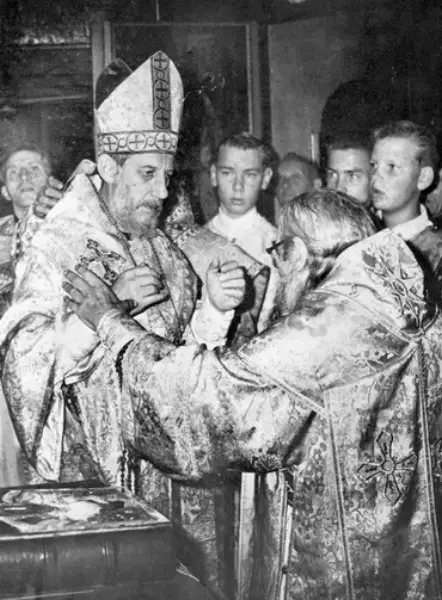
John of Saint-Denis, known in French as Jean-Nectaire and in the world as Evgraf Evgrafovich Kovalevsky, was a Russian-born bishop who became the leading architect of Western Rite Orthodoxy in France. Born in Saint Petersburg on 8 April 1905 into a noble family, he emigrated to France, where he devoted his life to bringing Orthodox Christianity to the French people in their own language and liturgical inheritance. While still a young man he co-founded, with the theologian Vladimir Lossky, the Brotherhood of St. Photius in 1925, and in 1944 the St. Denys Theological Institute. Ordained a priest of the Moscow Patriarchate in 1937 by Metropolitan Eleutherius, he took charge of the Western Orthodox Church founded by Archimandrite Irénée Winnaert after the latter's death, under the authority of Metropolitan Sergius, the Patriarchal locum tenens of Moscow. In 1952 the Russian Church's Holy Synod granted him the title of Doctor of Divinity. His episcopal hour struck in 1966: Saint John Maximovitch tonsured him a monk under the name Jean-Nectaire, and, with Theophilus of Sèvres assisting at the consecration, he took the throne as the first man to hold the see of Saint-Denis in modern times, heading the Orthodox Church of France as its First Hierarch. He died on 30 January 1970 and was canonized in 2008.
The Complete Life
A Noble Son of Saint Petersburg
Evgraf Kovalevsky was born on 8 April 1905 in Saint Petersburg, the imperial capital of Russia, into a noble family. His birth came in a year of revolution and unrest, and his childhood unfolded in a world about to be swept away; like many Russians of his generation he would spend his adult life in exile, in his case in France. He was not the only member of his family to dedicate himself to the Church. His brother Maxime Kovalevsky served as a deacon and became a distinguished musicologist, living from 1903 to 1988, and another brother, Pierre Kovalevsky, was a historian of the Russian emigration, living from 1901 to 1979. The household from which Evgraf came thus joined nobility, learning, and church service, and the gifts of its sons would shape Orthodox liturgical and intellectual life in their adopted country. The boy born beside the Neva would one day be buried to the memory of the Seine, bearing the name of the suburb of Paris, Saint-Denis, whose ancient Christian roots he spent his life recovering.
§ Life
Founding and Ordination
Kovalevsky's vocation expressed itself early in institutions of Orthodox scholarship and mission. In 1925, while still in his twenties, he joined Vladimir Lossky, one of the great Orthodox theologians of the twentieth century, in founding the Brotherhood of St. Photius, a society devoted to the Orthodox faith in the West. Two decades later, in 1944, he helped establish the St. Denys Theological Institute, a school for the formation of clergy and laity of the Western Orthodox movement. His ecclesiastical career advanced in 1937, when Metropolitan Eleutherius ordained him a priest of the Moscow Patriarchate. The decisive opportunity came with the death of Archimandrite Irénée, born Louis-Charles Winnaert, the founder of a Western Orthodox community in France: leadership of the Western Orthodox body that grew out of that community passed to Kovalevsky, who guided it in obedience to Metropolitan Sergius, serving as locum tenens of the Moscow throne. He thus became, in his early thirties, the leader of an ambitious experiment, the restoration of Orthodox Christianity in France according to the ancient liturgical tradition of the Gauls.
§ Life
First Hierarch of the Church of France
The work that occupied the rest of Kovalevsky's life was the building of a French Orthodox church in the Western rite. Recognition of his scholarship came in 1952, when the Holy Synod of the Church of Russia conferred on him the title Doctor of Divinity. The crowning of his mission arrived in 1966, in a sequence of events that transformed him from a priest-scholar into a bishop. In that year he was tonsured a monk by Saint John Maximovitch, the celebrated Russian archbishop of Shanghai and San Francisco, receiving the monastic name Jean-Nectaire. Consecration to the episcopate followed, Theophilus of Sèvres taking part in the rite, and John was enthroned over Saint-Denis, the first occupant of that see in modern times. The Western Rite diocese he now headed is known today as the Orthodox Church of France, and he presided over it as First Hierarch until the end of his life. The episcopate was brief, four years, but it consolidated decades of labor: a French-speaking Orthodox hierarchy, a restored Gallican liturgy, a theological institute, and a brotherhood of prayer now all stood behind the movement he led.
§ Life
Death
Bishop John did not long enjoy the episcopal dignity he had received so late in life. He died on 30 January 1970, at the age of sixty-four, after serving as First Hierarch of the Orthodox Church of France since 1966. His death removed from the young church the one figure who had presided over its entire development, from the brotherhood of 1925 through the institute of 1944 to the episcopate of 1966. The date of his repose, 30 January, became the day on which his commemoration would afterwards be kept. He left behind a church that would continue to treasure his memory, an extensive body of published writing in French, and a liturgical inheritance centered on the ancient rite of the Gauls. The story of his cause was only beginning: nearly four decades would pass between his death and his glorification, years in which his tomb and his books kept his influence alive among the faithful of the Western Orthodox communities he had shepherded.
§ Death and canonisation
Glorification
On 12 October 2008, Bishop John was canonized as a saint. The act was carried out by Bishop Gregory of Arles, of the Orthodox Church of the Gauls, at the Church of the Mother of God and St Thiebault in Gorze, France. The choice of Gorze, a town in Lorraine with deep monastic history, suited a saint whose whole life had been an argument that the Orthodox faith belongs naturally on French soil. The canonization placed John of Saint-Denis formally among the saints venerated in the Communion of Western Orthodox Churches, the family of jurisdictions among which his church stands. His feast is kept on 30 January, the anniversary of his death in 1970. He is remembered as the modern era's first Bishop of Saint-Denis and as the hierarch who, having been tonsured by a saint of the Russian Church, John Maximovitch, came himself to be numbered among the saints, a link between the Orthodox East that formed him and the West that he served.
§ Death and canonisation
Writings and Living Work
John of Saint-Denis left a substantial literary inheritance, almost all of it in French and much of it devoted to liturgy, prayer, and the spiritual life. At its center stand his works on the ancient Gallican liturgy of Saint Germanus of Paris, including studies of the Eucharistic canon of the old rite of the Gauls and of its chant, the very services his church restored. He wrote on Scripture, with introductions to Genesis and books on Ezekiel and the meaning of the Exodus; on doctrine, with studies of the incarnate Word, the Trinity, Peter and Paul, and the Virgin Mary; and on the spiritual life, with a method of prayer published in English as A Method of Prayer for Modern Times, homilies preached at the Church of St. Irenaeus, and works on Lent, on the destiny of the soul after death, and on the heavenly liturgy. Together these books made him one of the most prolific French Orthodox authors of his century. But his most durable monument is the church itself: the Orthodox Church of France, the institute that trains its clergy, and the conviction, embodied in his whole career, that a man born beside the Neva could restore to the Seine the faith of its first centuries.
§ Writings
Timeline
- 8 Apr 1905
Born Evgraf Evgrafovich Kovalevsky in Saint Petersburg, Russia, into a noble family
§ Life
- 1925
Co-founds with Vladimir Lossky the Brotherhood of St. Photius
§ Life
- 1937
Ordained a priest of the Moscow Patriarchate by Metropolitan Eleutherius
§ Life
- 1944
Co-founds the St. Denys Theological Institute in France
§ Life
- 1952
The Holy Synod of the Church of Russia confers on him the title Doctor of Divinity
§ Life
- 1966
Tonsured by Saint John Maximovitch as Jean-Nectaire, consecrated bishop, and installed as first Bishop of Saint-Denis and First Hierarch of the Orthodox Church of France
§ Life
- 30 Jan 1970
Dies after four years as First Hierarch of the Orthodox Church of France
§ Death and canonisation
- 12 Oct 2008
Canonized by Bishop Gregory of Arles at the Church of the Mother of God and St Thiebault in Gorze, France
§ Death and canonisation
The Record
- Major works
- La Sainte Messe selon l'ancien rite des Gaules ou Liturgie selon S. Germain de Paris·Homélies. Quelques enseignements spirituels donnés en l'Eglise Saint Irénée·Message de Noël·Pierre et Paul. Leur signification. Leur place dans la tradition chrétienne catholique orthodoxe·Quarante Degrés ou quarante Immolation de Carême·La Sainte Messe selon St Germain de Paris et le chant des fidèles·Initiation à la Genèse·Technique de la prière (English: A Method of Prayer for Modern Times, Praxis, 1993)·Le chemin de la vie et la destinée de l'âme après la mort·Ezéchiel·Le mystère des origines·Initiation trinitaire·La liturgie céleste·Marie, Vierge et Mère·Les chemins de l'homme·Le Verbe incarné·La quête de l'Esprit·Le sens de l'exode·Le carême
- Canonization
- Canonized 12 October 2008 at the Church of the Mother of God and St Thiebault, Gorze, France, by Bishop Gregory of Arles of the Orthodox Church of the Gauls
Prayer
Bibliography
Show 5 sources
- Кострюков, Андрей (2016). "О некоторых причинах неудачи православия западного обряда". Вестник ПСТГУ. Серия 2: История. История Русской Православной Церкви (in Russian). 69 (2): 80–98.
- de Foucauld, Élie (2016). Évêque Jean de Saint-Denis (Eugraph Kovalevsky): biographie (in French). Vol. I. Clelles: Forgeville. ISBN 978-2-902117-01-7.
- de Foucauld, Élie (2023). Évêque Jean de Saint-Denis (Eugraph Kovalevsky): biographie (in French). Vol. II. Clelles: Forgeville. ISBN 978-2-902117-15-4.
- de Foucauld, Élie (2023). Évêque Jean de Saint-Denis (Eugraph Kovalevsky): biographie (in French). Vol. III. Clelles: Forgeville. ISBN 978-2-902117-16-1.
- de Foucauld, Élie (2024). Saint Jean de Saint-Denis (Eugraph Kovalevsky) (in French). Clelles: Forgeville. ISBN 9782902117178.
Profile text adapted from the Wikipedia article, licensed CC BY-SA 4.0.
Pray with this saint every day
Save St. John of Saint-Denis to your favorites, read the full profile, and get feast-day reminders in the Saints app.
Get the Saints AppFree on the App Store for iPhone and iPad