
1896 – 1966·Feast July 2
St. John of Shanghai and San Francisco
Wonderworker and Archbishop of the Russian Diaspora
Overview
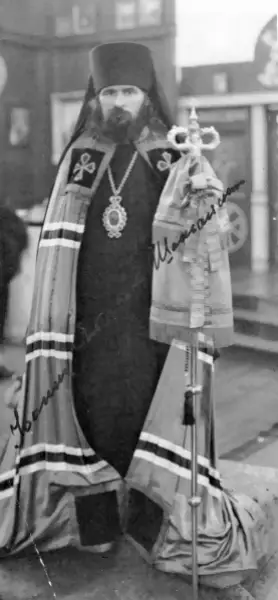
John of Shanghai and San Francisco, born Mikhail Borisovich Maximovitch, was a prelate of the Russian Orthodox Church Outside Russia venerated throughout the Eastern Orthodox Church as a wonderworker. Born on 4 June 1896 in the village of Adamovka in the Kharkov Governorate of the Russian Empire, now eastern Ukraine, he grew up collecting icons and reading the lives of the saints, and as a child converted his French caretaker from Catholicism to Orthodoxy. After law studies at Kharkov University and exile following the revolution, he trained in theology at Belgrade, was tonsured and ordained by Metropolitan Anthony Khrapovitsky, and took the name of his distant ancestor, John of Tobolsk. Known even then for sleeping in a chair and eating once a day, he served as a seminary teacher in Bitola before being ordained a bishop in 1934 for Shanghai. There he founded an orphanage, united a divided flock, and cared for refugees through war and revolution, leading them from China to the Philippines and ultimately to the West. As Archbishop of Western Europe he recovered the memory of the pre-Schism Western saints, and as Archbishop of San Francisco he completed the Holy Virgin Cathedral. He died in Seattle on 2 July 1966; his relics remain incorrupt in San Francisco.
The Complete Life
The Boy Who Collected Saints
Mikhail Borisovich Maximovitch was born on 4 June 1896 at Adamovka, a village of the Izyumsky Uyezd in Kharkov Governorate, then within the Russian Empire and lying today in eastern Ukraine. Even as a boy his path was plain: icons and church books were his treasures, and he pored over the lives of the saints with an appetite that never left him. A story his family loved tells how the child brought his French nurse, a Catholic, over to the Orthodox faith. Schooling came first at the Poltava Military School between 1907 and 1914, the final years of peace for the old Russian world. He then entered Kharkov Imperial University, taking his law degree in 1918 while revolution tore the country apart. At Kharkiv he combined study with the life of the Church, and Metropolitan Antony Khrapovitsky stirred him there to press deeper into his faith. In later years he would say that the monastery of the city had grown more important to him than any secular classroom, a confession that revealed where his heart had long ago decided to belong.
§ Early life
Exile, Tonsure, and Teaching
The revolution scattered the Maximovitch family, and in 1921 the household, having settled in Yugoslavia, sent for Mikhail and brought him to Belgrade. Exile meant poverty, and he helped keep the family fed by hawking newspapers in the streets, all the while pursuing his preparation for the Church. In 1925 came his theology degree from Belgrade University, and from 1925 to 1927 he taught religion at the Gymnasium of Velika Kikinda. His tonsure followed in 1926 at the hands of Metropolitan Anthony Khrapovitsky, the same hierarch whose preaching had turned his heart in Kharkov years before; professed a monk and ordained hierodeacon, he received the name of his forebear John of Tobolsk. Before that year ended, Bishop Gabriel Chepur of Chelyabinsk raised him to the priesthood. A new rule of life took hold at once: he abandoned his bed altogether, taking his rest seated, and limited himself to a single daily meal. Tutoring and instructing occupied him in Yugoslavia for several years, until in 1929 the Serbian Church's Synod named him to the staff of the Bitola seminary, where Nikolaj Velimirović was principal. He began visiting the hospitals of the town, praying with the sick and bringing them communion, and word of his holiness started to spread.
§ Yugoslavia
Shanghai: Shepherd in Exile
The year 1934 brought him to the episcopate: Metropolitan Anthony consecrated him for the Russian Church Abroad, and he was sent to shepherd the diocese of Shanghai. What he found there was a half-built Saint Nicholas' Church and a congregation fractured along lines of ethnicity, and he turned to both repairs with equal energy. He joined the city's charitable works, founded an orphanage, opened a home for children of the destitute, reconciled the quarreling factions of his flock, and drew close to the Serbs and Greeks of local Orthodoxy. Wonders came to be ascribed to his prayers. His asceticism, impossible to conceal in a public man, drew notice; under the Japanese occupation he defied the nightly curfew whenever souls required it. In 1946, alone among the Russian hierarchs of China in rejecting the jurisdiction of the Moscow Patriarchate then controlled by the Soviet state under Patriarch Alexy I, he received from the Synod of the Russian Church Abroad his elevation to archbishop of China. The Communist victory of 1949 uprooted the Russian colony, and John led his people out, to a camp on Tubabao Island in the Philippines and onward to Australia and America. He went himself to the American capital to plead his flock's cause, and on 16 June 1950 President Truman put his signature to H.R. 4567, whose provisions admitted four thousand Europeans of the Far East to the United States as refugees.
§ Shanghai
An Ascetic in the World
The holiness of John Maximovitch was of the visible, embodied kind that observers could not fail to notice. From the time of his priestly ordination he gave up sleeping in a bed, resting instead as he could, and he ate only once a day, keeping his body under strict discipline through decades of refugee hardship and episcopal travel. Yet his asceticism never turned inward or away from people. In Yugoslavia he haunted the hospitals, praying with the sick and bringing them communion; in Shanghai the miracles attributed to his prayers made his name known far beyond his own flock; in his own lifetime he was known to some as possessing powers of healing and clairvoyance. Deeply reverent in worship, he carried a special devotion to the nineteenth-century Russian saint John of Kronstadt, and he labored actively for the canonization of that saint, which was accomplished in 1964. Another side of his spiritual legacy was literary and liturgical: his compiling of the lives of the saints recovered for Orthodox veneration numerous saints of the West from the centuries before the Schism, and those saints continue to be honored in Orthodoxy today through his labor. His spirituality joined austerity, mercy, and the communion of saints into a single whole.
§ Yugoslavia
San Francisco: Cathedral and Trial
Western Europe became his field in 1951: he received the archdiocese there and fixed his residence first at Paris and afterward at Brussels. Then, in 1962, the Synod of the Russian Church Abroad called him to San Francisco. Old problems awaited new ground: a congregation at odds with itself and a cathedral still unfinished. With the same persistence he had shown in China he brought the Holy Virgin Cathedral, dedicated to the Theotokos under her title Joy of All Who Sorrow, to completion on Geary Boulevard in the Richmond district. His enemies, however, were at work: political adversaries smeared him and dragged him into court on charges of mismanaging the money raised for the cathedral's building. The exoneration, when it came, vindicated him fully, though the wounds of the affair ran deep. Through it all he pressed on with his labor for the glorification of John of Kronstadt, achieved in 1964, and held his troubled community together in growing calm. On 2 July 1966, during a visit to Seattle, he departed this life, and his body was laid beneath the altar of the cathedral his own hands had raised.
§ San Francisco
Glorification
Veneration for Archbishop John gathered quickly after his death. On 2 July 1994, the twenty-eighth anniversary of his repose, the Russian Orthodox Church Outside Russia glorified him as a saint, in ceremonies in San Francisco, the city of his cathedral and his tomb. The Orthodox Church in America commemorates his feast on 2 July each year, while in the Russian Church Abroad his feast is kept on the Saturday nearest to 2 July. On 2 July 2008 the Patriarchate of Moscow formally recognized ROCOR's canonization, extending his veneration to the whole Russian Orthodox Church. His glorification confirmed what much of the Orthodox world had already believed during his lifetime and after it: that the wandering archbishop of Shanghai, Tubabao, Paris, Brussels, and San Francisco had been a true wonderworker of the diaspora. The anniversary of his death, kept as his feast, unites the many jurisdictions and lands of his long exile in a single commemoration of the bishop who shepherded them all.
§ Veneration
Incorrupt Relics and a Worldwide Cult
A shrine within the nave of San Francisco's Holy Virgin Cathedral holds the relics of John of Shanghai, and these are accounted incorrupt. At the time of his death witnesses attested that no decay had touched his body before its first burial; the exhumation and examination of 1993 reached the same conclusion. From that shrine devotion has traveled widely, and pieces of his remains now rest in Spain, Serbia, Russia, Mount Athos, South Korea, Bulgaria, Romania, Canada, the United Kingdom, North Macedonia, and further countries besides. The wonders were set down in writing almost at once: Seraphim Rose and Herman Podmoshensky gathered roughly a hundred distinct miracles ascribed to John and his intercession, while already in life some credited him with healing and with clairvoyance. Parishes and schools on several continents carry his name, and Orthodox exiles, converts, and admirers of the ancient Western saints alike look to him as a father. In him the diaspora found its proof that holiness knows no homeland, and that a saint can lead a wandering, homeless people anywhere in the world.
§ Relics and miracles
Timeline
- 4 Jun 1896
Born Mikhail Borisovich Maximovitch in the village of Adamovka, Kharkov Governorate, Russian Empire
§ Early life
- 1907
Enters Poltava Military School, where he studies until 1914
§ Early life
- 1918
Receives his law degree from Kharkov Imperial University
§ Early life
- 1921
His family, now in Yugoslavia, brings him to Belgrade
§ Yugoslavia
- 1925
Graduates from Belgrade University with a degree in theology while supporting his family by selling newspapers
§ Yugoslavia
- 1926
Tonsured and ordained a hierodeacon by Metropolitan Anthony Khrapovitsky, receiving the name of his ancestor John of Tobolsk
§ Yugoslavia
- 1926
Ordained to the priesthood by Bishop Gabriel Chepur of Chelyabinsk
§ Yugoslavia
- 1929
Appointed teacher at the seminary in Bitola under principal Nikolaj Velimirović
§ Yugoslavia
- 1934
Consecrated a bishop of the Russian Orthodox Church Outside Russia and assigned to the diocese of Shanghai
§ Shanghai
- 1946
Made archbishop of China by the Synod of the Russian Church Abroad, the sole Russian hierarch in China refusing submission to the Soviet-controlled Moscow Patriarchate
§ Shanghai
- 1949
Leads his flock out of Communist China to a refugee camp on Tubabao Island in the Philippines
§ Shanghai
- 16 Jun 1950
President Truman signs H.R. 4567, allowing 4,000 Europeans in the Far East, including John's followers, to enter the United States as refugees
§ Shanghai
- 1951
Given charge of the Western European archdiocese, taking up residence first in Paris and later in Brussels
§ Western Europe
- 1962
Reassigned by the Holy Synod to the see of San Francisco, where he finds a divided community and an unfinished cathedral
§ San Francisco
- 1964
Plays an active role in the preparation of the canonization of John of Kronstadt
§ San Francisco
- 2 Jul 1966
Dies while visiting Seattle and is entombed beneath the altar of the cathedral he built in San Francisco
§ Death
- 1993
His body is exhumed and examined, with findings confirming the incorruption of his relics
§ Relics and miracles
- 2 Jul 1994
Glorified by the Russian Orthodox Church Outside Russia on the 28th anniversary of his death
§ Veneration
- 2 Jul 2008
The Patriarchate of Moscow recognizes his canonization for universal veneration
§ Veneration
The Record
- Major works
- Compilations of the lives of saints that introduced numerous pre-Schism Western saints to Orthodox veneration
- Canonization
- Glorified July 2, 1994, in San Francisco by the Holy Synod of the Russian Orthodox Church Outside Russia; recognized for universal veneration by the Patriarchate of Moscow on July 2, 2008
Prayer
Bibliography
Show 17 sources
- "Life of St. John - St. John the Wonderworker". St. John the Wonderworker. Archived from the original on 2024-12-17. Retrieved 2025-02-02.
- "St. John Maximovitch". arizonaorthodox.com. Retrieved 2025-02-02.
- "Saint John [Maximovitch], Archbishop of Shanghai and San Francisco". www.oca.org. Retrieved 2026-03-17.
- Perekrestov, Peter (1994). A Brief Life of St. John of Shanghai and San Francisco. reprint - San Francisco, "Russian Shepherd. pp. 10–13.
- "Holy Virgin Cathedral - Joy of all Who Sorrow - San Francisco, CA - Russian Orthodox Church Outside of Russia". sfsobor.com. Retrieved 2024-11-28.
- Le Karo, Bernard (2013). Свети Јован Шангајски - чудотворац последњих времена [Saint John of Shanghai - the Wonderworker of the Late Times]. Belgrade: Православна мисионарска школа при храму Светог Александра Невског. ISBN 978-86-86555-64-9.
- "Crkva danas slavi svetog Jovana Šangajskog" [Saint John of Shanghai Celebrated Today]. Radio Televizija Vojvodine. 2 July 2009. Retrieved 28 May 2016.
- "Metropolitan Antony of Kiev and Galicia (1863-1936)". orthodoxengland.org.uk. Retrieved 2024-11-28.
- Cunningham, Lawrence (1 May 2025). "From Shanghai to Tubabao: The Enduring Legacy of St. John Maximovitch in the Philippines". ROCOR Studies. Retrieved 17 June 2026.
- Namee, Matthew (2025-07-02). "When a god visited Congress". Orthodox History. Retrieved 2026-03-17.
- "Statement by the President Upon Signing Bill Amending the Displaced Persons Act | Harry S. Truman". www.trumanlibrary.gov. Retrieved 2026-03-17.
- Blessed John the Wonderworker: A Preliminary Account of the Life and Miracles of Archbishop John Maximovitch. Platina: St. Herman of Alaska Brotherhood, 1987. (ISBN 0938635018).
- "The Russian Orthodox Church Outside of Russia - Official Website". www.synod.com. Retrieved 2024-10-08.
- Kiley, Brendan (2025-04-26). "This saint's body never decomposed. How is that possible?". The Seattle Times. Retrieved 2026-03-18.
- Kiley, Brendan (2025-04-26). "Seattle church honors a saint — and gets some privacy". The Seattle Times. Retrieved 2026-03-18.
- "Romanian parish in Spain given relics of St. John Maximovitch | Orthodox Times (en)". orthodoxtimes.com. Retrieved 2026-03-18.
- Rose, Fr. Seraphim; Podmoshensky, Abbot Herman (1998). Blessed John the Wonderworker: A Preliminary Account of the Life and Miracles of Archbishop John Maximovitch (3rd ed.). Platina, California: St. Herman of Alaska Brotherhood. pp. 5–8.
Profile text adapted from the Wikipedia article, licensed CC BY-SA 4.0.
Pray with this saint every day
Save St. John of Shanghai and San Francisco to your favorites, read the full profile, and get feast-day reminders in the Saints app.
Get the Saints AppFree on the App Store for iPhone and iPad