
1542-1591·Feast December 14
St. John of the Cross
Carmelite Priest, Mystic, Doctor of the Church
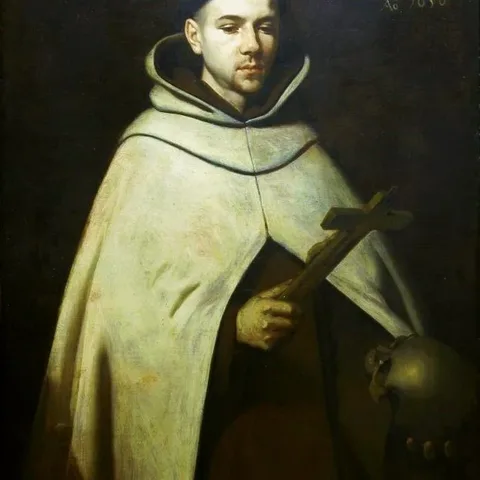
Overview
Juan de Yepes y Alvarez was born in 1542 at Fontiveros in Old Castile, son of a silk merchant's accountant cast off by his family for marrying a poor orphan. His father died when he was about three, and poverty moved the family to Medina del Campo, where the boy studied with Jesuits and worked in a hospital. Entering the Carmelites in 1563 and reading theology at Salamanca, he was ordained in 1567 and was weighing the Carthusians when he met Teresa of Avila at Medina. Her project of restoring the Carmelites' Primitive Rule claimed him instead: on 28 November 1568 he opened the first house of Discalced friars, at Duruelo, taking the name John of the Cross. As confessor to Teresa's community at Avila and then as founder and provincial figure in Andalusia, he carried the reform forward until the night of 2 December 1577, when friars of the old observance seized and imprisoned him at Toledo. In a freezing cell, flogged weekly before the community, he composed much of his Spiritual Canticle before escaping through a window in August 1578. His poems and their commentaries — the Ascent, the Dark Night, the Living Flame — map the soul's road to God through detachment and dark faith. He died of erysipelas at Ubeda on 14 December 1591.
The Complete Life
Early Life
Juan de Yepes y Álvarez was born in 1542 at Fontiveros in Old Castile, the son of a silk merchant's accountant who was cast off by his wealthy family for marrying a poor orphan. His father died when Juan was about three, leaving the family in poverty so severe that one brother died of starvation; the family moved to Medina del Campo, where the boy studied with the Jesuits and worked as a nurse and orderly in a hospital for the poor. He entered the Carmelite Order in 1563 as John of Saint Matthias, and read theology at the University of Salamanca, among the greatest schools of Europe, being ordained in 1567. He was weighing a transfer to the Carthusians — the way of silence — when a meeting changed everything.
§ Early life and education
The Reform of Carmel
At Medina del Campo in 1567 John met Teresa of Ávila, the tiny, tireless reformer who was restoring the Carmelite Order to its Primitive Rule. She claimed him for her project among the friars as she had claimed her nuns. On 28 November 1568, in a poor house at Duruelo, John opened the first house of Discalced — barefoot — Carmelite friars, taking the name John of the Cross. He served as confessor and spiritual director to Teresa's community at the Incarnation in Avila from 1572, and then as founder, rector of the college at Baeza, and a provincial figure in Andalusia: the working years of the reform, whose union of contemplative depth and administrative burden he carried without complaint.
§ Joining the Reform of Teresa of Ávila
Imprisonment and Escape
The reform divided the order, and the friars of the old observance answered in kind: on the night of 2 December 1577 John was seized and imprisoned in the priory at Toledo. For nine months he was held in a freezing cell barely large enough to lie down in, flogged weekly before the community, and pressed to renounce the reform. In that cell he composed much of his Spiritual Canticle, the love poem that would become one of the great lyrics of any language. On 15 August 1578 he escaped through a window, lowering himself by a strip of carpet, and was taken in by the Discalced nuns. His captors had made, involuntarily, the greatest gift to Spanish literature the Carmelite order ever gave.
§ Foundations, imprisonment, torture and death
The Mystical Doctor
John's poems and their prose commentaries — the Ascent of Mount Carmel and the Dark Night on the same poem, the Spiritual Canticle, the Living Flame of Love, and the Sayings of Light and Love — constitute the most rigorous mystical theology in the Christian tradition. His teaching runs against every instinct: God must strip the soul of its attachments, its very concepts of God included, in the dark night of sense and of spirit, because divine union cannot be received by a soul still full of itself. Nothing, he insists, is gained by force of desire; all is received. His formulas have passed into common speech — the dark night itself; where there is no love, put love and you will find love; in the evening of life we will be judged on love alone. He wrote for a small circle of directees; his books, half poem, half commentary, repay a lifetime.
§ Literary works
Canonization
John's last years were afflicted by the politics of his own order: stripped of his offices at the consultation of Madrid in 1591, sent to a remote house at Ubeda where the superior treated him harshly, he died of erysipelas on 14 December 1591, aged forty-nine. He was beatified by Clement X in 1675, canonized by Benedict XIII in 1726, and declared a Doctor of the Church by Pius XI in 1926. His feast is 14 December; he is honored in the Catholic Church, the Church of England and by the Lutheran churches, and is invoked as the patron of mystics and of Spanish poetry.
§ Introduction
Legacy
John of the Cross is, with Teresa his collaborator, the teacher of the Christian interior life at its most demanding. His works have been translated into every language, studied by philosophers and poets as well as spiritual directors, and claimed by secular readers whom no other mystical writer reaches; his poems are in the Spanish canon beside the greatest. For the Church he is the doctor of the dark night — the teacher that the absence of God can be the road to God — and his counsel has consoled every generation since that has had to walk it. The Discalced Carmel he founded with Teresa remains one of the Church's largest contemplative orders.
§ Introduction
Timeline
- 24 Jun 1542
Born Juan de Yepes y Álvarez at Fontiveros, Ávila, in the Crown of Castile.
§ Early life and education
- 1545
His father Gonzalo dies when John is about three years old, leaving the family in poverty.
§ Early life and education
- 1551
His mother moves the family to Medina del Campo, where she finds work.
§ Early life and education
- 1563
Enters the Carmelite Order, taking the name John of St. Matthias.
§ Early life and education
- 1564
Makes his first vows and enrolls at Salamanca University to study theology and philosophy.
§ Early life and education
- 1567
Ordained a priest; probably in September he meets Teresa of Ávila at Medina del Campo and is won to her reform.
§ Joining the Reform of Teresa of Ávila
- 28 Nov 1568
The first monastery of Discalced Carmelite friars is established at Duruelo; John takes the name John of the Cross.
§ Joining the Reform of Teresa of Ávila
- Jun 1570
The community moves to Mancera de Abajo; in October John sets up a new foundation at Pastrana.
§ Joining the Reform of Teresa of Ávila
- 1572
Arrives in Ávila at Teresa's invitation, becoming spiritual director and confessor to her nuns at the Incarnation.
§ Joining the Reform of Teresa of Ávila
- Jan 1576
Detained at Medina del Campo by traditional Carmelite friars, he is quickly freed through the papal nuncio's intervention.
§ Joining the Reform of Teresa of Ávila
- May 1576
A General Chapter at Piacenza orders the total suppression of the Discalced houses.
§ Joining the Reform of Teresa of Ávila
- 2 Dec 1577
Seized at night in Ávila by Carmelites opposed to reform, he is taken prisoner to the monastery at Toledo.
§ Foundations, imprisonment, torture and death
- 15 Aug 1578
Escapes his Toledo prison through a small window after eight months, having composed much of the Spiritual Canticle in captivity.
§ Foundations, imprisonment, torture and death
- 13 Jun 1579
The Colegio de San Basilio opens at Baeza with John as its rector, a post he holds until 1582.
§ Foundations, imprisonment, torture and death
- 3 Mar 1581
Elected one of the Definitors of the Discalced Carmelites at their first General Chapter in Alcalá de Henares.
§ Foundations, imprisonment, torture and death
- Mar 1582
Becomes prior of the monastery of Los Mártires near the Alhambra in Granada.
§ Foundations, imprisonment, torture and death
- 1584
Writes the first redaction of his commentary on the Spiritual Canticle at Ana de Jesús's request in Granada.
§ Literary works
- May 1585
Elected Vicar Provincial of Andalusia at the Lisbon General Chapter; during this office he founds seven monasteries.
§ Foundations, imprisonment, torture and death
- Jun 1588
Elected third Councillor to the Vicar General and returns to Segovia, where he also serves as prior.
§ Foundations, imprisonment, torture and death
- Jun 1591
Removed from his Segovia post after disagreeing with Doria, he is sent to the isolated monastery of La Peñuela.
§ Foundations, imprisonment, torture and death
- 14 Dec 1591
Dies of erysipelas at Úbeda, aged forty-nine.
§ Foundations, imprisonment, torture and death
- 1593
His body is secretly moved from Úbeda to the monastery at Segovia at that house's request.
§ Foundations, imprisonment, torture and death
- 15 Oct 1596
Pope Clement VIII issues a Brief ordering the body's return to Úbeda.
§ Foundations, imprisonment, torture and death
- 25 Jan 1675
Beatified by Pope Clement X in Rome.
§ Veneration
- 27 Dec 1726
Canonized by Pope Benedict XIII in Rome.
§ Veneration
- 1926
Pope Pius XI names him a Doctor of the Church.
§ Veneration
In Their Own Words
Love consists not in feeling great things but in having great detachment and in suffering for the Beloved.
Whoever flees prayer flees all that is good.
Deny your desires and you will find what your heart longs for.
The soul that desires God to surrender himself to it entirely must surrender itself entirely to him without keeping anything for itself.
Strive to preserve your heart in peace; let no event of this world disturb it; reflect that all must come to an end.
The Record
- Major works
- The Ascent of Mount Carmel·The Dark Night·The Spiritual Canticle·The Living Flame of Love·Sayings of Light and Love
- Symbols
- Discalced Carmelite habit·Cross·His drawing of the crucified Christ 'from above' (which inspired Dali's 1951 painting)
- Canonization
- Beatified 1675 by Pope Clement X; canonized 1726 by Pope Benedict XIII; declared Doctor of the Church in 1926 by Pope Pius XI
Prayer
Bibliography
Show 12 sources
- ↑ "St. John of the Cross" . Britannica . Retrieved 4 August 2020 .
- 1 2 3 4 Pombo, Elena L. (2022). "San Juan de La Cruz". In Soriano, Antonio H.; Vallina, Emiliano F. (eds.). Los Santos En La Universidad de Salamanca . CRI-Critical (in Spanish). Salamanca : Ediciones Universidad de Salamanca . pp. 141– 161
- 1 2 Lesser Feasts and Fasts 2018 . Church Publishing, Inc. 17 December 2019. ISBN 978-1-64065-235-4 .
- ↑ "Notable Lutheran Saints" . Resurrectionpeople.org . Archived from the original on 16 May 2019 . Retrieved 16 July 2019 .
- ↑ In 1952, the Spanish National Ministry for Education named him the Patron Saint of Spanish poets. The same ministry repeatedly authorized and approved the inclusion of John's writings among the canon of Spanish writers.
- ↑ "St. John of the Cross" . Encyclopedia Britannica . Retrieved 30 June 2024 .
- ↑ Egan, James M. (1948). "The Three Ages of the Interior Life by Reginald Garrigou-Lagrange O. P., Common Mystic Prayer by Gabriel Diefenbach, O. F. M." . The Thomist: A Speculative Quarterly Review . 11 (1): 119– 122. doi : 10.1353/tho.194
- ↑ Rodriguez, Jose Vincente (1991). God Speaks in the Night. The Life, Times, and Teaching of St. John of the Cross' . Washington, DC: ICS Publications. p. 3.
- ↑ Thompson 2002 , p. 27.
- ↑ Roth, Norman. Conversos, Inquisition, and the Expulsion of the Jews from Spain , Madison, WI: The University of Wisconsin Press, 1995, pp. 157, 369
- ↑ Tillyer 1984 , p. 4.
- ↑ Gerald Brenan, St John of the Cross: His Life and Poetry (Cambridge: Cambridge University Press, 1973), p. 4
Profile text adapted from the Wikipedia article, licensed CC BY-SA 4.0.
Pray with this saint every day
Save St. John of the Cross to your favorites, read the full profile, and get feast-day reminders in the Saints app.
Get the Saints AppFree on the App Store for iPhone and iPad