
died before 1111·Feast November 14
St. John of Trogir
Bishop of Trogir who turned aside a king
Overview
John of Trogir served as bishop of the Dalmatian city of Trogir in the eleventh century and is honored as the city's principal patron. He first embraced monastic life as a Benedictine at the monastery of Saint Peter in Osor, on the island of Cres, where he was formed in the disciplined rhythm of prayer and labor that marked that order. When the citizens of Trogir needed a bishop, they asked for John by name, and Laurentinus, Archbishop of Split, consecrated him for the office. Charters issued by the Croatian kings toward the close of the eleventh century preserve his name among their witnesses, evidence of a bishop engaged in the public life of his region. His most celebrated moment came in 1105, when Coloman, King of Hungary, advanced through Dalmatia in pursuit of the crown. John met the king and persuaded him to spare Trogir from destruction, an intervention the city never forgot. He died before 1111, and his tomb in Trogir Cathedral remains a center of devotion.
The Complete Life
From the Cloister to the Cathedra
John's religious formation took place within the Benedictine monastery of Saint Peter in Osor, a house on the island of Cres in the northern Adriatic. There he professed the ancient rule that joins ceaseless prayer to manual labor, a schooling in humility that shaped the rest of his life. The monastic communities of the Dalmatian coast stood at a crossroads of Latin and Byzantine influence, and their monks were often the most educated men of their cities, which made them natural candidates for episcopal office. When Trogir required a bishop, its citizens did not wait for an outside imposition; they requested John themselves, a sign of the esteem his character had already earned. Laurentinus, Archbishop of Split, the metropolitan of the region, carried out the consecration. Thus a monk of Cres became the chief pastor of a coastal city, trading the stability of the cloister for the uncertainties of a frontier see, a transition he appears to have accepted out of obedience rather than ambition. The island of Cres, with its ancient Christian communities, sheltered monasteries whose reputation for learning and holiness reached across the Adriatic, and houses like Saint Peter's supplied the Dalmatian cities with the educated clergy their churches required. For a citizenry choosing its own bishop, a monk formed in such a school was an obvious and trustworthy candidate, and the citizen's request that carried John to Trogir speaks well of what his years at Osor had made of him.
§ John of Trogir
The City He Saved
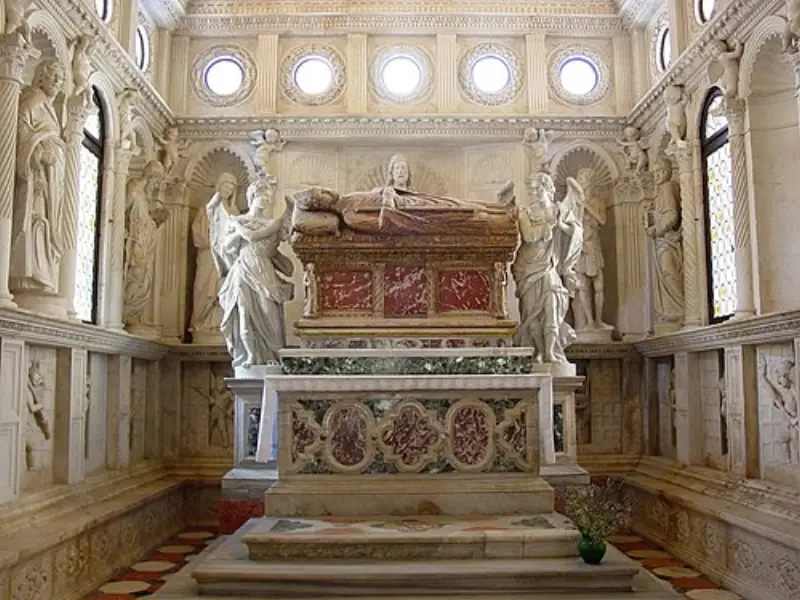
The act for which John is chiefly remembered occurred in 1105. Coloman, King of Hungary, was campaigning to secure the Croatian crown, and his advance threatened Trogir with destruction. Bishop John went out to meet him and succeeded in turning the king aside, delivering the city and its inhabitants from ruin. It was a victory won without troops or walls, by the standing of one man of God before a monarch. In the charters of the Croatian kings from the closing years of the eleventh century, John's name appears among the witnesses, a record of his continued prominence in the affairs of the kingdom. After his death, which came before 1111, his body was laid to rest in the cathedral of Trogir, where the Chapel of Saint Ivan Trogiranin was later built around his tomb. The city keeps his feast with solemnity each November 14, honoring him as its patron and as the bishop whose intercession once stood between it and the torch. Devotion to him has outlived every kingdom and empire that afterwards ruled the Dalmatian coast; the chapel that shelters his remains ranks among the artistic treasures of the cathedral, and the annual solemnity keeps alive, for each new generation of the city's inhabitants and visitors, the memory of the bishop whose single meeting with a king delivered his people.
§ John of Trogir
The Record
- Patron of
- patron of the city of Trogir
- Symbols
- bishop's vestments
- Canonization
- Pre-congregation; venerated in Trogir since the Middle Ages
Prayer
Bibliography
Show 1 sources
- matica.hr (in Croatian)
Profile text adapted from the Wikipedia article, licensed CC BY-SA 4.0.
Pray with this saint every day
Save St. John of Trogir to your favorites, read the full profile, and get feast-day reminders in the Saints app.
Get the Saints AppFree on the App Store for iPhone and iPad