
1873–1958·Feast June 5
St. John of Valamo
Schema-Igumen and Elder of New Valamo
Overview
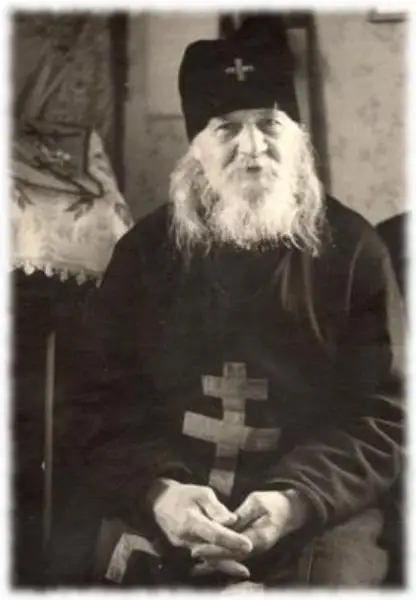
Schema-Igumen John, baptized Ivan Alekseyevich Alekseyev, became one of the best-loved spiritual fathers of Finnish Orthodoxy. Born to a peasant family in Tver Governorate in 1873, he worked as a boy in his brother's St. Petersburg bar before monastic life claimed him: novice at Valamo in 1889, soldier for four years, then monk for good, tonsured in 1910 as Brother Iakinf. Six years of prayer in the St. John the Baptist Skete prepared him for the hardest posting of his life, igumen of the Pechenga Monastery in the far north from 1921, where he was ordained deacon and priest and labored a decade among unlettered brethren. He came home in 1931 to the Great Schema and the name John, serving as father confessor until his death. The Winter War uprooted the monastery, and he formed the evacuated community's conscience by his calm, first at Kannonkoski, then at New Valamo in Heinävesi. His letters of counsel to his confession children were collected and printed in 1956, and published abroad as Christ in Our Midst, making his voice known far beyond Finland. He died on June 5, 1958, and was glorified by the Ecumenical Patriarchate in 2018.
The Complete Life
Early Life and Monastic Formation
Ivan Alekseyev grew up in a peasant household in Tver Governorate with his parents, a sister, and two brothers. A visiting tailor taught him his letters, and booklet lives of the saints fed a taste for reading that visits to Volokolamsk Monastery turned toward the cloister. At thirteen he left for St. Petersburg and the bar his brother ran, where he saw human misery at its worst; years later he judged that no better school existed for a future guide of souls. Books bought in the city widened his mind, and the road then led through Konevets Monastery to Valamo, where he entered as a sixteen-year-old novice in 1889. Military service interrupted the habit, four years in a sharpshooter battalion, two more with his father, and then in 1900 the return to Valamo for good. He joined the brotherhood in 1907 and in 1910 took the tonsure as Brother Iakinf, named for the martyr Hyacinth. After a testing posting to the monastery's podvor'e in St. Petersburg, he received the reward he had longed for: the St. John the Baptist Skete, austere and quiet, where he spent six years beside the hermits and soaked in the Philokalia.
§ Origins and early monastic life
Igumen in the Far North
On 19 October 1921 the ordinary monk Iakinf was named igumen of the Pechenga Monastery on the Arctic coast, ordained deacon and priest almost at once, and given two weeks to master the services. The decade that followed was punishing: the brethren were diligent but unlettered, services went unsaid, and spiritual literature was foreign to them. He reproved, taught literacy, and slowly changed the tone of the house. In 1924 grievances mounted, his authority seemed undermined, and he announced his departure for Valamo, but the brethren begged and he stayed. Far northern isolation even spared the monastery the calendar controversy dividing Finnish Orthodoxy, since Pechenga had already adopted the Gregorian calendar.
§ A hard and difficult assignment in the far north
Return, Great Schema, and Exile
October 1931 brought him home, where the Great Schema was conferred on him with the name John. Back at his beloved skete he mentored a young novice, Georgi, who would rise to become Archbishop of Karelia and All Finland, and from 1937 he wintered as assistant father confessor in the main monastery, drawing confession children such as Jelena Armfelt who remained his correspondents for life. War then scattered everything. He read the Gospel in his cell while bombs broke the windows around him, and carried out of the evacuation chiefly spiritual books, mourning two icons left behind. Six of the old monks died at the Vuoskoski school in Kannonkoski; the survivors found a permanent home in a purchased mansion at Papinniemi, Heinävesi. Of the new exile he would tolerate no regret, calling longing for Lake Ladoga a temptation to sin. At New Valamo he was made an elder, lodged in a room at the east end of a barrack-like building, and hundreds came knocking at that door in the decades that followed.
§ In exile
Spiritual Counsel and Writing
When Old Valamo's final father confessor died in 1948, John assumed the office himself and held it until 1958. The war's needy years saw his confession children sending him food, and his answering letters became their comfort in grief. Among them were Tito Colliander, who later described his confessor in the book Ateria, and Jelena Armfelt, whose correspondence was published generations later. Meanwhile Hieromonk Paul had begun translating some of the letters into Finnish for the magazine Aamun Koitto; the favorable response produced the 1956 Russian book of typed duplicates, 'Letters from a Valamo elder', with a cover drawn by the elder himself. Inside Valamo the reception was hostile, and John answered his critics in words of striking meekness. Archbishop Paul's Finnish edition followed in 1976, and English readers received the letters as Christ in Our Midst in 1979 and 1980; Russian reprints and even an Armenian edition have kept the book in circulation.
§ Spiritual counsel
Death
On the morning of 5 June 1958 the novice Andrei Peschkoff called to ask whether the elder needed anything from the store and found him silent in bed. Hieromonk Gabriel confirmed that Fr. John was dead. Archbishop Herman officiated at the funeral, with Colliander and other confession children present, in the last such office of his own life.
§ Death
Canonization
His cause was taken up by the Finnish Orthodox synod in March 2016, which proposed him alongside Johannes Karhapää. Both men's names were entered in the Hagiologion of the Orthodox Church by the Holy Synod of the Ecumenical Patriarchate of Constantinople on 29 November 2018, and New Valamo kept the feast of canonization on 31 May and 1 June 2019.
§ Canonization
Timeline
- 1873
Born Ivan Alekseyevich Alekseyev on 26 February to a peasant family in the village of Gubka, Tver Governorate
§ Early life
- 1889
Becomes a novice at Valamo Monastery at the age of sixteen
§ The call of the monastic life prevails
- 1910
Tonsured a monk with the name Iakinf, after the Greek martyr Hyacinth
§ The call of the monastic life prevails
- 1921
Appointed igumen of the Pechenga (Petsamo) Monastery on 19 October; consecrated deacon and then priest within a short time
§ A hard and difficult assignment in the far north
- 1924
Troubles within the brethren move him to consider leaving; the monks beg him to remain, and he stays a full decade in the north
§ A hard and difficult assignment in the far north
- 1931
Released from Petsamo in October; tonsured to the Great Schema at Valamo with the name John
§ Returning home
- 1937
Begins serving in winters as assistant to the father confessor of the main monastery
§ Returning home
- 1947
Chosen head of the monastery after Igumen Hariton's death, but the appointment is left unconfirmed because a Great-Schema monk could not be elected to the office
§ Difficult moments
- 1948
Receives the office of father confessor, held until his death, after the passing of Schema-Igumen Yefrem
§ Spiritual counsel
- 1956
His letters are issued in Russian as 'Letters from a Valamo elder'; he draws the cover picture himself, and reception inside the monastery turns hostile
§ The hermit becomes a published writer
- 1958
Dies quietly on 5 June at New Valamo; Archbishop Herman conducts the funeral, his last such service
§ Death
- 1985
The monastery publishes a biography of the elder, built on letters kept by Jelena Armfelt and the monastery archives
§ Memory of the beloved spiritual guide
- 2008
A memorial service at his grave marks the fiftieth anniversary of his death
§ Memory of the beloved spiritual guide
- 2018
The Holy Synod of the Ecumenical Patriarchate records his name in the Hagiologion on 29 November, alongside Johannes Karhapää
§ Canonization
- 2019
Feast of canonization kept at New Valamo Monastery on 31 May and 1 June
§ Canonization
In Their Own Words
In general, the letter mortifies the soul among the Valamo monks. This book will be a hindrance to those monks, who see the only thing that is necessary. This had not been written to condemn anyone, but the monks' notions have become more obvious than before.
The Record
- Major works
- Letters from a Valamo elder (Russian, 1956)·Christ is in Our Midst. Letters from a Russian Monk (English, London 1979; Crestwood, NY 1980)·Valamon vanhuksen kirjeitä (Finnish translation by Archbishop Paul, 1976)
- Symbols
- Elder's schema and prayer rope
- Canonization
- Inscribed in the Hagiologion by the Holy Synod of the Ecumenical Patriarchate of Constantinople, 29 November 2018; canonization feast celebrated 31 May – 1 June 2019 at New Valamo Monastery, Heinävesi, Finland
Prayer
Bibliography
Show 12 sources
- 1 2 Johannes: Valamon vanhuksen kirjeitä , p. 11.
- 1 2 3 Johannes: Valamon vanhuksen kirjeitä , p. 17.
- ↑ "Преподобный старец Иоанн Валаамский (Алексеев), схиигумен" [ ‘St. John of Valaam (Alekseev), schema-igumen’ ] . azbyka.ru . Retrieved 7 December 2018 .
- ↑ Johannes: Valamon vanhuksen kirjeitä , p. 18.
- ↑ "Yakinthia Festival in Anogia" . Archived from the original on 16 November 2011 . Retrieved 7 December 2018 .
- 1 2 Panteleimon: Valamon paterikon , p. 268.
- ↑ Panteleimon: Luostari Jäämeren rannalla , p. 64.
- ↑ Panteleimon: Luostari Jäämeren rannalla , p. 69–70.
- ↑ Panteleimon: Valamon paterikon , p. 278–282.
- ↑ Panteleimon: Luostari Jäämeren rannalla , p. 65.
- ↑ Panteleimon: Luostari Jäämeren rannalla , p. 71.
- 1 2 "Valamon luostari" [ ‘Valamo Monastery’ ] . Archived from the original on 4 March 2016 . Retrieved 17 July 2008 .
Profile text adapted from the Wikipedia article, licensed CC BY-SA 4.0.
Pray with this saint every day
Save St. John of Valamo to your favorites, read the full profile, and get feast-day reminders in the Saints app.
Get the Saints AppFree on the App Store for iPhone and iPad