
1580-1615·Feast March 10 (Scotland); October 14 (elsewhere)
St. John Ogilvie
Jesuit Priest and Martyr of Scotland
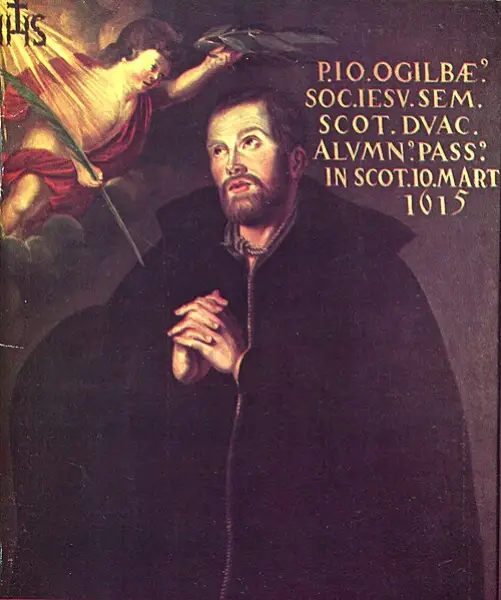
Overview
John Ogilvie, born in 1580, was firstborn son of the respected Calvinist laird Walter Ogilvie of Drumnakeith in Banffshire, in a family divided between Presbyterian and Catholic loyalties. Sent to the continent at twelve for schooling, he studied under Benedictines at Regensburg and Jesuits at Olomouc and Brno, and amid the era's public debates between Catholic and Reformed scholars he resolved the question for himself: in 1597, seventeen years old, he became a Catholic at Leuven, received by the Scripture scholar Cornelius à Lapide. He joined the Jesuits in 1599 and was ordained at Paris in 1613. After a spell at Rouen he begged repeatedly to be sent home to the hunted Catholics of the Glasgow area, where since the Reformation of 1560 it was illegal even to endorse the old faith. Returning late in 1613 in the guise of a horse trader calling himself John Watson, he preached in secret and said Mass in private houses for less than a year before his arrest in October 1614 on Archbishop Spottiswood's orders. Tortured by sleep deprivation, he refused to acknowledge King James's spiritual supremacy, saying he would grant it no more authority than an old hat, and called the king a runagate from God. Condemned, he was hanged at Glasgow's Cross on 10 March 1615, thirty-six years old, throwing his rosary into the crowd as he died.
The Complete Life
Early Life
John Ogilvie was born in 1580 at Drumnakeith in Banffshire, Scotland, born of Walter Ogilvie, a respected Calvinist laird, and his eldest son. The family was of the Scottish landed class, part Catholic by older loyalty and part Presbyterian by conviction, a division typical of the north-east after the Reformation of 1560. For a boy of that class and that century the path to education ran to the continent, and at twelve John was sent abroad, attending Catholic schools in Germany: the Benedictines at Regensburg, and the Jesuits at Olomouc and Brno in Moravia. His schooling, undertaken for learning rather than faith, became the occasion of conversion, since the Europe he studied in was alive with the controversies of the age, and the debates between Catholic and Calvinist scholars drew him into the question of the truth of religion he had been born out of.
§ Biography
Conversion and Vocation
At seventeen, in 1597, Ogilvie was received into the Catholic Church at Leuven by Cornelius a Lapide, the Jesuit professor of Scripture, one of the most learned men of the age. Two years later he entered the Society of Jesus, and his formation carried him through the order's houses in Austria and Bohemia to theology at Paris, where he was ordained priest in 1613. His desire from the beginning was fixed: he asked repeatedly to be sent to Scotland, where the Catholic remnant, stripped of clergy by the Kirk and the Crown, was sustained by a handful of priests. After a period of pastoral work at Rouen his superiors yielded, and in 1613, disguised and under an assumed name, he crossed to the Scotland of James VI, where the Penal statutes were enforced with vigor.
§ Biography
Spirituality and Teaching
Ogilvie's short life left no writings, and his spirituality is known through the interrogations, which preserved his answers in enough detail to show his cast of mind. He was a controversialist of precision, refusing the royal oath not out of sentiment but on the considered ground that spiritual jurisdiction belonged to the pope and that no secular authority could create it, and he declined to dispute doctrine with his judges on the scaffold's terms. His Jesuit formation shows in his insistence on obedience, having asked leave for the Scottish mission for years before receiving it, and in his calm under the sleeplessness and badgering designed to break him. The one thing his contemporaries agreed on reporting was his cheerfulness, a constitutively Ignatian trait, maintained to the gallows, and it became the chief lesson drawn from his death: that the persecuted priest's liberty of spirit was the argument his persecutors could not answer.
§ Introduction
Mission and Ministry
Ogilvie's Scottish mission lasted less than a year. He worked in Edinburgh, Glasgow, and the homes of the surviving Catholic nobility of the north-east, celebrating Mass in secret, reconciling the lapsed, and gathering the scattered faithful. The Catholic community he served was small and demoralized, dependent on a few households, and infiltrated by informers; the Kirk's authorities kept watch for priests as the English regime did. Ogilvie's method was the itinerant ministry of the hunted, moving between safe houses, preaching where a handful could gather. In 1614 he was betrayed and arrested in Glasgow, and his captivity became a cause: he was interrogated repeatedly, pressed by archbishop Spottiswoode's officials and by the king's own agents, starved of sleep, and offered preferment if he would conform. He answered with the sharpness that made him famous, refusing the oath purporting to decide the supremacy question by the king's authority alone.
§ Biography
Trial and Final Years
At his trial in Glasgow Ogilvie was convicted of treason for denying the king's spiritual jurisdiction, and he went to the gallows at Glasgow Cross, on 10 March 1615, at about thirty-five years old. The execution was botched in the manner of the day, and accounts of his death, circulated in Catholic Europe, deepened the outrage and the devotion that followed it. He was the only Jesuit martyred in Scotland, and his death effectively closed the era of open judicial killing of priests in that kingdom. His last words, witnesses reported, declared that he died for religion alone and prayed for the king.
§ Introduction
Canonization
Ogilvie was beatified by Pope Pius XI on 22 December 1929. His canonization on 17 October 1976 by Pope Paul VI made him the first Scottish saint canonized since the Reformation and, to this day, the only post-Reformation Scottish saint, a fact that defines his place in the church of Scotland. The canonization was based on the martyrdom itself and on the recognition of the miracle required, and the rite in Rome was received in Scotland with great celebration as the rehabilitation of the country's Catholic dead.
§ Introduction
Legacy
Ogilvie is the patron of Catholics in Scotland, and his shrine and feast, 10 March, center the Scottish church's memory of its penal era. His historical significance is considerable: the record of his interrogations survives in unusual detail, giving historians the fullest inside view of the mind of a missionary priest and of the Kirk-state apparatus that destroyed him. His defense of conscience against the imposed oath, debated with his judges on the scaffold's edge, has made him a figure invoked well beyond the Catholic community, in Scotland's long arguments over religious authority and civil power. In Glasgow, the place of his execution at the Cross is marked, and annual commemorations keep his memory in the archdiocese.
§ Introduction
Timeline
- 1580
Born at Drumnakeith, Banffshire, eldest son of the Calvinist Walter Ogilvie.
§ Biography
- 1597
Received into the Catholic Church at Leuven by Cornelius a Lapide, aged seventeen.
§ Biography
- 1599
Enters the Society of Jesus.
§ Biography
- 1613
Ordained a priest at Paris and afterwards serves at Rouen.
§ Biography
- Nov 1613
Slips back into Scotland in November disguised as the horse trader John Watson, preaching and saying Mass in secret.
§ Biography
- Oct 1614
Discovered and arrested in Glasgow on the orders of Archbishop John Spottiswood.
§ Biography
- 10 Mar 1615
Hanged at Glasgow Cross after a trial over his refusal of royal authority over the Church.
§ Biography
- 22 Dec 1929
Beatified in Rome by Pope Pius XI.
§ Introduction
- 17 Oct 1976
Canonized by Pope Paul VI, becoming the only post-Reformation Scottish saint.
§ Veneration
In Their Own Words
If there be here any hidden Catholics, let them pray for me but the prayers of heretics I will not have.
The Record
- Symbols
- Rosary thrown to the crowd at his execution·Jesuit cassock and horse-trader's disguise
- Canonization
- Declared Venerable in the seventeenth century; beatified in 1929; canonized by Pope Paul VI on 17 October 1976 — the only post-Reformation Scottish saint
Prayer
Bibliography
Show 9 sources
- 1 2 3 Barrett, Michael. "Ven. John Ogilvie." The Catholic Encyclopedia Vol. 11. New York: Robert Appleton Company, 1911. 11 December 2021 This article incorporates text from this source, which is in the public domain .
- ↑ "Patron Saints Index: Saint John Ogilvie" . 15 January 2009. Archived from the original on 15 January 2009 . Retrieved 14 May 2017 .
- ↑ "10. mars: Den hellige John Ogilvie (~1580–1615)" . 13 March 2010. Archived from the original on 13 March 2010 . Retrieved 14 May 2017 . {{ cite web }} : CS1 maint: bot: original URL status unknown ( link )
- ↑ Solenne canonizzazione in San Pietro del beato Giovanni Ogilvie vatican.va, article in Italian
- ↑ "Irondequoit Catholic Communities – – John Ogilvie" . 11 October 2008. Archived from the original on 11 October 2008 . Retrieved 14 May 2017 . {{ cite web }} : CS1 maint: bot: original URL status unknown ( link )
- ↑ Caledonian (10 September 2020). "St John Ogilvie" . St Aloysius' Glasgow . Retrieved 27 March 2025 .
- ↑ Magee, Molly. "St John Ogilvie High School" . www.southlanarkshire.gov.uk . Retrieved 27 March 2025 .
- ↑ "Jesuits in Britain - Call to honour Scotland's only martyr - 20 March 2017" . Archived from the original on 22 July 2019 . Retrieved 22 July 2019 .
- ↑ "No. 48154" . The London Gazette (Supplement). 14 April 1980. p. 5584.
Profile text adapted from the Wikipedia article, licensed CC BY-SA 4.0.
Pray with this saint every day
Save St. John Ogilvie to your favorites, read the full profile, and get feast-day reminders in the Saints app.
Get the Saints AppFree on the App Store for iPhone and iPad