
c. 1532 – 1582·Feast April 2
St. John Payne
Seminary priest and martyr of Elizabethan England
Overview
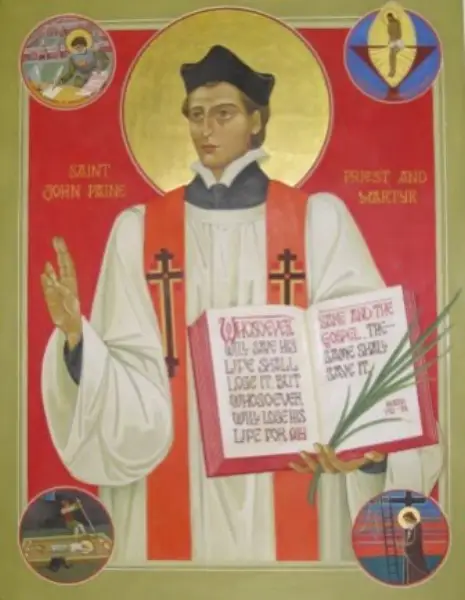
John Payne was an English Catholic priest and martyr, one of the Forty Martyrs of England and Wales. Born at Peterborough around 1532, he was likely well into manhood when in 1574 he left England for the English College at Douai, where he acted as bursar; on 7 April 1576 the Archbishop of Cambrai ordained him priest. Within weeks he returned to England on the missionary appeal, traveling with Cuthbert Mayne, and made his base chiefly at Ingatestone in Essex in the household of Anne, widow of Sir William Petre, passing as her steward while the house concealed a priest hole. He reconciled the Oxford graduate George Godsalve to the Catholic Church and labored in Essex and London until his arrests began: detained in 1577, he returned to Douai, came back to England before Christmas 1579, and was finally taken in Warwickshire in July 1581 through the efforts of the informer George Eliot. Examined by Walsingham, twice racked in the Tower of London, and indicted at Chelmsford on a fabricated charge of conspiring to murder the Queen, he was condemned on the testimony of a proven criminal. He was hanged, drawn, and quartered at Chelmsford on 2 April 1582, praying for nearly half an hour and professing his innocence while the sympathetic crowd hung on his feet to bring death the sooner. Leo XIII beatified him in 1886, and Paul VI canonized him with the other English and Welsh martyrs in 1970.
The Complete Life
From Peterborough to Douai
John Payne was born at Peterborough in 1532, into the generation that lived through England's break with Rome as young adults. For much of his early manhood the old faith was proscribed in his native country, and it was as a probably mature man that he made the decisive journey of his life: in 1574 he went to the English College at Douai, in the Spanish Netherlands, the seminary founded to train priests for the forbidden Catholic mission in England. There the exile community shaped men of unusual resolution, and Payne was trusted with responsibility, serving the college as its bursar. His formation culminated in ordination: on 7 April 1576 he was ordained priest by the Archbishop of Cambrai. He was about forty-four years old, an age at which most men settle into safer courses, and he had before him only the choice between quiet security abroad and a preaching mission at home that could end on the gallows. Within seventeen days of his ordination he had made that choice, setting out with the newly founded mission's first wave of seminary priests. Douai had given him what the Elizabethan settlement had denied his generation: a Catholic priesthood, and a community of likeminded men, among them Cuthbert Mayne, who would become, like Payne himself, one of the future Forty Martyrs of England and Wales.
§ Background
The Missionary Priest in Disguise
On 24 April 1576, scarcely two weeks after ordination, Payne set out for the English mission alongside Cuthbert Mayne. Mayne made for his native South West England; Payne settled in Essex, lodging chiefly with Lady Petre — Anne, Sir William Petre's widow and the daughter of Sir William Browne, a former Lord Mayor of London, at Ingatestone, and also in London. The Petre household remained secretly Catholic, its great house equipped with a priest hole in which the missioner could vanish when pursuivants searched the premises; Payne passed openly as Lady Petre's steward, a disguise that let him move through gentry society unnoticed. Shortly after his arrival he brought back to the old faith George Godsalve (Godsalf in some spellings), a Bath-diocese scholar who had taken Oxford's B.A. and been made deacon while the Catholic Mary reigned, before later conforming to Protestantism. Payne dispatched Godsalve to Douai; he arrived there on 15 July 1576 to be readied for Catholic ordination, which he would receive at Cambrai that December. The pattern of Payne's vocation was thus set: secret ministry among recusant households, the quiet reconciliation of lapsed Catholics, and the channeling of promising men back to the seminaries abroad. It was work performed under constant threat, and arrest soon followed.
§ Ministry
Arrests and the Web of the Informer
Payne was seized at Ingatestone and jailed early in 1577, though he was quickly freed and went back to Douai that November, probably coming back to Ingatestone before Christmas 1579. The final catastrophe began in early July 1581, when Payne and Godsalve, who had come back to England in June 1577, were arrested in Warwickshire while staying on the estate of Lady Petre, through the efforts of the informer George Eliot, nicknamed 'Judas' — a criminal guilty of murder, rape, and theft, who had built a career on denouncing Catholics and priests for bounty. Eliot had insinuated himself into the Petre household, embezzled money there, and then enticed a young woman of the Roper household and asked Father Payne to marry them; on Payne's refusal, he resolved to be revenged and profit as well. Payne and Godsalve were examined by Sir Francis Walsingham at Greenwich and committed to the Tower of London on 14 July 1581. As the more significant catch, Payne underwent the rack on the Council's orders on 14 August, then again on 31 October, yet the torture produced nothing that his enemies could use beyond what they invented. Godsalve did not give in either, spending years in prison before his release from the Marshalsea in September 1585 and banishment; he died in Paris in 1592. Payne's own course now led to trial and death.
§ Arrest
Trial and Gallows at Chelmsford
On 20 March 1582 Payne was abruptly roused, taken half dressed from his cell, and handed over by the Lieutenant of the Tower, Sir Owen Hopton, to officers who would carry him to Chelmsford jail; he was not allowed to return for his purse, which the Lieutenant's wife, Anne Echyngham, stole. On 22 March he was indicted at Chelmsford for treason: plotting the murder of the Queen and her chief officers so that Mary, Queen of Scots, might take the throne. Payne rejected the charges, professing loyalty to the Queen in everything lawful — everything, that is, not opposed to his Catholicism or his allegiance to the Pope — and he challenged Eliot's reliability. The crown made no effort to corroborate the tale, much of which had already been rehearsed when Edmund Campion was tried on 20 November 1581; conviction was a foregone conclusion. When Payne came to execution on Monday morning, 2 April 1582, nine months into his imprisonment, he was drawn on a hurdle to the scaffold, knelt praying for nearly half an hour, kissed the boards, made a public profession of faith, and protested his innocence. When Lord Rich called on him to repent of treason and a Protestant minister claimed his brother had once admitted it, Payne answered with composure, asking that the brother be brought; he was not found in time. The onlookers were so moved that they hung on his feet to hasten death and would not allow the quartering until life was gone, defeated the government's design of a smooth, quiet execution.
§ Execution
Among the Forty Martyrs
John Payne numbers among the prominent Catholic martyrs of the Elizabethan persecution who were later designated the Forty Martyrs of England and Wales. Recognition came slowly and by an unusual route: he was beatified 'equipollently' by Pope Leo XIII, by means of a decree dated 29 December 1886 — a form of canonization procedure by which the Pope confirms a longstanding cult without the ordinary judicial process, appropriate for martyrs whose deaths in odium fidei were a matter of public record. His feast is kept on 2 April, the anniversary of his execution, and on 25 October, the date on which the Forty Martyrs are celebrated together. The final act came in the modern era: on 25 October 1970 Pope Paul VI canonized Payne along with the other Martyrs of England and Wales, raising to the altars a representative company of the seminary priests, religious, and laypeople who died under the Elizabethan and Stuart penal laws. In Payne the cohort included one of the earliest of the Douai missionaries, a priest who had endured rack and prison rather than abandon his flock. The canonization of 1970 closed a process that had begun in the seminaries of the exile Church and ended in St. Peter's Basilica, four centuries after a half-dressed prisoner was dragged from the Tower toward an Essex gallows.
§ Beatification and canonisation
Remembered in Essex
Payne's memory lives on most concretely in the county where he ministered and died. A Roman Catholic secondary school in Chelmsford, toward Broomfield, is named St John Payne Catholic School in his honor, so that the town that witnessed his execution now educates its Catholic young under his patronage. In Colchester, the Roman Catholic church of St John Payne stands on the Greenstead estate; the parish was founded in 1972, two years after his canonization, and the Parish of Greenstead, Ardleigh and Mistley ministers to communities along the Essex-Suffolk border, with St John Payne as its parish church. Within the wider communion of the Forty Martyrs of England and Wales, he is commemorated each 2 April and 25 October, and his story is preserved in the classic literature of the English martyrs, from Richard Challoner's Memoirs of Missionary Priests to the lives compiled by Bede Camm and the menologies of Richard Stanton, as well as the Catholic Encyclopedia article by John Wainewright. Historians have continued to study him: the 1996 study by P. Lake and M. Questier on 'Agency, Appropriation and Rhetoric Under the Gallows' examined the theatrical politics of his execution, and Godfrey Anstruther's Seminary Priests remains the most reliable compact source for his career. The young priest-hunting world of Walsingham and Eliot has passed, but the parish of Greenstead still gathers each Sunday under the martyr's name.
§ Schools and churches
Timeline
- 1532
Born at Peterborough, England.
§ Background
- 1574
Went to the English College at Douai, where he served as bursar.
§ Background
- 7 Apr 1576
Ordained priest by the Archbishop of Cambrai.
§ Background
- 24 Apr 1576
Departed Douai for mission work in England, traveling with Cuthbert Mayne.
§ Ministry
- 15 Jul 1576
Sent George Godsalve to the English College at Douai to prepare for the Catholic priesthood.
§ Ministry
- 1577
Arrested at Ingatestone and imprisoned early in the year; soon released, he returned to Douai in November.
§ Ministry
- 1579
Probably returned to Ingatestone from Douai before Christmas.
§ Ministry
- Jul 1581
Arrested in Warwickshire with George Godsalve through the efforts of the informer George Eliot.
§ Arrest
- 14 Jul 1581
After examination by Walsingham at Greenwich, committed to the Tower of London.
§ Arrest
- 14 Aug 1581
Racked in the Tower on the orders of the Council.
§ Arrest
- 31 Oct 1581
Racked a second time.
§ Arrest
- 20 Mar 1582
Taken half dressed from his cell by the Lieutenant of the Tower and delivered to officers bound for Chelmsford jail.
§ Arrest
- 22 Mar 1582
Indicted at Chelmsford for treason on the uncorroborated testimony of George Eliot; the guilty verdict was a foregone conclusion.
§ Trial
- 2 Apr 1582
Dragged on a hurdle to execution at Chelmsford and hanged, drawn, and quartered; the crowd hung on his feet to hasten his end.
§ Execution
- 29 Dec 1886
Beatified equipollently by Pope Leo XIII by decree.
§ Beatification and canonisation
- 25 Oct 1970
Canonized by Pope Paul VI along with the other Martyrs of England and Wales.
§ Beatification and canonisation
The Record
- Major works
- Catholic missionary service in Essex and London (1576-1581)
- Symbols
- Palm of martyrdom·priest's vestments
- Canonization
- Canonized 25 October 1970 by Pope Paul VI as one of the Forty Martyrs of England and Wales; beatified by Leo XIII on 29 December 1886
Prayer
Bibliography
Show 7 sources
- Nelson, Thomas (2001). Nelson's Dictionary of Christianity: The Authoritative Resource on the Christian World. Thomas Nelson. ISBN 978-1-4185-3981-8.
- Stanton, Richard, A Menology of England and Wales, p. 140, Burns & Oates, Ltd., London, 1892.
- Wainewright, John. "Bl. John Payne." The Catholic Encyclopedia. Vol. 8. New York: Robert Appleton Company, 1910.
- Camm OSB, Bede, Lives of the English Martyrs, p. 429, Longmans, Green & Co., London, 1914.
- Lake, P.; Questier, M. (1 November 1996). "Agency, Appropriation and Rhetoric Under the Gallows: Puritans, Romanists and the State in Early Modern England". Past & Present (153): 64-107. doi:10.1093/past/153.1.64. ISSN 0031-2746.
- Challoner, Richard. Memoirs of Missionary Priests, Thomas Richardson & son, 1843, p. 90.
- Anstruther, Godfrey, Seminary Priests, St Edmund's College, Ware, vol. 1, 1968, pp. 133-134, 311-313.
Profile text adapted from the Wikipedia article, licensed CC BY-SA 4.0.
Pray with this saint every day
Save St. John Payne to your favorites, read the full profile, and get feast-day reminders in the Saints app.
Get the Saints AppFree on the App Store for iPhone and iPad