
c. 1637-1679·Feast July 19
St. John Plessington
Priest Martyred in the Popish Plot Panic
Overview
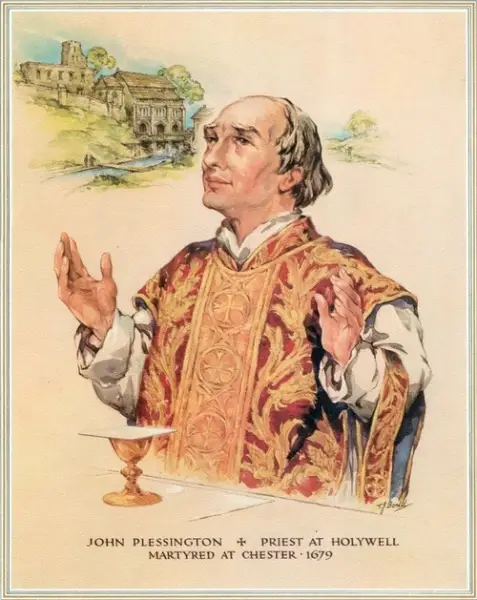
John Plessington — recorded variously as Plesington, as William Scarisbrick and as William Pleasington — was born in Lancashire and died on the gallows for the crime of exercising Catholic priesthood in a kingdom that had outlawed it. Raised in a family punished alike for its Catholicism and its Royalist politics, he received his schooling from the Jesuits at Scarisbrick Hall before crossing to Spain for studies at the Royal College of Saint Alban in Valladolid and continuing at Saint Omer in France. Ordained at Segovia in 1662, he slipped back into England the following year and served the hidden Catholic communities of Holywell and Cheshire, often under the alias John Scarisbrick, while also tutoring at Puddington Old Hall near Chester. The fabricated hysteria of Titus Oates's Popish Plot gave the authorities their pretext: arrested at Chester, he passed two months in prison and was condemned as a traitor simply for being a priest. From the scaffold at Gallow's Hill, Boughton, he died the death of hanged, drawn and quartered, defending the Roman ordination of the English clergy with his last words. Pius XI beatified him in 1929, and in 1970 Paul VI canonized him among the Forty Martyrs of England and Wales.
The Complete Life
A Household Under Siege
The Plessingtons of Dimples Hall near Garstang belonged to that generation of Lancashire Catholic gentry for which loyalty to the old faith and loyalty to the Crown had become dangerously entangled. John arrived there in about 1637; his father, Robert Plessington, was both a Royalist and a Catholic, and his mother was Alice Rawstone. The family endured persecution on both counts at once, suffering for their religious convictions and for the political allegiances of the Civil War era. To grow up in such a house was to learn early that the faith was not a cultural inheritance to be taken for granted but a trust that could cost a family its property, its liberty and its standing. Lancashire remained one of the strongest pockets of Catholic survival in Protestant England, sustained by recusant gentry families who kept chaplains, sheltered missionaries and married within their own network. It was precisely from such milieus that the seminary priests of the mission drew their recruits, and the boy from Dimples Hall would prove no exception. That he emerged from a household already marked by the state's suspicion makes his later choice of the priesthood less a distant ideal than a continuation of the family's stubborn fidelity, carried one step further and onto the scaffold.
§ Life
Formation Across Two Kingdoms
Education for a Catholic boy in Restoration England meant exile, and John's formation followed the well-worn route of the mission. His first schooling came from the Jesuits at Scarisbrick Hall, a Catholic college in his native Lancashire that operated under difficult and shifting legal conditions. From there he moved on to Spain, studying at Valladolid in the Royal College of Saint Alban, one of the seminaries that trained Englishmen for the forbidden priesthood at home. His studies continued at the English seminary of Saint Omer in France, another hinge of the mission network through which generations of priests passed between the continental colleges and the parishes without pastors in England. The journeying ended at Segovia, where on 25 March 1662 he was ordained a priest. By the following year he was ready to return. The route he had taken, through Spain and French Flanders rather than the more common Italian colleges, linked him to the Hispano-English tradition that supplied so many of the northern mission's clergy. Nothing in his quiet, competent career suggested the notoriety that death would bring; he returned as hundreds had before him, a priest in his mid-twenties carrying the sacraments into a country where his order of ordination was itself a capital indictment.
§ Life
A Priest Under Another Name
From 1663 Plessington worked the covert Catholic circuits of Holywell in Flintshire and the neighboring county of Cheshire, an area where recusant families were numerous enough to sustain a secret clergy and watchful enough to require one. Survival on the mission meant anonymity, and he practiced it habitually, going by the name John Scarisbrick, a surname drawn from the world of his Jesuit schooling. For a time he also served as tutor at Puddington Old Hall near Chester, the seat of a Catholic family where a resident priest-educator could move with relative safety. This was the unglamorous core of his apostolate: Mass said in guarded rooms, children instructed, the sacraments carried from estate to estate by men whose existence the law refused to acknowledge. For some sixteen years the arrangement held. The halt came not through discovery of anything he had done but through the national convulsion of 1678, when Titus Oates's fabricated tale of a Catholic conspiracy to kill the king set the whole kingdom hunting imaginary traitors. The panic revived the old statutes against priests with murderous energy, and in that poisoned atmosphere Plessington was arrested at Chester. His long discretion had kept him alive through decades; the Plot made his identity as a priest, once discovered, the whole of the case against him.
§ Life
Two Months and a Scaffold
Imprisoned at Chester during the Popish Plot scare, Plessington endured two months of captivity before his trial, charged under the law that made presence in the kingdom by a Roman-ordained priest an act of treason. The sentence, when it came, was the full medieval formula: to be hanged, drawn and quartered. He met it at Gallow's Hill in Boughton on 19 July 1679, aged about forty-one. Before the execution was carried out he was allowed to speak from the scaffold, and his declaration was remarkable less for defiance than for argument. His argument from the scaffold ran like this: the law of the nation condemns as a traitor any priest whose orders derive from Rome; yet the first Protestant bishops, by their own writers' admission, were ordained by that same Church of Rome or by no one at all, so the established clergy's orders descend from the very authority now being punished. The statement has been preserved as a last, level-headed rebuke to the incoherence of his condemnation. He then suffered the full penalty. By the manner of his death he joined the long roster of seminary priests who died not for any act against the state but for the bare fact of their priesthood.
§ Life
From Beatification to the Altar
Recognition of Plessington's martyrdom came in two stages separated by four decades. On 15 December 1929 Pope Pius XI beatified him, one of a large cohort of English and Welsh Reformation martyrs advanced in the modern revival of their causes. His 1962 beatification process led to the opening of a grave believed to be his, an investigation that proved inconclusive in an unexpected way, for the remains found there were those of a younger man. The canonization followed on 25 October 1970, when Pope Paul VI raised Plessington and thirty-nine companions to the altars as the Forty Martyrs of England and Wales, the representative group drawn from those Catholics put to death for the faith in England and Wales between 1535 and 1679. In the liturgy of that canonization the Church effectively reversed the verdict of 1679: the traitor of the Popish Plot panic was proclaimed a saint, his execution an act of persecution rather than justice. He is now honored liturgically on 19 July, the anniversary of his death, and collectively with his companion martyrs on 25 October. The bones recovered from a trunk in Wales and possibly his true relics remain under investigation, a reminder that even the location of his mortal remains is part of an unfinished story.
§ Introduction
Memory in Chester
Chester has kept the martyr's memory close to the place of his death. Inside the entrance porch of Chester's St Werburgh's Catholic Church, on Grosvenor Park Road, a memorial tablet commemorates him, within a short walk of the Gallow's Hill execution site. Close at hand stands the granite obelisk that Chester raised in 1898 to the Protestant martyr George Marsh; in 1980 the Catholic counterpart was added to its base, an inscription noting that Plessington died there for the faith on 19 July 1679 and was declared a saint on 25 October 1970, an unusually generous juxtaposition of two confessions' memorials on a single monument. His name also lives in education: a Catholic school bearing the title St. John Plessington serves Wirral, and it was named TES School of the Year in 2010 for the whole of England, Wales, Ireland and Scotland. The story of his remains continued to unfold in the twenty-first century. Bones discovered in the late nineteenth century, wrapped in seventeenth-century clothing in a Flintshire pub long used for secret Catholic worship in the region where he had ministered, and later entrusted to a Jesuit community at Tremeirchion, came to be regarded as possibly his, their signs of violence consistent with an execution of the period. In 2015 Bishop Mark Davies of Shrewsbury launched a campaign to fund DNA testing of the bones.
§ Memorial
Timeline
- 1637
Born at Dimples Hall, Garstang, Lancashire, son of the Catholic Royalist Robert Plessington and Alice Rawstone
§ Life
- 25 Mar 1662
Ordained a priest at Segovia in Spain after studies at Valladolid and Saint Omer
§ Life
- 1663
Returns to England to minister in secret to Catholics around Holywell and Cheshire under the alias John Scarisbrick
§ Life
- 19 Jul 1679
After two months' imprisonment on a Popish Plot charge, hanged, drawn and quartered at Gallow's Hill, Boughton, Cheshire
§ Life
- 15 Dec 1929
Beatified at Rome by Pope Pius XI
§ Introduction
- 25 Oct 1970
Canonized by Pope Paul VI as one of the Forty Martyrs of England and Wales
§ Life
The Record
- Symbols
- Chasuble·Chalice·Eucharist·Rosary·Martyr's palm
- Canonization
- Beatified 15 December 1929 by Pope Pius XI; canonized 25 October 1970 by Pope Paul VI as one of the Forty Martyrs of England and Wales
Prayer
Bibliography
Show 2 sources
- "List of 40 martyrs", accessed 20 July 2008 (archived 13 March 2013 at the Wayback Machine).
- Bingham, John (19 October 2015). "The priest in the pub: could mystery bones be relics of saint?" The Telegraph.
Profile text adapted from the Wikipedia article, licensed CC BY-SA 4.0.
Pray with this saint every day
Save St. John Plessington to your favorites, read the full profile, and get feast-day reminders in the Saints app.
Get the Saints AppFree on the App Store for iPhone and iPad