
c. 1570-1600·Feast June 21
St. John Rigby
Layman Martyred Under Elizabeth I
Overview
John Rigby was an Elizabethan Catholic layman who died for the faith without ever holding holy orders, one of the few married-state figures among the Forty Martyrs of England and Wales. His birth came around 1570 into the recusant gentry of Harrock Hall, Wrightington: John was one of the youngest of the six or so sons that Nicholas Rigby and his wife Mary Breres raised, and his early manhood passed in the ordinary service of households like his own. In 1600, employed as steward to Sir Edmund Huddleston, he was sent to the Old Bailey to plead illness on behalf of his employer's daughter, the widow Mrs. Fortescue, summoned on a recusancy charge. There a commissioner turned the questioning on Rigby himself, and he freely acknowledged that he was a Catholic. Sent to Newgate, he signed a confession declaring that he had been reconciled to the Roman faith by the Franciscan friar John Jones and had avoided Anglican services since. Twice offered the chance to recant, twice he refused, telling the judge that a traitor's sentence was the very thing he desired. On 21 June 1600 he suffered at St Thomas Waterings, pardoning the men who put him to death with a last gift of gold as he mounted the cart. Pius XI beatified him in 1929; Paul VI canonized him with the Forty Martyrs in 1970.
The Complete Life
A Younger Son of Harrock Hall
Around 1570 there was born at Harrock Hall in Wrightington, hard by Chorley in Lancashire, a boy named John, fifth or sixth in order among the sons of Nicholas Rigby and of his wife Mary, born a Breres. The household into which he was born belonged to the resilient Catholic gentry of the county, the class that had absorbed the losses of the Reformation and continued, generation after generation, to send sons to the continental seminaries and daughters into equally committed marriages. As one of at least six boys, John stood to inherit little; younger sons of such families commonly made their way as stewards, soldiers or servants of their kin, and his later employment suggests he took the administrative road. An odd wrinkle marks his memory: in The Autobiography of a Hunted Priest, the account of the Jesuit John Gerard's ministry, he appears under the name Thomas Rigby, one more example of the careful aliases under which Elizabethan Catholics moved. What his upbringing gave him was unambiguous. He had been received into the Catholic church by a priest of the Franciscan habit, John Jones, in the Clink prison some two or three years before his death, an act of reconciliation that in the England of the time was itself legally fraught and, once admitted, fatal.
§ Life
Steward, Envoy, Confessor
By 1600 Rigby was serving as steward to Sir Edmund Huddleston, a Catholic gentleman whose household affairs required exactly the competent, discreet management that a recusant younger son could supply. The turn of his life came through a small act of family service. Sir Edmund's daughter, the widow Mrs. Fortescue, faced a summons to the Old Bailey sessions house over her recusancy, and Sir Edmund dispatched Rigby to plead that illness kept her away. It was a routine errand, the sort a trusted servant undertook a hundred times. At the sessions house, however, a commissioner chose to interrogate the envoy about his own religion rather than the excuse he had come to deliver. Where a more careful man might have equivocated, Rigby acknowledged plainly that he was a Catholic. For that answer he was committed to Newgate. On the following day, St Valentine's feast, he set his position down in writing: the confession recorded that John Jones, a Franciscan, had received him into the Roman communion in the Clink two or three years before, and that he had stayed away from Anglican worship ever since. The document converted suspicion into legal proof, and the case that had begun as another's became wholly his own.
§ Life
Twice Offered, Twice Refused
From Newgate Rigby was transferred to the White Lion, and there the machinery of persuasion took over. Twice the authorities offered him his life on the condition of recantation, and twice he declined, a refusal all the more striking in a layman who had no flock to edify and no altar to protect, only his own soul to keep. Brought before the judge, he heard the sentence for treason pronounced upon him and answered that it was the thing which he desired. On 21 June 1600 the sentence was carried out at St Thomas Waterings, a place of execution on the Kent road. As he climbed the cart, he pressed a piece of gold into the executioner's hand, bidding him accept it as a token of free forgiveness, his own and that of everyone else whose hands were on his death. The hanging itself went wrong: cut down too soon, Rigby landed on his feet alive, and was thrown down and held while the butchery of drawing and quartering was completed. Richard Challoner's later chronicle preserved the verdict of the spectators, who went away complaining bitterly of the barbarity they had witnessed. Two years earlier, on the same ground, the friar John Jones who had received him into the Church had suffered the same death.
§ Life
Honored Among the Forty
The process by which the Elizabethan martyrs returned to public honor moved slowly through the centuries, and Rigby's name travelled in the main cohort. On 15 December 1929, in Rome, Pope Pius XI beatified him among the large group of English and Welsh martyrs elevated in that era of revived causes. The canonization came on 25 October 1970, when Pope Paul VI proclaimed him and thirty-nine companions saints of the Catholic Church as the Forty Martyrs of England and Wales, selected to represent the Catholics executed for the faith in those countries between 1535 and 1679. His individual feast is kept on 21 June, the anniversary of his execution at St Thomas Waterings, and he shares the collective feast of 25 October with the rest of the Forty. Rigby's canonization carried a particular significance within that company: he was a layman, condemned not for priesthood but for the confession of faith and the refusal of recantation, demonstrating that the martyr roll of the English mission belongs to the whole body of the faithful and not to clergy alone. The acknowledgment also restored to honor the memory of John Jones, the Franciscan who had reconciled him and had already died a martyr's death on the very spot where Rigby followed him.
§ Canonization
Colleges and Windows
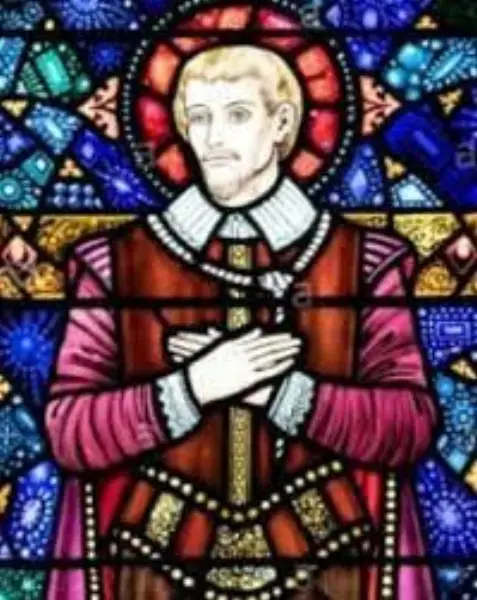
The memory of John Rigby took durable institutional form in the industrial northwest where his family had its roots. Orrell, within the Metropolitan Borough of Wigan in Greater Manchester, keeps him close: its Sixth Form Roman Catholic college, called St John Rigby, is named for the martyr, and one building, Harrock House, echoes in turn his birthplace at Harrock Hall, tying the modern college to the Lancashire landscape that formed him. Devotion also found its way into glass. Our Lady & All Saints Church at Parbold, a village within reach of Wrightington, holds stained glass windows depicting the martyr, documented by Richard Collier in a series of studies published on 21 June 2014, the martyr's feast day. The iconography follows the convention recorded in his attributes: the noose about the neck, the martyr's palm in the hand, the shackles about the ankles, images that state plainly how he died and what he conquered. Beyond these local memorials, his story survives in the literature of the mission, notably the account of John Gerard's priesthood in which, under the alias Thomas, he appears as one of the laymen whose quiet constancy sustained the underground church of Elizabethan Lancashire.
§ Legacy
Timeline
- 1570
Born at Harrock Hall, Wrightington, Lancashire, fifth or sixth son of Nicholas Rigby and Mary Breres
§ Life
- 14 Feb 1600
On the feast of St Valentine, signs a confession in Newgate acknowledging his reconciliation to the Catholic faith by John Jones
§ Life
- 21 Jun 1600
Executed by hanging, drawing and quartering at St Thomas Waterings, having twice refused liberty in exchange for recanting
§ Life
- 15 Dec 1929
Beatified in Rome by Pope Pius XI
§ Canonization
- 25 Oct 1970
Raised to sainthood by Pope Paul VI in Rome, joining the group of forty martyrs honored from England and Wales
§ Canonization
In Their Own Words
Take this in token that I freely forgive thee and others that have been accessory to my death.
The people, going away, complained very much of the barbarity of the execution.
The Record
- Patron of
- Bachelors·Torture victims
- Symbols
- Noose about the neck·Martyr's palm·Shackles on the ankles
- Canonization
- Beatified 15 December 1929 in Rome by Pope Pius XI; canonized 25 October 1970 in Rome by Pope Paul VI
Prayer
Bibliography
Show 7 sources
- Gerard, John. The Autobiography of a Hunted Priest, p. 81 footnote; Pellegrini & Cudahy, New York, 1952.
- Lake, P.; Questier, M. (1 November 1996). "Agency, Appropriation and Rhetoric Under the Gallows: Puritans, Romanists and the State in Early Modern England". Past & Present (153): 64-107. doi:10.1093/past/153.1.64. ISSN 0031-2746.
- Stanton, Richard, A Menology of England and Wales, Burns & Oates, ltd., London, 1892.
- "St John Rigby, 21st June", Diocese of Shrewsbury (archived from the original on 21 June 2020).
- Wainewright, John. "St. John Rigby." The Catholic Encyclopedia. Vol. 13. New York: Robert Appleton Company, 1912.
- Collier, Richard (21 June 2014), Stained Glass at Our Lady & All Saints Church, Parbold.
- Herbermann, Charles, ed. (1913). "St. John Rigby". Catholic Encyclopedia. New York: Robert Appleton Company.
Profile text adapted from the Wikipedia article, licensed CC BY-SA 4.0.
Pray with this saint every day
Save St. John Rigby to your favorites, read the full profile, and get feast-day reminders in the Saints app.
Get the Saints AppFree on the App Store for iPhone and iPad