
1577-1610·Feast December 10
St. John Roberts
Benedictine Monk, Priest, and Martyr
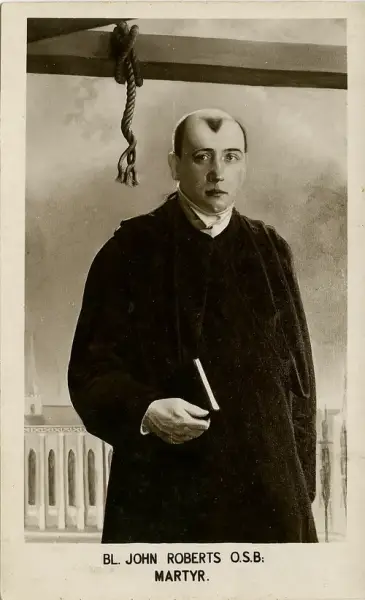
Overview
John Roberts was born in 1577 at Trawsfynydd in Snowdonia, son of a farmer of princely Welsh descent, and baptized Anglican in the parish church of St Madryn. After a short stay at St John's College, Oxford, and legal studies at Furnival's Inn in London, he set out across Europe, where a visit to Notre-Dame in Paris changed everything: he left the law and his former faith and became a Catholic. He entered the Benedictine house at Valladolid in 1598, taking the name Brother John of Merioneth, professed at San Martín Pinario in Compostela at the close of 1600, and was ordained before setting out for Britain on 26 December 1602. What followed was a cat-and-mouse ministry of returns, arrests, and banishments: vicar of the English monks on the mission, banished within weeks, he came back to nurse the sick of London's plague, was arrested in the Gunpowder Plot sweep of 1605 and held seven months in the Gatehouse, and during a longer exile founded at Douai the house of English Benedictines that became St Gregory's, later Downside Abbey, serving as its first prior. Captured on 2 December 1610 just as he finished saying Mass, he was condemned under the statute that made it treason for a priest to labor in England and put to death at Tyburn on 10 December alongside Thomas Somers. The London crowd, remembering his plague nursing, refused to let him be cut down alive.
The Complete Life
Early Life
John Roberts was born in 1577 at Trawsfynydd, a village in Snowdonia in north Wales, a son of John Roberts and of his wife Anna, of Rhiw Goch Farm. His father, a farmer, was of the Welsh gentry and claimed descent from the Welsh princes. The boy was baptized Anglican at St Madryn's, the parish church, and is said to have had his early schooling from an old man who had once been a Cistercian at Cymer Abbey, near Dolgellau, until that house was put down under Henry VIII in 1537 — a detail that captures the situation of Welsh Catholicism a generation after the Reformation. In February 1595 Roberts went up to St John's College, Oxford, left after two years, and continued to the study of law at Furnival's Inn in London. The community of Trawsfynydd, remote even by Welsh standards, remained a pocket of Catholic sympathy long after the Reformation, and Roberts's family connections to the old gentry gave him the networks that recusant survival required.
§ Early life and conversion to Catholicism
Conversion and Vocation
Travel in Europe settled his future. Visiting Notre-Dame Cathedral at Paris, he abandoned law and his former faith alike and became a Catholic. Moving on to Spain, he joined the Benedictine house of St Benedict at Valladolid in 1598, known there as Brother John of Merioneth after his native county, and was sent to San Martín Pinario, at Santiago de Compostela, for his novitiate, where he professed toward the end of 1600. His studies completed, he was ordained and sailed for Britain on 26 December 1602; observed en route by a government spy, he nevertheless entered the country in April 1603, and was at once made vicar on the mission for the English monks of the Spanish Congregation. The choice of the Spanish Benedictine congregation was itself a statement: English monks of the period had perforce to make their profession in Spanish or Italian houses, and the project of an English Benedictine mission was being assembled, one recruit at a time, out of such men.
§ Benedictine missionary
Mission and Ministry
Roberts's English ministry lasted seven years and was a cycle of arrest, banishment, and return. Arrested and banished on 13 May 1603, he reached Douai on 24 May and was back in Britain almost immediately, working among the plague victims of London. In 1604, embarking for Spain with four postulants, among them William Scott, later Maurus Scott, he was arrested again; the authorities, failing to recognize a priest, released and banished him, and he returned at once. On 5 November 1605 he was found by Justice Grange searching the house of Mrs Percy, first wife of the Gunpowder Plotter Thomas Percy; acquitted of complicity in the plot, he was nevertheless held seven months in the Gatehouse Prison at Westminster and exiled in July 1606. During a longer absence he founded at Douai a house for English Benedictines who had entered Spanish monasteries — the beginning of St Gregory's, Douai, of which he was the first prior.
§ Benedictine missionary
Trial and Final Years
Roberts returned to London, where his plague nursing had made him known and loved. He was captured on 2 December 1610 at the very moment he finished saying Mass, convicted under the statute forbidding priests to minister in England, and executed at Tyburn on 10 December 1610 together with the priest Thomas Somers. The London crowd that had benefited from his nursing of the plague sick refused to allow him to be cut down alive — a defiance of the executioner's usual practice, and the clearest evidence of the standing he had acquired in the capital in seven broken years of work there. He had returned to London in 1607 after his fourteen months of exile and the foundation at Douai, and worked there for three more years under constant threat, saying Mass in secret rooms for the Catholics of the capital, ministering in the plague seasons, and keeping the contact between the English mission and the Spanish houses alive. At his trial he was offered the usual opportunity to save himself by denying his priesthood and refused it, and at Tyburn he declared from the hurdle that he died for the Catholic faith and forgave those who condemned him. Somers died with him; the two are named together in the martyrologies of 10 December.
§ Return to Britain and martyrdom
Canonization
Roberts was beatified among the English martyrs in 1929 and canonized by Pope Paul VI on 25 October 1970 as one of the Forty Martyrs of England and Wales. His individual feast is 10 December, the day of his death; the group's is 25 October. Welsh Catholicism counts him its foremost martyr of the recusancy era — the one Welsh-born priest of the forty killed at Tyburn — and the Bishops' Conference of England and Wales has several times proposed him for wider devotion as such. Beatified in 1929 together with a large group of the Elizabethan and Stuart martyrs, Roberts entered the calendar of the saints when Paul VI canonized the Forty Martyrs of England and Wales on 25 October 1970. The Forty, chosen from some six hundred put to death between 1535 and 1679, were deliberately balanced among priests, religious, and laymen, and Roberts and his fellow Benedictine Alban Roe represent the monastic strand of the English mission in the group. Wales holds him as its own: he is the most prominent Welsh-born martyr of the whole era, and devotion to him at Trawsfynydd and in the Welsh dioceses has been continuous since 1970, with his native parish and St Madryn's church the center of it.
§ Introduction
Legacy
Roberts's living legacy is Downside Abbey. The community he founded at Douai was banished from France during the Revolution in 1795, returned to England, and settled at Downside in Somerset in 1814, where it remains one of the English Benedictine congregation's two great houses and keeps its first prior among its founders. His martyrdom is remembered chiefly through that continuity — a monastery that began as a Spanish-English project in 1606 and still exists — and through the Welsh devotion to a priest who came from a Snowdonia farm to Tyburn by way of Paris, Valladolid, and Compostela. Downside Abbey, the continuation of the St Gregory's community he founded at Douai in 1606 and governed as its first prior, remains the principal institutional memorial of his life, and the abbey keeps his relics and his memory as part of its own foundation story. The monastic historian's point about Roberts is that he did two things at once: he was a working missionary priest in the London plague years, and the organizer of a durable religious community in exile — and that the second was, in the long run, as important as the first. Welsh Catholics add a third claim on him, as the martyr of Snowdonia whose native parish church still stands.
§ Foundation of St. Gregory's monastery, Douai
Timeline
- 1577
Born at Trawsfynydd, a village in Snowdonia, north Wales
§ Introduction
- Feb 1595
Entered St John's College, Oxford, leaving after two years for legal study
§ Early life and conversion to Catholicism
- 1598
Became a member of the Benedictine community of St Benedict's Monastery, Valladolid
§ Early life and conversion to Catholicism
- 1600
Made his monastic profession at San Martín Pinario, Santiago de Compostela
§ Benedictine missionary
- 26 Dec 1602
Ordained priest and set out for the English mission
§ Benedictine missionary
- Apr 1603
Entered Britain in secret and was appointed vicar of the English monks on the mission
§ Benedictine missionary
- 13 May 1603
Arrested and banished from England
§ Benedictine missionary
- 1604
Arrested again while embarking for Spain with four postulants; released and banished, but returned at once
§ Benedictine missionary
- 5 Nov 1605
Arrested at the house of Mrs Percy during a search linked to the Gunpowder Plot
§ Benedictine missionary
- Jul 1606
Exiled again after seven months imprisoned in the Gatehouse at Westminster
§ Benedictine missionary
- Oct 1607
Returned to Britain, and was arrested again that December
§ Return to Britain and martyrdom
- May 1609
Taken to Newgate Prison; the French ambassador's intercession reduced his sentence to banishment
§ Return to Britain and martyrdom
- 2 Dec 1610
Captured just after finishing Mass, followed by the spy John Cecil, and taken to Newgate in his vestments
§ Return to Britain and martyrdom
- 5 Dec 1610
Found guilty at trial of violating the statute that barred priests from ministry in England
§ Return to Britain and martyrdom
- 10 Dec 1610
Hanged, drawn, and quartered at Tyburn, London, alongside Thomas Somers
§ Return to Britain and martyrdom
- 4 Dec 1886
Beatification approved by Pope Leo XIII in his decree of that date
§ Veneration
- 25 Oct 1970
Canonized by Pope Paul VI at St Peter's Basilica as one of the Forty Martyrs of England and Wales
§ Veneration
The Record
- Canonization
- Beatified by Pope Leo XIII on 4 December 1886; canonized by Pope Paul VI on 25 October 1970 among the Forty Martyrs of England and Wales
Prayer
Bibliography
Show 10 sources
- 1 2 3 4 5 "Life of Trawsfynydd Catholic martyr Saint John Roberts" , BBC Northwest Wales, 8 December 2009
- 1 2 "Welsh Martyr honoured in ecumenical service" The British Orthodox Church within the Coptic Orthodox Patriarchate , 17 July 2010
- 1 2 3 4 "The Welsh martyr who ministered in London" Archived 16 June 2018 at the Wayback Machine , Archdiocese of Southwark
- ↑ " "The History of Downside Abbey" " . Archived from the original on 12 June 2015 . Retrieved 5 February 2013 .
- 1 2 3 4 5 6 Huddleston, Gilbert. "St. John Roberts" . The Catholic Encyclopedia. Vol. 13. New York: Robert Appleton Company, 1912. Retrieved 5 February 2013.
- 1 2 "Open-air mass for Wales' martyr" , WalesOnline, 5 June 2010.
- 1 2 3 "Welsh service for martyred Saint John Roberts", BBC Wales, 17 July 2010
- ↑ "Celebrations planned for 'forgotten martyr of Wales'", WalesOnline, 26 November 2009
- ↑ "St John Roberts' Trail" . Snowdonia Heritage . Retrieved 27 November 2015 .
- ↑ "Llys Ednowain" . Trawsfynydd . Retrieved 27 November 2015 .
Profile text adapted from the Wikipedia article, licensed CC BY-SA 4.0.
Pray with this saint every day
Save St. John Roberts to your favorites, read the full profile, and get feast-day reminders in the Saints app.
Get the Saints AppFree on the App Store for iPhone and iPad