
died 1539·Feast December 23
St. John Stone
Augustinian Friar Who Refused the King
Overview
John Stone was an English Augustinian friar, a doctor of theology and a native of Canterbury, whose refusal to accept Henry VIII's supremacy over the Church cost him his life in December 1539. Nothing survives of his early life or education, but he is conjectured to have joined the Augustinians at Canterbury, where he lived in the friary on the street still called Whitefriars; after ordination he served for a time as professor and Prior at Droitwich before returning to his native city. When the king's agents sought supporters for the divorce of Queen Catherine, every effort was made to win the weight of his theological opinion, and he denounced the project as contrary to morality and justice. From the pulpit of the Austin Friars he publicly rejected the royal claim to spiritual supremacy, and when the friary was dissolved in December 1538 he alone among his brothers refused to sign the documents acknowledging the king as head of the Church and surrendering the house as voluntary. Sent to Cromwell and imprisoned in the Tower, he was returned to Canterbury for trial in the autumn of 1539, condemned for treason under the Treason Act, and hanged, drawn and quartered at the Dane John, probably on 27 December 1539. Leo XIII beatified him in 1886; Paul VI canonized him among the Forty Martyrs in 1970.
The Complete Life
A Doctor of Canterbury
The records are silent about almost everything in John Stone's life before the crisis that destroyed him. Nothing is known of his early years, his education, or his activities within the Augustinian Order, though it is conjectured that he entered the friary at Canterbury, since that was the place of his death and he is described as a native of the city. What the surviving accounts affirm is his standing: a theologian with a doctor's title, resident in the Augustinian friary of Canterbury, a house that stood on St George's Street, where the spot keeps to this day the name Whitefriars. Once ordained he was assigned to Droitwich, holding there the posts of professor and Prior for a period before Canterbury received him back. That double experience, of the lecture hall and of governance as Prior, explains the weight his contemporaries attached to his judgment. A doctor of theology in an Augustinian house was a scarce and valuable authority, and when the greatest constitutional question of the age reached Canterbury, it was precisely the weight of his opinion that both sides sought. The friary in which he lived was not wealthy, but it stood at the heart of a city that was itself a memorial to the costs of church-state conflict.
§ Life
Against the Divorce and the Supremacy
Stone's opposition to the royal program was early, reasoned and public. During the campaign to gather support for the contemplated divorce of Queen Catherine, the king's agents approached him, and being a doctor of theology he was courted with every effort to win his influence and secure the weight of his opinion for the Council convoked at Canterbury. He answered with a firm condemnation: the divorce, he declared, offended against morality and against justice alike. When the Reformation Parliament carried through the attack on the Church's independence, he took the argument into the open air of preaching: from the pulpit of the Austin Friars he publicly denounced King Henry VIII's claim to spiritual supremacy over the English Church. Why no action followed at once? The sources connect his reprieve with the intimacy between Cromwell and his order's Provincial, a shelter that postponed but could not cancel the reckoning. The legal framework was closing around men like him. Supremacy became statute in 1534: the Act of that year pronounced Henry sole supreme head of the English Church, and a following Treasons Act attached the penalties of high treason to any malicious wish to strip the king of that title. Signing or not signing had become the test of everything.
§ Life
The Signature He Would Not Give
The confrontation came to the friary door on 14 December 1538, when Richard Yngworth, Bishop of Dover, visited Canterbury with an order to close the Augustinian house as part of the dissolution of the monasteries. The commissioners found the Austin Friars in humiliating poverty, their debts forty pounds and their implements not worth six, apart from a little plate weighing 126 ounces. Each expelled friar had to put his name to two papers: in the first he owned Henry as head of the Church in England; in the second he stated that the friary's surrender flowed from his own free choice. One man alone would not set his name down: Stone, who said plainly what he objected to in the king's pretensions over the Church. The officers understood the danger of his example: he was immediately separated from his confreres to forestall his influence over them, and urged with threats to alter his position. Nothing moved him. He was dispatched to Thomas Cromwell in London, who failed to shake him and ordered him imprisoned in the Tower. Prayer filled his prison months, and it was prayer, the accounts say, that steeled him against betraying the faith. October 1539 saw him returned to Canterbury, where on the 27th a commission of Oyer and Terminer went out to the mayor and four other gentlemen, convening his trial.
§ Life
Trial and a Politician's Execution
The trial itself was brief. The Guildhall — now demolished — on Guildhall Street housed the proceedings; on the bench sat the incoming mayor, Thomas Bele, together with Sir Christopher Hales and, in all likelihood, Baron John Hales. The jury, handed an indictment for high treason under the 1535 Treason Act, had no room to return any verdict except conviction; the statute left no appeal. On 6 December came the sentence; from there he was moved to the tower by Westgate to spend his final days. The ordinary course would have been swift execution, but an extraordinary guest intervened. Anne of Cleves, journeying to become Henry's fourth wife, was due to reach Canterbury on Sunday 7 December 1539 and stop there overnight; her arrival was delayed by bad weather, and the historian Michael Benedict Hackett, the leading expert on Stone, questioned whether the execution really fell within her visit. The inference of the sources is that it happened on Saturday 27 December 1539, timed as part of the festivities arranged for her reception, for the bill of expenses was extraordinary, fifteen pounds, nine shillings and eleven pence against six pence for a previous execution, and the apparatus was removed only after she departed. Instead of the traditional gibbet at Holloway, a half-ton of wood was purchased for two shillings and sixpence to build a gallows on the Dane John, the hillock inside the walls. There Stone was hanged, drawn and quartered, his head and body displayed at the city entrance as a warning.
§ Trial and execution
From Martyr's Picture to the Altar
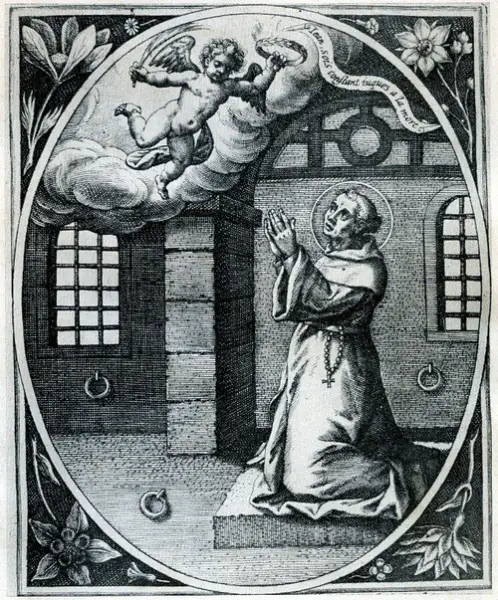
Devotion to Stone began almost immediately, and he was soon venerated as a martyr. Before the century was out, Gregory XIII had approved a martyr-picture of Stone for the English College in Rome and had allowed, in 1584, an engraving after it to go to print — images that carried the martyr's memory through the seminaries forming priests for the English mission. When the English Reformation's martyrs were catalogued for Rome, the list that carried the beatification process forward opened with Stone's name at its head, an honor recognizing how unclouded his witness was. Pope Leo XIII beatified him on 9 December 1886, and the canonization followed on 25 October 1970, when Pope Paul VI canonized him with thirty-nine other English martyrs. The Forty are the group selected to stand for the Catholics slain for the faith in England and Wales across the years 1535 to 1679, and his place among them is fixed. His liturgical commemoration is kept on 23 December, having formerly been observed on 12 May, and the Augustinians commemorate him on 25 October with the rest of the group. He was thus restored to the Church's public honor more than four centuries after the gallows on the Dane John.
§ Veneration
Patron of Converts and of a Catholic Society
Stone's patronage has gathered around the causes his life dramatized. Patron of the Catholic Society at the University of Kent, he keeps a watching brief over Catholic students in the city where he died; Anglicans seeking full communion with Rome and the Archdiocese of Westminster likewise claim his patronage, communities that live the question of conscience and communion for which he died. His image has followed the Church to new continents. One fresco groups him with the other Augustinian saints and blesseds at the Los Angeles church of Our Mother of Good Counsel; windows in St. Maurice at Resurrection Church, Dania Beach in Florida, St Augustine's Hammersmith in London, and St Nicholas of Tolentine in Philadelphia, all show the martyr. The Augustinian artist Janos Hajnal drew him for Fernando Rojo Martinez's book Il Fascino di Dio: Profili de Agiografia Agostiniana, and the original drawing rests in the Roman office of the order's Postulator of Causes. Scholarship has kept pace with devotion: Benedict Hackett's Saint John Stone; Austin Friar Martyr 1539, published in 1970, the year of the canonization, carries a lithograph of the martyr on its title page.
§ Iconography
Timeline
- 1534
The Act of Supremacy declares Henry VIII supreme head of the Church in England, requiring religious to acknowledge his title
§ Life
- 14 Dec 1538
Bishop Richard Yngworth of Dover orders the closure of the Canterbury Augustinian friary; Stone alone refuses to sign the surrender documents
§ Life
- Oct 1539
Sent back to Canterbury from London to stand trial for treason
§ Life
- 27 Oct 1539
A commission of Oyer and Terminer is addressed to the Mayor of Canterbury and four gentlemen for his trial
§ Life
- 6 Dec 1539
Sentence is handed down after a short trial at the Guildhall; he is taken to Westgate tower to await execution
§ Trial and execution
- 27 Dec 1539
Probably executed by hanging, drawing and quartering at the Dane John, timed with Anne of Cleves's delayed passage through Canterbury
§ Trial and execution
- 1584
Pope Gregory XIII permits the printing of an engraving of Stone as a martyr, having sanctioned his depiction in the English College at Rome
§ Veneration
- 9 Dec 1886
Beatified by Pope Leo XIII
§ Veneration
- 25 Oct 1970
Declared saint by Pope Paul VI alongside thirty-nine fellow English martyrs, in the company of forty representing the Catholics of England and Wales slain for the faith
§ Veneration
The Record
- Patron of
- University of Kent Catholic Society·Anglican converts to Catholicism·Archdiocese of Westminster
- Symbols
- Augustinian habit·Martyr's palm·Shackles
- Canonization
- Beatified 9 December 1886 by Pope Leo XIII; canonized 25 October 1970 by Pope Paul VI as one of the Forty Martyrs of England and Wales
Prayer
Bibliography
Show 8 sources
- Taylor, Thomas. "St. John Stone". Midwest Augustinians, Province of Our Mother of Good Counsel.
- Wainewright, John. "Bl. John Stone." The Catholic Encyclopedia. Vol. 8. New York: Robert Appleton Company, 1910.
- Foran OSA, Rev. E.A., English Augustinian Martyrs, Foran & Perry, London, 1922.
- Bunce, Canon Michael, "St John Stone", Southwark diocesan website (archived 14 August 2006 at the Wayback Machine).
- "The Austin Friars of Canterbury".
- "John Stone", Augnet (archived 11 October 2013 at the Wayback Machine).
- Hackett, Benedict. Saint John Stone; Austin Friar Martyr 1539 (1970).
- "St. John Stone", Villanova University (archived 28 July 2014).
Profile text adapted from the Wikipedia article, licensed CC BY-SA 4.0.
Pray with this saint every day
Save St. John Stone to your favorites, read the full profile, and get feast-day reminders in the Saints app.
Get the Saints AppFree on the App Store for iPhone and iPad