
c. 6 – c. 100·Feast December 27
St. John the Apostle
Beloved apostle, evangelist, and seer of Patmos
Overview
John the Apostle, also called Saint John the Beloved and, in Eastern Orthodox Christianity, Saint John the Theologian, was one of the Twelve Apostles of Jesus according to the New Testament. Born about AD 6, generally listed as the youngest of the apostles, he was a son of the fisherman Zebedee and of Salome, and the younger brother of James the Great. The Church Fathers identify him with John the Evangelist, John of Patmos, John the Elder, and the Beloved Disciple, and hold that he outlived all the other apostles as the only one to die a natural death, though modern scholars are divided on these claims. He stood with Peter and James as one of the three Pillars of the Church, was present with the Lord at the Transfiguration and in Gethsemane, and alone among the Twelve remained at the foot of the cross, where he received the Lord's mother into his care. Tradition relates that after the Assumption of Mary he went to Ephesus, was banished to Patmos under Emperor Domitian, wrote the Gospel and Epistles bearing his name and the Book of Revelation, trained Polycarp of Smyrna, and died at Ephesus in old age, about the year AD 100.
The Complete Life
A Fisherman of Galilee
John was born about AD 6 into a family of Jewish fishermen who worked the Sea of Galilee. His father was Zebedee, and his elder brother James would himself become one of the Twelve, known to history as James the Great. Church tradition names his mother as Salome, and some early sources add that she was a sister of Mary, the mother of Jesus; if so, John and James were cousins of the Lord, a kinship that would deepen the intimacy of their calling. The family's life was one of nets, boats, and the rhythm of the lake, a modest trade in a province under Roman rule. From this setting John first encountered the movement of John the Baptist: according to some traditions he was among the Baptist's disciples before he followed Jesus, though he is not named in that episode. The Gospels of Matthew, Mark, and Luke recount how Zebedee and his sons were fishing when Jesus called Peter, Andrew, James, and John to leave everything and follow him, and how the two sons of Zebedee were counted from the beginning among the Twelve Apostles chosen to be at the heart of the Lord's ministry.
§ References to John in the New Testament
Called, and Named a Son of Thunder
The Gospel of John preserves what may be the earliest moment of John's vocation: upon hearing the Baptist point to Jesus as the Lamb of God, two men attached to the Baptist went after Jesus and passed the day in his company; tradition names John among them, making him among the first called by the Lord. The Synoptic Gospels record that Jesus gave John and his brother the name Boanerges, sons of thunder, a title the evangelists connect with their fiery temperament. On one occasion the brothers asked to call down heavenly fire upon a Samaritan town that refused hospitality, and Jesus rebuked them; on another, John reported that the disciples had forbidden a stranger to cast out demons in the Lord's name, and was told that anyone not working against them was in effect supporting them. Yet the same impetuous fisherman became the disciple whom Jesus loved, the one who leaned on the Lord's breast at the Last Supper. Together with Peter and James, John formed an inner circle among the Twelve, chosen to accompany Jesus at the raising of Jairus' daughter, at the Transfiguration, and in the agony of Gethsemane.
§ Position among the apostles
At the Cross and at the Head of the Church
The mission of John reached its defining hour at Jerusalem. After the arrest in Gethsemane, he alone, with Peter, followed the Lord into the palace of the high priest, and on Calvary he was the only apostle to remain at the foot of the cross, standing with the myrrhbearers and the women while the others had scattered. There Jesus entrusted his mother to the beloved disciple with the words, Woman, here is your son, and to John, Here is your mother, a charge John accepted as the Lord's final legacy. At Solomon's colonnade he stood beside Peter when the lame man was healed, and the jail cell that followed received them both; the two of them then went together to inspect the young church of Samaria. Paul, in his dispute with opponents in Galatia, would appeal to the standing of John, Peter, and James the Just as the Church's acknowledged three Pillars — the leading figures of the Jerusalem community whose approval had ratified Paul's own preaching of a gospel freed from the Jewish Law. To this apostolic authority tradition adds the testimony of writing: the Gospel that bears his name claims to rest on the written witness of the disciple whom Jesus loved.
§ The disciple whom Jesus loved
Ephesus, Patmos, and a Peaceful Death
According to tradition, after the Assumption of Mary John went to Ephesus, where Irenaeus records that he continued with the church founded by Paul until the times of Trajan. The persecution of Christians under Herod Agrippa had scattered the apostles through the Roman provinces, and John's own path led across the Aegean: Roman authorities banished him to the Greek island of Patmos during the persecutions under Emperor Domitian, and there, tradition says, he received and wrote the Book of Revelation. Tertullian adds that before this exile John had been plunged into boiling oil in Rome and had suffered nothing, a miracle said to have converted his whole audience in the Colosseum. At Ephesus in his old age he trained Polycarp, the future Bishop of Smyrna, who carried his teaching to Irenaeus, and counted Ignatius of Antioch among his disciples. He is said to have died of natural causes sometime after AD 98, the one apostle whose death came by natural decay rather than violence, though another account ascribed to Papias claims he was slain by the Jews. His tomb at the Basilica of St. John near Ephesus, opened under Constantine and contained no bones at all; from this came the conviction that heaven had claimed his body, while the ground overhead was said to rise and fall with the breathing of a saint still asleep.
§ Extrabiblical traditions
Theologian of the Church
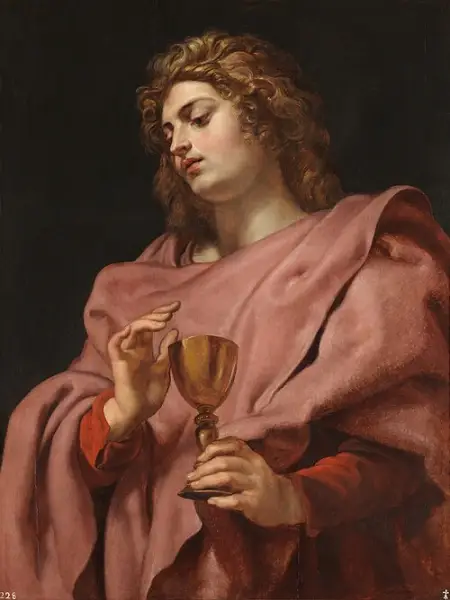
The liturgical memory of John is among the richest of any apostle. The Roman Catholic Church, the Anglican Communion, and the Lutheran calendars keep his feast on December 27, the Church of England observing it as a Festival, while the Eastern Orthodox Church commemorates him on many days, above all the Repose of the Holy Apostle and Evangelist John the Theologian on September 26, and May 8, when Christians once drew healing ashes from his grave at Ephesus. He is patron of authors, booksellers, editors, publishers, scribes, scholars, and theologians, of burn-victims and poison-victims, of love, loyalty, and friendships, and of Turkey and Asia Minor in memory of his missionary work there, and he is invoked against jealousy and envy. Islamic tradition counts John among the disciples of Jesus, the Druze honor him as a prophet. In art his eagle, gospel book, and the chalice with its serpent have made him instantly recognizable for eighteen centuries, and his influence on Ignatius, Polycarp, Papias, and through them on the whole apostolic church marks him as the bridge between the eyewitnesses of Christ and the catholic tradition.
§ Liturgical commemoration
Timeline
- 6
Born about this time to Zebedee, a fisherman working the Sea of Galilee, and — if church tradition is right — to Salome.
§ References to John in the New Testament
- 44
Martyrdom claimed his brother James first among the Twelve; John, by tradition, outlived that loss by more than five decades.
§ References to John in the New Testament
- 48
Around this time the Apostolic Council convened at Jerusalem while John stayed on in Judea and its neighborhood.
§ Position among the apostles
- 98
Reportedly died peacefully at Ephesus in old age during Trajan's reign, alone among the Twelve in being spared a martyr's end.
§ Extrabiblical traditions
- 1955
Pope Pius XII abolished the Octave of his December 27 feast, formerly kept in the Tridentine calendar through January 3.
§ Liturgical commemoration
In Their Own Words
Woman, here is your son... Here is your mother.
Let us fly, lest even the bath-house fall down, because Cerinthus, the enemy of the truth, is within.
The Record
- Major works
- Gospel of John (traditional attribution)·Three Johannine Epistles (traditional attribution)·Book of Revelation (traditional attribution)
- Patron of
- authors, booksellers, editors, publishers, and scribes·theologians and scholars·against jealousy and envy·burn-victims and poison-victims·Turkey, Asia Minor, and the Turkish people·love, loyalty, and friendships
- Symbols
- Eagle·Gospel book·Serpent in a chalice·Cauldron
- Canonization
- Pre-congregation; venerated by all Christian denominations that venerate saints, and honored as a prophet in Islam and the Druze faith
Prayer
Bibliography
Show 5 sources
- Saint Sophronius of Jerusalem (2007 [c. 600]). "The Life of the Evangelist John". The Explanation of the Holy Gospel According to John. House Springs, Missouri: Chrysostom Press. pp. 2–3. ISBN 978-1-889814-09-4.
- Moss, Candida (5 March 2013). The Myth of Persecution: How Early Christians Invented a Story of Martyrdom. HarperCollins. p. 136. ISBN 978-0-06-210454-0.
- Kurian, George Thomas; Smith, III, James D. (2010). The Encyclopedia of Christian Literature, Volume 2. Scarecrow Press. p. 391. ISBN 9780810872837.
- Wheeler, Brandon M. Historical Dictionary of Prophets In Islam And Judaism. "Disciples of Christ".
- Swayd, Samy S. (2009). The A to Z of the Druzes. Rowman & Littlefield. p. 109. ISBN 9780810868366.
Profile text adapted from the Wikipedia article, licensed CC BY-SA 4.0.
Pray with this saint every day
Save St. John the Apostle to your favorites, read the full profile, and get feast-day reminders in the Saints app.
Get the Saints AppFree on the App Store for iPhone and iPad